| Key Takeaways |
|---|
| • Native Texas plants need less water, fertilizer, and maintenance than non-native species once established in your yard. • Texas has 5 distinct growing regions, and choosing plants native to your specific area gives you the best chance of success. • Fall is the best time to plant natives in Texas because cooler temperatures help roots establish before summer heat. |
From the Great Plains to the Gulf Coast, Texas stretches across so many climates that no single plant list works for the whole state. Instead, each region supports native plants suited to specific local conditions.
These 30 Texas native plants, organized by region, will help you find the right fit for your yard.
But don’t take our word for it. We also have included an Ask the Experts section with insights and comments on Texas native plants from educators at Sam Houston State University, the University of Texas at Austin, and Austin Community College.
If you need a hand with the heavy lifting, one of LawnStarter’s local landscaping pros can help you plan and plant a native garden that thrives.
Table of Contents:
- Why Plant Native Plants in Texas
- Native Plants of Central Texas
- Native Plants of North Texas
- Native Plants of East Texas
- Native Plants of South Texas
- Native Plants of West Texas
- How to Choose Native Plants for Your Region
- Ask the Experts
- FAQs
Why Plant Native Plants in Texas
Plants native to Texas are species that evolved naturally in this state’s diverse ecosystems over thousands of years. Texas is home to more than 5,000 native plant species, according to the Texas Parks and Wildlife Department (TPWD).
These plants are adapted to the state’s heat, drought, and soil conditions, which means less watering, less fertilizer, and less effort for you.
Water savings: Most native Texas plants are drought tolerant once established and need up to 80% less water than non-natives.
Reduced water bills: Native landscaping can lower your outdoor water use compared to traditional turf lawns, saving you money every month during Texas summers.
Low maintenance: Native plants resist local pests and diseases, so you spend less time and money on upkeep.
Wildlife support: Texas natives attract butterflies, hummingbirds, bees, and other native pollinators that keep your garden healthy.
Erosion control: Deep-rooted native grasses and shrubs stabilize soil and reduce runoff during Texas storms.
See Related: 22 Best Drought-Tolerant Plants for Texas
Native Plants of Central Texas
Central Texas features limestone hills, alkaline soils, and hot summers, making these 6 native plants ideal choices for the region.
Bald Cypress (Taxodium distichum)
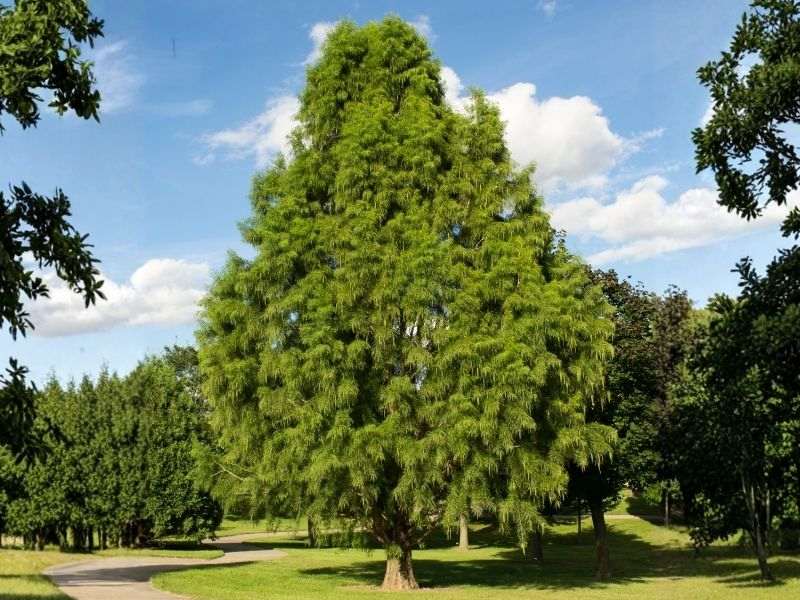
This tall conifer with spreading branches creates a spectacular show in fall when its leaves turn a brilliant orange. The bald cypress has a tendency to develop root “knees” that stick out from its tapered trunk.
Plant type: Tree
Hardiness zones: 4a-10b
Sun: Full sun, partial shade
Soil: Moist sandy, loam, or clay soils
Duration: Deciduous
Height: 50-75 feet
Maintenance: Clean up fallen leaves and cones.
Black-eyed Susan (Rudbeckia hirta)
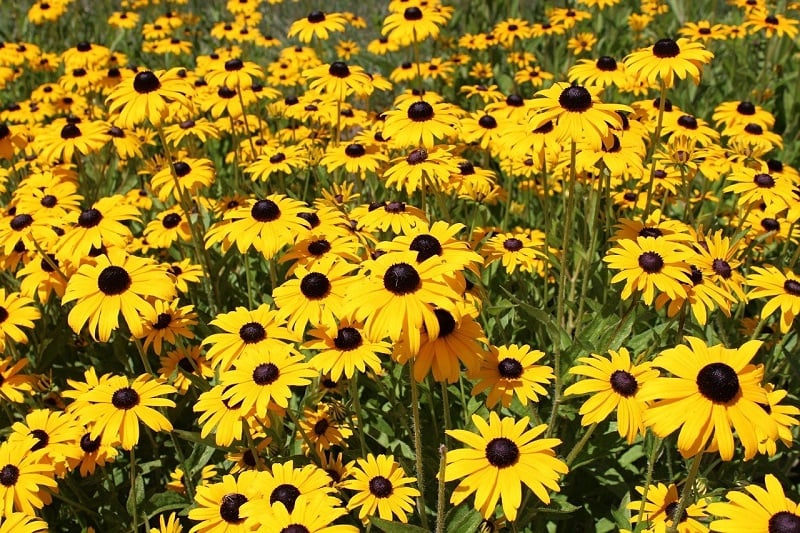
In summer, black-eyed Susans bloom in a blanket of bright yellow, daisy-like flowers. This popular Texas wildflower is drought-tolerant and attracts butterfly species.
Plant type: Flower
Hardiness zones: 3a-9b
Sun: Full sun
Soil: Tolerates most soil types
Duration: Annual, biennial or short-lived perennial
Height: 1-3 feet
Maintenance: Remove dead flowers to encourage more blooms.
See Related: 12 Native Plants Perfect for Your Butterfly Garden
Mexican Buckeye (Ungnadia speciosa)
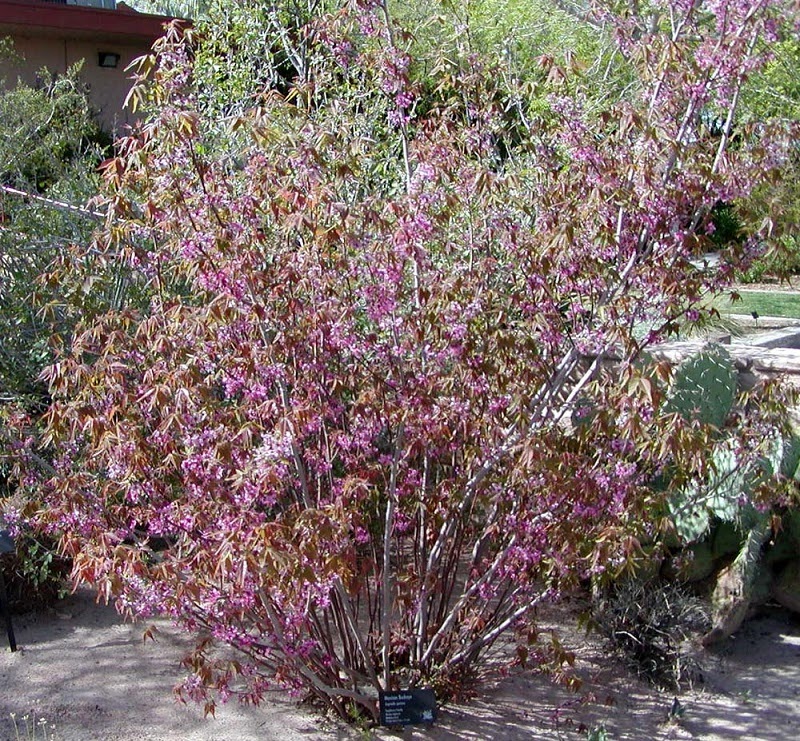
Depending on how you prune it, the Mexican buckeye can grow into a large shrub or small tree. The multi-trunked plant has light gray or brown bark and produces fragrant bright pink flowers that attract honey bees and butterflies.
Plant type: Shrub or tree
Hardiness zones: 7a-9a
Sun: Full sun, partial shade
Soil: Dry, rocky soils
Duration: Deciduous
Height: 8 to 30 feet
Maintenance: Prune as needed to maintain desired shape and height.
Red Yucca (Hesperaloe parviflora)
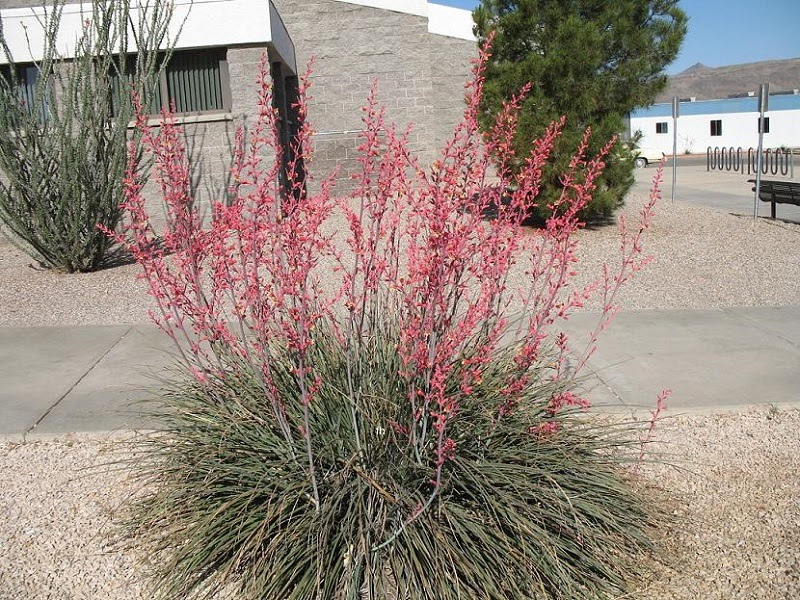
Though not actually a yucca, this succulent gets its common name from its blade-like foliage that resembles a true yucca plant. The red yucca produces tubular coral-colored flowers on tall stalks in late spring and early summer, and the flowers attract hummingbirds.
Plant type: Succulent
Hardiness zones: 5-10
Sun: Full sun
Soil: Dry sandy, loam, clay, or limestone soils
Duration: Perennial
Height: 2-5 feet
Maintenance: Remove old flower stalks after flowering season.
Texas Rock Rose (Pavonia lasiopetala)
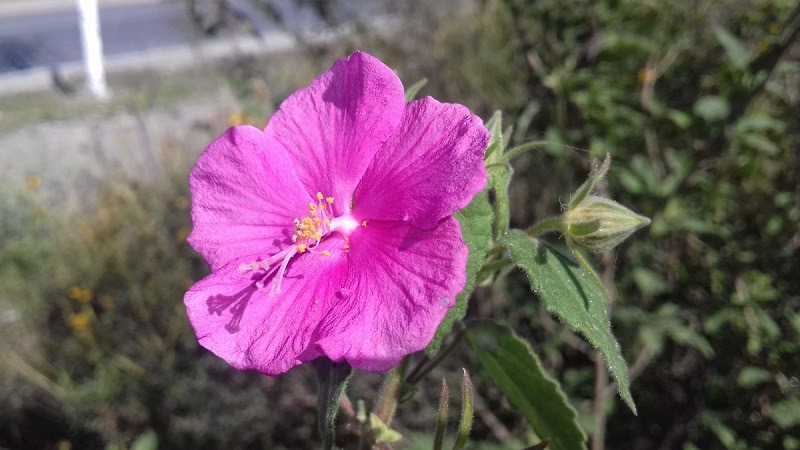
This small shrub blooms with pink hibiscus-like flowers in spring and summer that attract butterflies. In landscapes, rock rose works well in garden beds, containers and rock gardens.
Plant type: Shrub
Hardiness zones: 6-10
Sun: Full sun, partial shade
Soil: Well-draining limestone soils
Duration: Perennial
Height: Up to 4 feet
Maintenance: Cut back in late winter to prevent excessive growth.
Yaupon Holly (Ilex vomitoria)
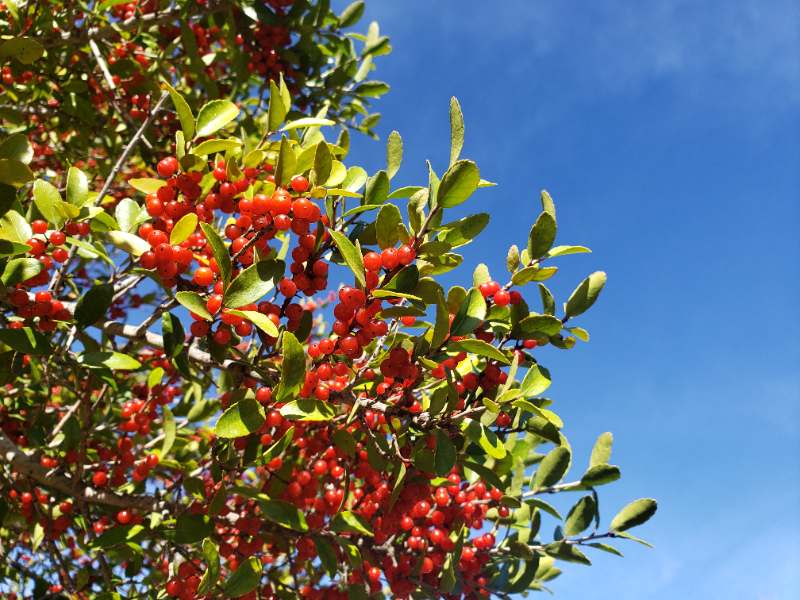
Yaupon holly can be single or multi-trunked, with gray bark, dark green leaves, and bright red berries that attract birds. You can grow this evergreen plant as a shrub with a pop of color or as a specimen tree.
Plant type: Shrub or tree
Hardiness zones: 7a-9b
Sun: Full sun, partial shade, full shade
Soil: Tolerates most soil types
Duration: Evergreen
Height: 12-25 feet
Maintenance: Prune as needed to maintain desired shape and height.
Native Plants of North Texas
With local gardens ranging from heavy clay to sandy Cross Timbers landscapes and hot summers that turn topsoil into dust, choosing the right plants for North Texas is no small task. Add these 6 natives to your short list; they are built to handle every local challenge, including the occasional ice storm.
Ashe Juniper (Juniperus ashei)
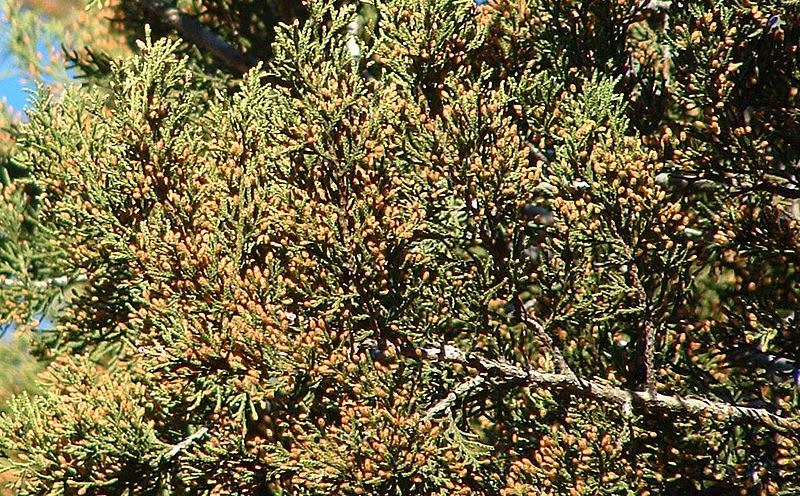
Ashe juniper, also called Texas cedar, has dark green foliage with a pleasant scent. Male trees turn burnt gold in winter when covered in pollen, while female trees grow blue fruit that resembles blueberries.
Plant type: Tree
Hardiness zones: 7a-9b
Sun: Full sun
Soil: Any well-draining soil
Duration: Evergreen
Height: Up to 50 feet
Maintenance: Make sure soil does not stay wet; otherwise, roots will rot.
Chinquapin Oak (Quercus muehlenbergii)
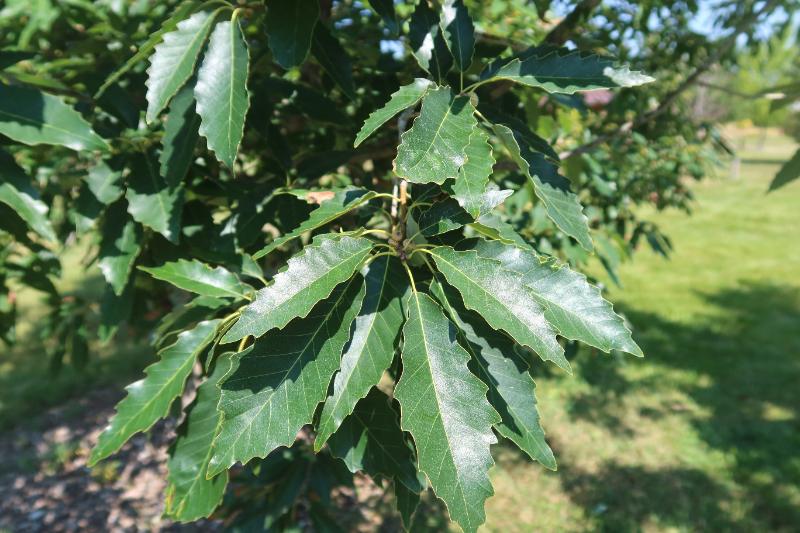
The chinquapin oak grows relatively fast with spreading branches, making it a perfect shade tree. In fall, its leaves turn bright yellow to rich bronze and orange.
Plant type: Tree
Hardiness zones: 3a-9a
Sun: Full sun, partial shade
Soil: Well-draining rocky or sandy soils
Duration: Deciduous
Height: 45-110 feet
Maintenance: Clean up fallen leaves and acorns.
Crossvine (Bignonia capreolata)
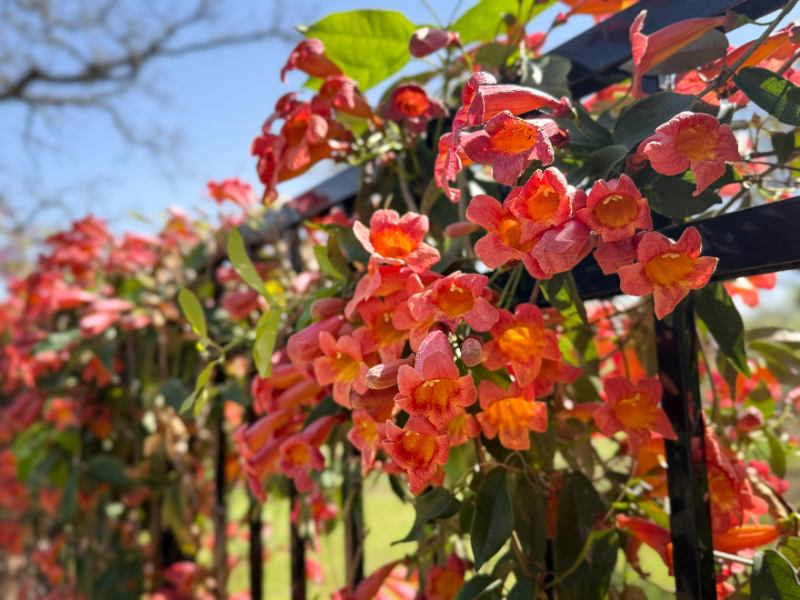
Crossvine is a climbing vine that works well for decorating landscape features such as pergolas, arbors, and trellises. Its dark green leaves change to a purplish color in winter, and showy clusters of trumpet-shaped yellow, red, and orange flowers bloom in spring.
Plant type: Vine
Hardiness zones: 5a-9b
Sun: Full sun, partial shade
Soil: Moist but well-draining soils
Duration: Perennial
Height: Up to 50 feet (climbing)
Maintenance: Cut back in spring to encourage healthy new growth.
Dwarf Palmetto (Sabal minor)
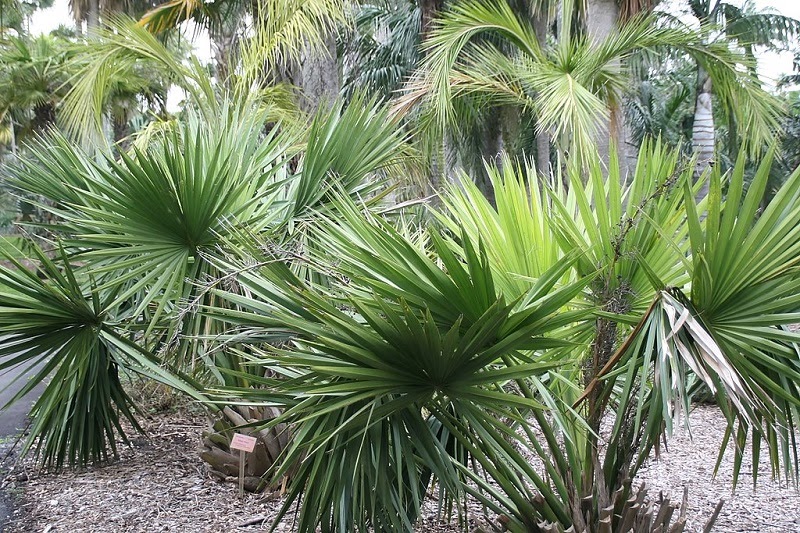
Dwarf palmetto is a drought-tolerant, cold-hardy, slow-growing palm with fan-shaped pale green or bluish fronds. You can use it as a specimen planting, for ground cover, or in a privacy hedge.
Plant type: Palm
Hardiness zones: 7a-10b
Sun: Full sun, partial shade
Soil: Any moist but well-draining soils
Duration: Perennial
Height: 5-10 feet
Maintenance: May need winter protection in below-freezing temperatures.
Lemon Beebalm (Monarda citriodora)
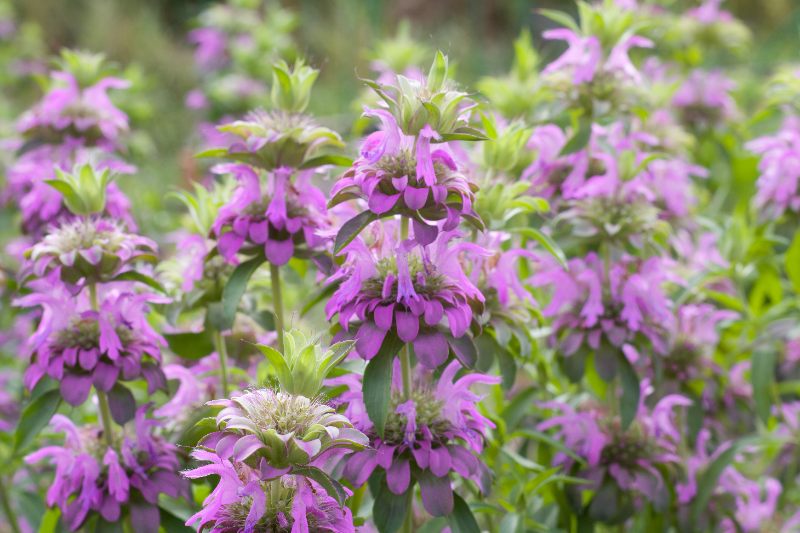
Lemon beebalm, aka lemon mint, aka horsemint, produces unusually shaped flowers in summer that range in color from lavender to pink and attract pollinators like bees and butterflies.
The leaves of the lemon beebalm produce a pleasant citrus scent when rubbed or crushed.
Plant type: Flower
Hardiness zones: 2a-11b
Sun: Full sun, partial shade
Soil: Dry sandy, rocky, or loam soils
Duration: Annual
Height: 1-2 feet
Maintenance: Remove dead flowers to encourage more blooms, and cut stems back to the ground after flowering season.
Purple Coneflower (Echinacea purpurea)
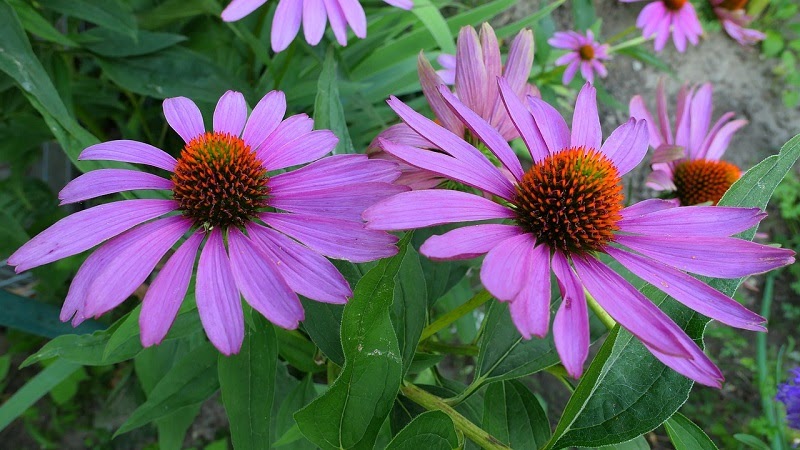
The purple coneflower, a popular garden flower in Texas, features lavender petals around a spiny brown center. These flowers are easy to grow and rewarding, with bright blooms that come out in spring and last throughout summer.
Plant type: Flower
Hardiness zones: 3a-9a
Sun: Full sun, partial shade
Soil: Well-draining dry to medium soils
Duration: Perennial
Height: 2-5 feet
Maintenance: Water 1 inch per week.
Native Plants of East Texas
East Texas gardeners deal with heavy clay bottomlands, sandy Piney Woods soils, hot summers, and occasional ice storms. Growing healthy plants is anything but easy, unless you’re choosing native species such as the 6 beautiful plants below.
Beautyberry (Callicarpa americana)
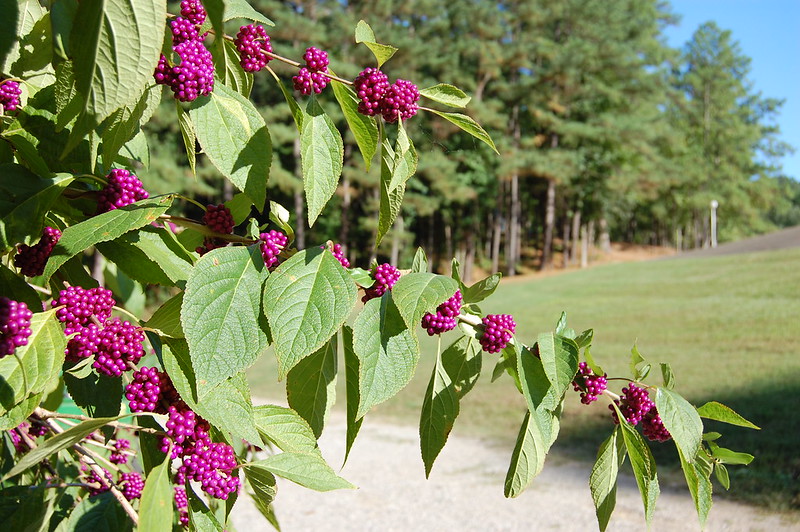
Beautyberry is a shrub with long, arching branches and bright green foliage. The plant’s main appeal, of course, is its striking clusters of bright purple berries that add an interesting pop of color to your landscape and feed local birds.
Plant type: Shrub
Hardiness zones: 6a-10b
Sun: Full sun, partial shade
Soil: Prefers rich soils but can grow in poor, sandy soils as well
Duration: Deciduous
Height: 3-8 feet
Maintenance: Prune before flowering season to keep the shrub compact.
Southern Sugar Maple (Acer floridanum)
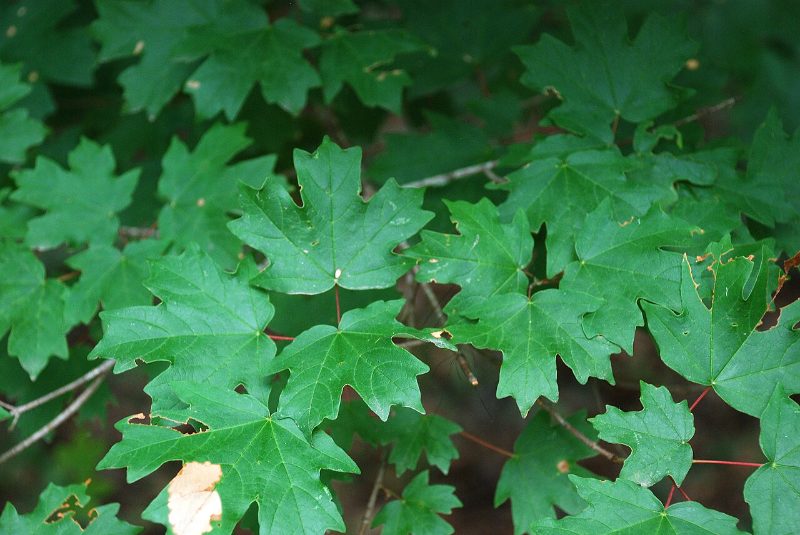
The southern sugar maple, aka the Florida maple, is a smaller and more heat-tolerant cousin of the northern sugar maple. It makes a great specimen or shade tree, and its leaves turn bright red, orange, and gold in fall.
Plant type: Tree
Hardiness zones: 6b-9a
Sun: Full sun, partial shade
Soil: Occasionally wet clay or sandy soils
Duration: Deciduous
Height: 20-30 feet, sometimes reaching 60 feet or more
Maintenance: Water regularly during long dry spells, clean up fallen leaves in fall.
Texas Lantana (Lantana urticoides)
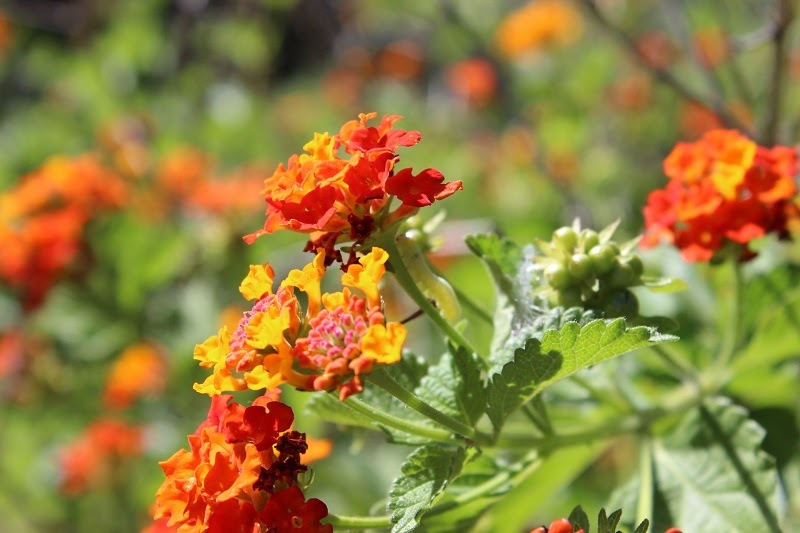
Also known as calico bush, the Texas lantana is a spreading shrub that blooms from late spring through early fall with clusters of vibrant, tubular flowers that attract butterflies and birds.
Safety note: Do not plant Texas lantana near high-traffic areas. Its branches have spines. Also, its berries are poisonous.
Plant type: Shrub
Hardiness zones: 8a-11b
Sun: Full sun, partial shade
Soil: Dry, poor soils
Duration: Deciduous
Height: 2-6 feet
Maintenance: Cut back branches regularly to encourage healthy new growth.
Texas Paintbrush (Castilleja indivisa)
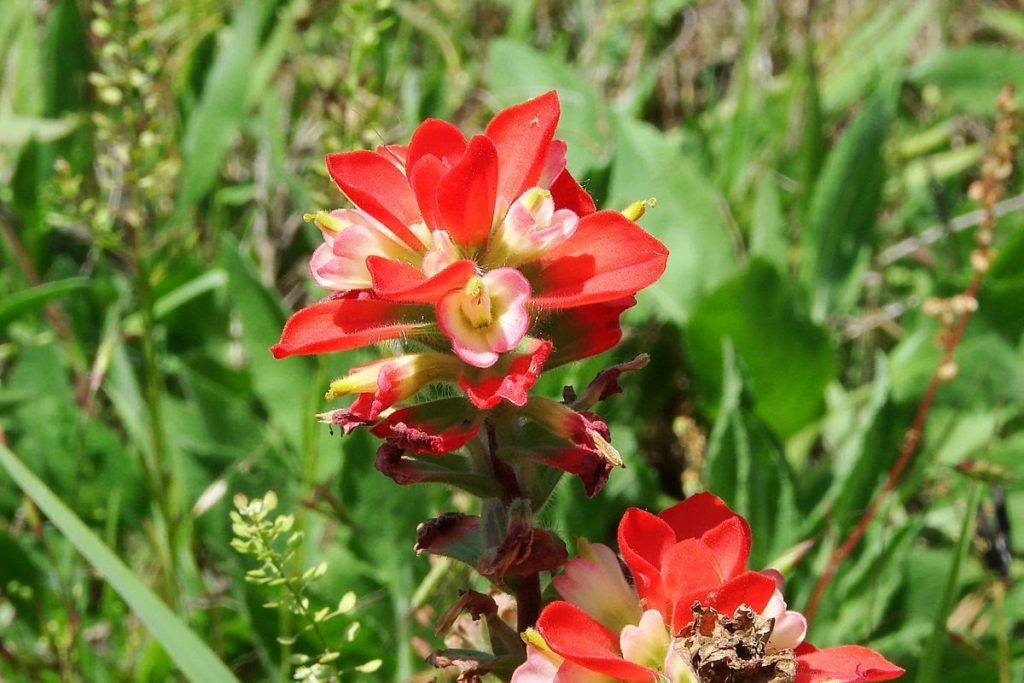
The Texas paintbrush is an interesting specimen, with small inconspicuous flowers surrounded by long, leaf-like bracts in vibrant red or orange. This drought-tolerant plant is beautiful but can be unpredictable, blooming perfectly one year and poorly the next for no apparent reason.
Plant type: Flower
Hardiness zones: 6a-11b
Sun: Full sun
Soil: Dry, well-draining sandy, loam, or clay soils
Duration: Annual or biennial
Height: 6-24 inches
Maintenance: Allow the plant to reseed after flowering if you want it to return the next year.
Trumpet Creeper (Campsis radicans)
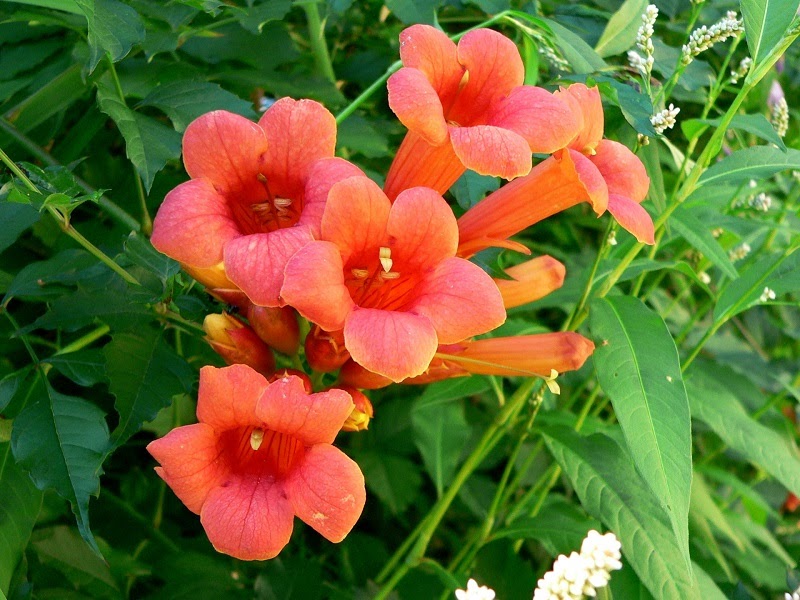
This fast-growing vine is perfect for climbing up trees, walls, fences, or other landscape features. It produces showy, trumpet-shaped, bright red flowers that attract hummingbirds.
Safety note: Trumpet creeper can overtake other plants and become weedy, earning it nicknames like hellvine and devil’s shoestring.
Plant type: Vine
Hardiness zones: 4a-10b
Sun: Full sun
Soil: Tolerates most soil types but flowers best with moisture
Duration: Perennial
Height: Up to 40 feet (climbing)
Maintenance: Prune regularly to keep it contained. Cut back in late winter or early spring for bushier growth.
Winecup (Callirhoe involucrata)
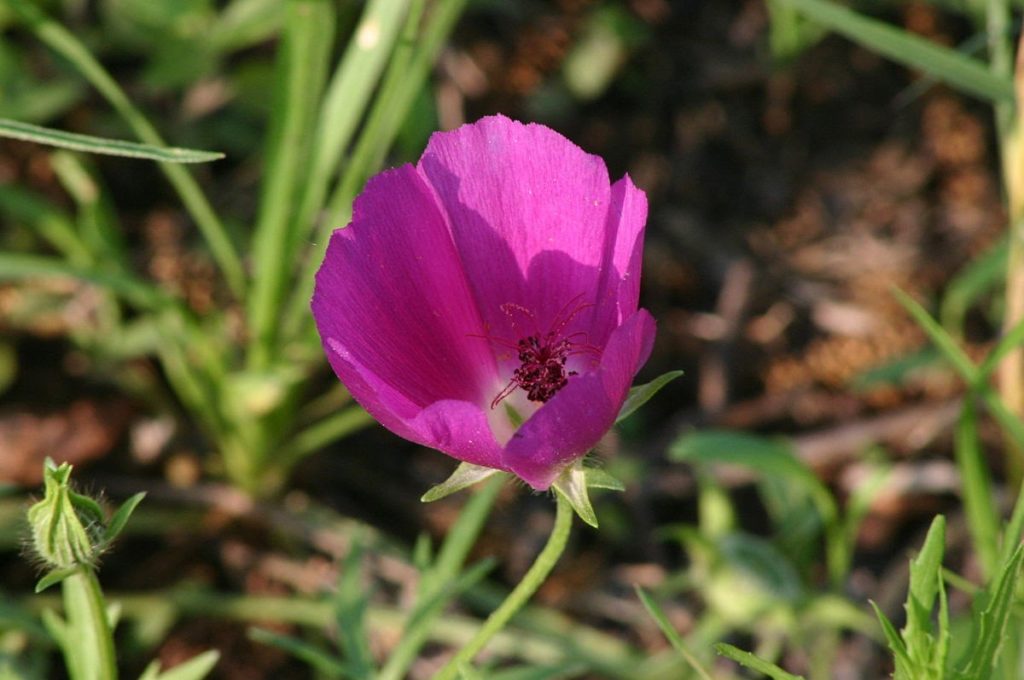
These cup-shaped, deep purple wildflowers spread along the ground and form a thick mat, making them a great choice for ground cover.
The drought-tolerant winecup blooms in spring. Its flowers open each morning and close each night.
Plant type: Flower
Hardiness zones: 4a-8b
Sun: Full sun
Soil: Well-draining rocky or sandy soils
Duration: Perennial
Height: 8-12 inches
Maintenance: Remove dead flowers to prolong growing season.
Native Plants of South Texas
South Texas brings subtropical conditions with mild winters and extended heat. These native plants are well suited to the Rio Grande Valley and Gulf Coast.
Coral Bean (Erythrina herbacea)
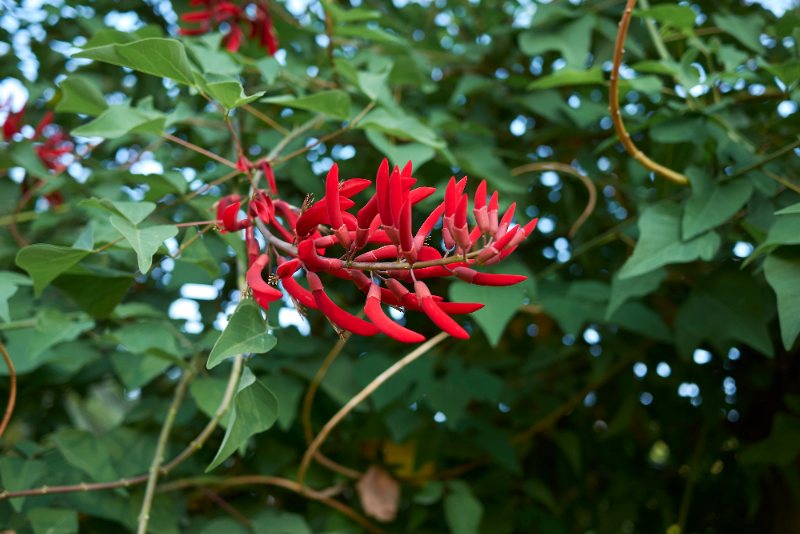
In South Texas, coral bean grows as a low shrub with glossy leaves and thorny branches (so be careful not to plant it in high-traffic areas).
When the coral bean’s branches are bare in spring, the plant produces spikes of showy, bright red, bean pod-shaped flowers that can add an interesting element to your landscaping.
Plant type: Shrub
Hardiness zones: 8a-11b
Sun: Full sun, partial shade
Soil: Well-draining or sandy soils
Duration: Deciduous
Height: 6-12 feet
Maintenance: Prune as needed to maintain desired shape and height.
Heartleaf Rosemallow (Hibiscus martianus)
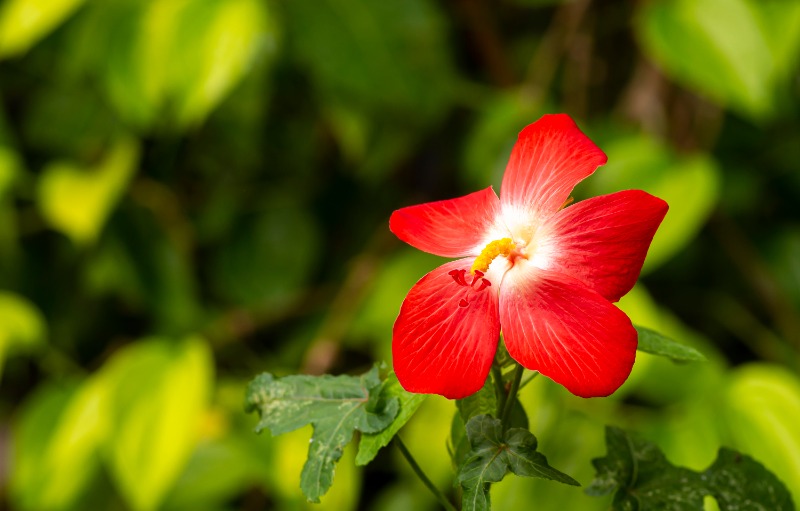
The heartleaf rosemallow is a type of hibiscus that produces beautiful bright red flowers year-round, as long as temperatures stay above freezing. This drought-tolerant plant adds a tropical touch to your Texas landscape.
Plant type: Flower
Hardiness zones: 8a-10a
Sun: Full sun, partial shade
Soil: Dry, well-draining gravelly or limestone soils
Duration: Perennial
Height: 1-3 feet
Maintenance: Prune lightly to encourage compact growth and more blooms.
Texas Mountain Laurel (Sophora secundiflora)
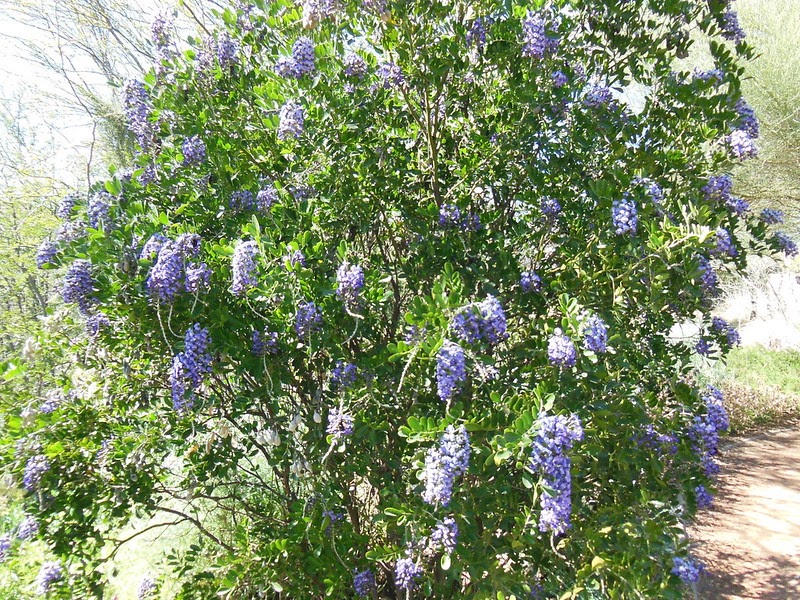
Also known as mescal bean, this multi-trunked plant can grow as either a large shrub or small tree depending on how you prune and train it.
Texas mountain laurels have rounded, shiny leaves and clusters of small lavender flowers with a strong grape-like scent that attracts butterflies. This shrub is a great choice for Corpus Christi landscaping.
Safety note: Seeds are toxic if chewed; keep away from children and pets.
Plant type: Shrub or tree
Hardiness zones: 7b-10b
Sun: Full sun, partial shade
Soil: Any well-draining soil
Duration: Evergreen
Height: 10-35 feet
Maintenance: Prune as needed to maintain desired shape and height.
Texas Palmetto (Sabal mexicana)
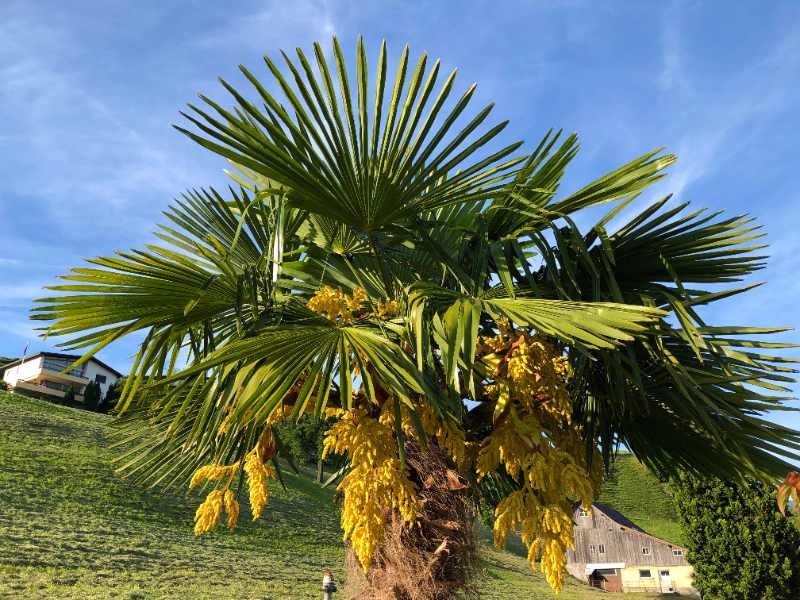
The Texas palmetto is a very slow-growing palm. Its trunk typically will not show above ground until the tree is about 10 years old.
When mature, it has a stout, thick, spiny trunk and fan-shaped fronds. South Texas is the only place in the United States where this palm grows naturally.
Plant type: Palm
Hardiness zones: 8a-11b
Sun: Full sun, partial shade
Soil: Tolerates most soil types
Duration: Evergreen
Height: Up to 50 feet
Maintenance: Remove dead fronds and fruit stems.
Texas Prickly Pear (Opuntia engelmannii var. lindheimeri)
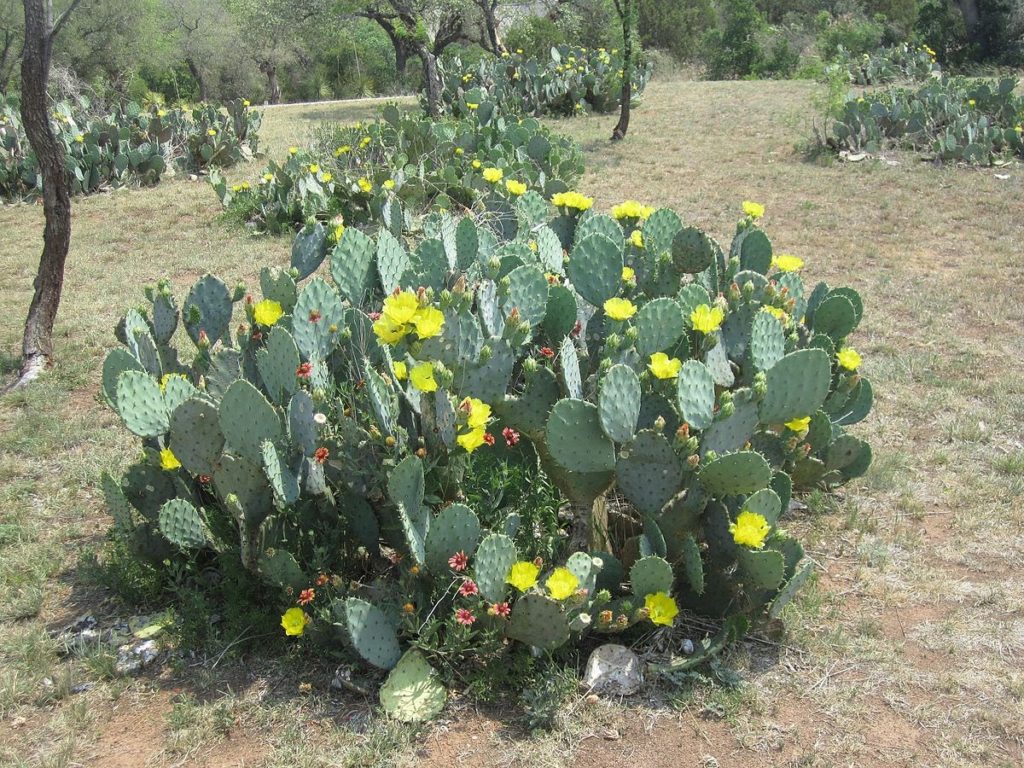
Texas prickly pear is a colorful specimen cactus with green or blue-green pads, yellow to orange flowers, and purple fruits. It can grow erect or spreading, and some varieties have spines while others do not.
Plant type: Succulent
Hardiness zones: 8b-10b
Sun: Full sun
Soil: Dry soils
Duration: Perennial
Height: 3-9 feet
Maintenance: No required maintenance.
Texas Sage (Leucophyllum frutescens)
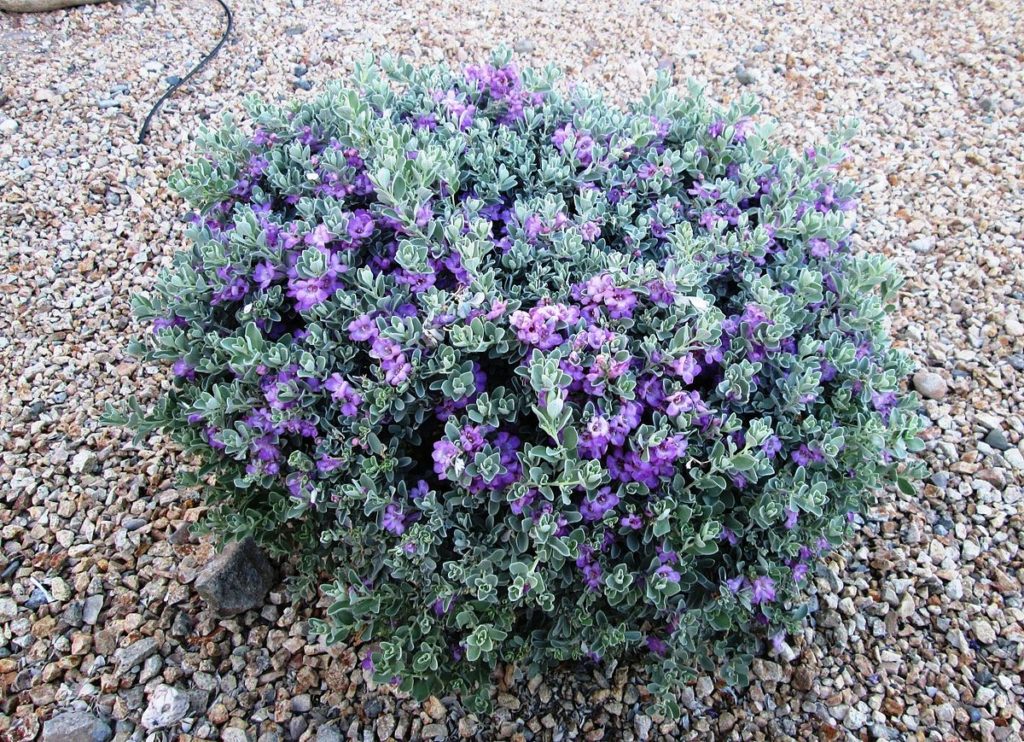
Texas sage, aka cenizo, aka Texas barometer bush, is not in fact a true sage (or Salvia) plant. It’s actually a small shrub with soft, hairy silver-gray leaves and bell-shaped flowers of violet, purple, lavender, or pink that bloom during the warm months, with heaviest flowering after rain.
Plant type: Shrub
Hardiness zones: 8a-11b
Sun: Full sun, partial shade
Soil: Dry, well-draining soils
Duration: Evergreen
Height: 2-8 feet
Maintenance: Prune regularly to keep the plant compact.
Native Plants of West Texas
West Texas has arid conditions, alkaline caliche soils, and intense sun, but these 6 native plants are tough enough to handle the desert climate.
Arizona Cypress (Hesperocyparis arizonica)
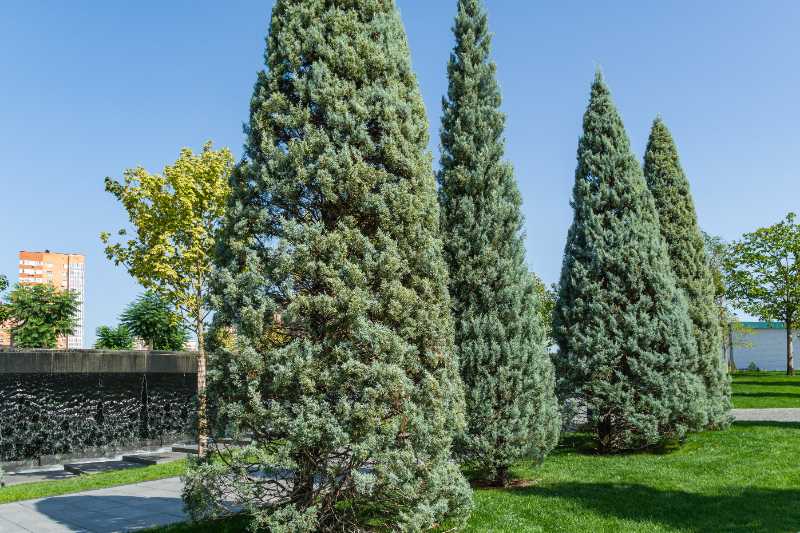
This deer-resistant, fast-growing tree has the classic pyramid shape of a cypress (think Christmas trees). The Arizona cypress has soft, gray-green to blue-green foliage, and its bark changes color from tan to plum to red as the tree ages.
Plant type: Tree
Hardiness zones: 7a-11a
Sun: Full sun
Soil: Well-draining sandy, loam, or clay soils
Duration: Evergreen
Height: 30-40 feet
Maintenance: Water at least every other week during growing season.
Desert Willow (Chilopsis linearis)
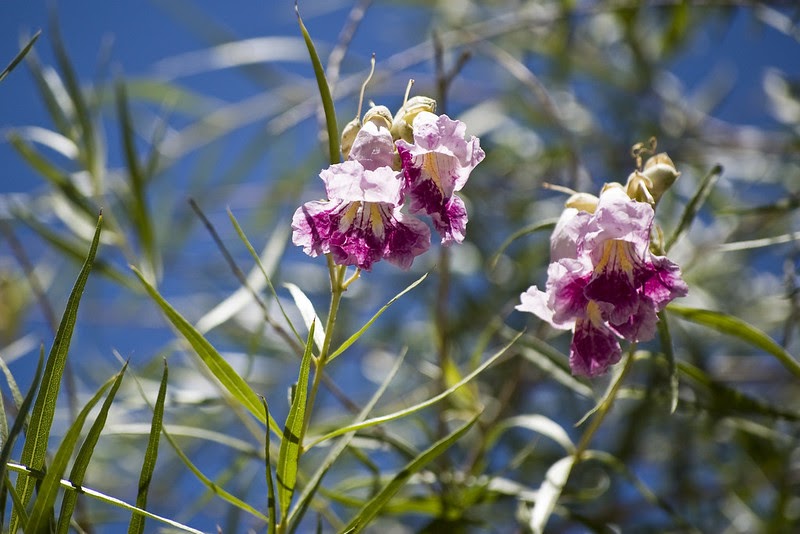
A desert willow can function as a large shrub or small tree depending on how you prune it. This fast-growing, drought-tolerant plant has slender branches and a twisting trunk.
It produces exotic-looking flowers in different shades of white, pink, purple, or magenta during summer.
Plant type: Shrub or tree
Hardiness zones: 7b-11b
Sun: Full sun
Soil: Any well-draining soil
Duration: Deciduous
Height: 20-30 feet
Maintenance: Cut back during winter to encourage new growth and blooms. Water occasionally during long droughts.
Flame Acanthus (Anisacanthus quadrifidus)
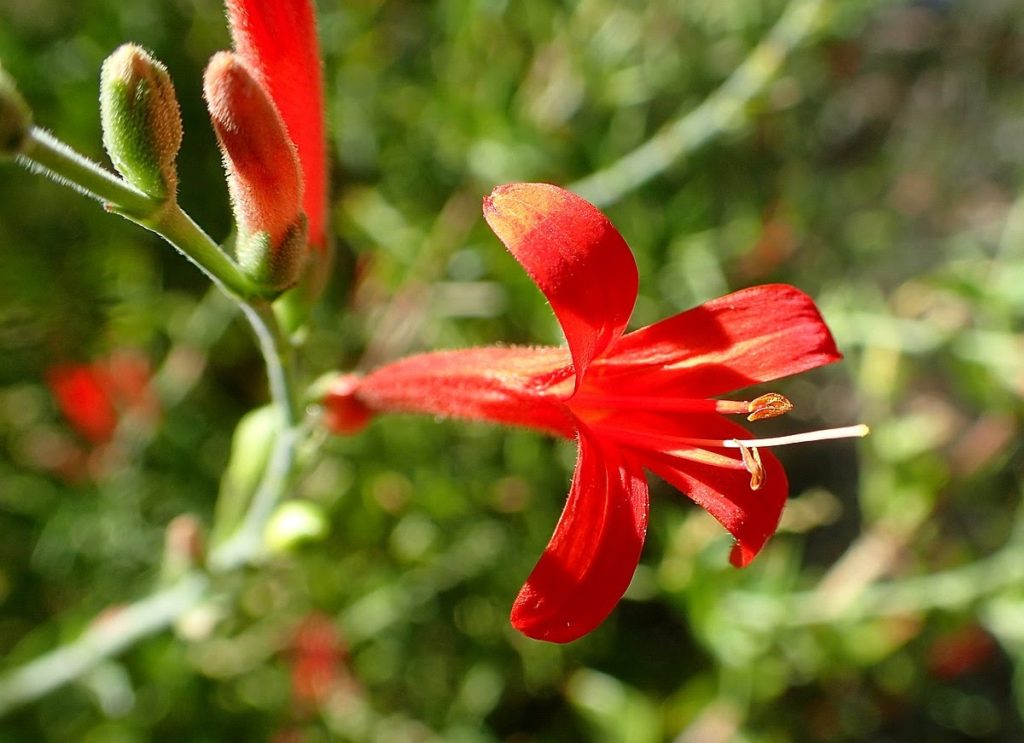
Flame acanthus is a spreading shrub that’s popular in Texas landscapes because of its showy, tubular, red-orange flowers that bloom from June through November when many other plants are out of season.
Those flowers are highly attractive to hummingbirds, so some people refer to the plant as hummingbird bush.
Plant type: Shrub
Hardiness zones: 7a-10b
Sun: Full sun, partial shade
Soil: Tolerates most soil types
Duration: Deciduous
Height: 3-5 feet
Maintenance: Prune each winter to encourage compact growth and more blooms.
See Related: How to Attract Hummingbirds to Your Garden
Lechuguilla (Agave lechuguilla)
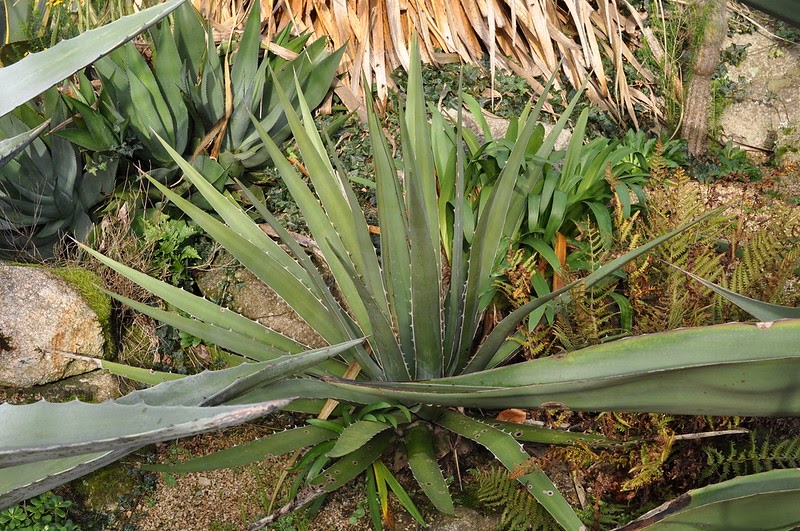
This yellow-green rosette succulent will not produce a flower stalk until it is about 12 to 15 years old. When it finally blooms, the flower can reach a spectacular height of 15 feet.
Safety note: Plant the lechuguilla away from walkways. It is nicknamed “shin dagger” for the sharp spines on its leaves.
Plant type: Succulent
Hardiness zones: 8a-10b
Sun: Full sun
Soil: Dry rocky soils
Duration: Perennial
Height: 1-2 feet without flower stalk, up to 15 feet with flower stalk
Maintenance: Remove dead growth.
Purple Muhly (Muhlenbergia rigida)
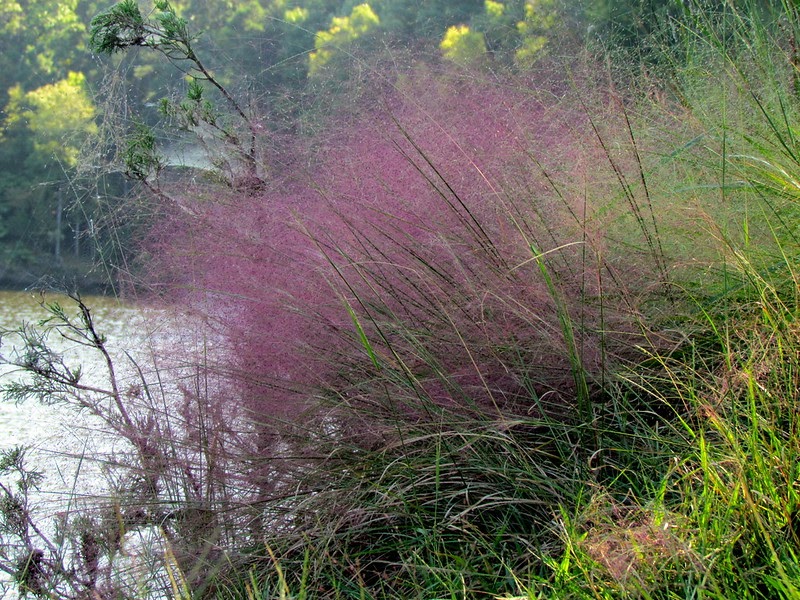
Purple muhly is an ornamental grass that grows in tufts, with purple seed heads giving it a cloud-like appearance. It works well for mass plantings and landscape bed borders.
Plant type: Ornamental grass
Hardiness zones: 5b-9a
Sun: Full sun
Soil: Dry rocky or gravelly soils
Duration: Perennial
Height: 2-3 feet
Maintenance: Cut back to the ground in late winter to prepare for new growth.
Yellow Bells (Tecoma stans)
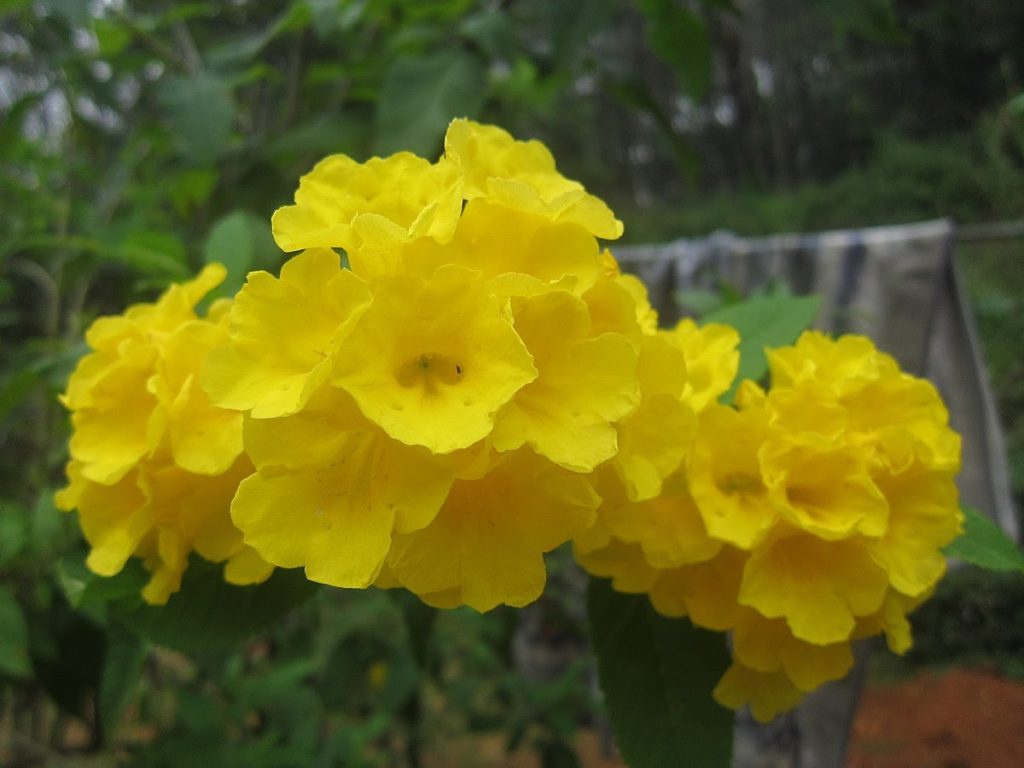
Also known as esperanza, this decorative shrub is useful for landscaping in Texas because it is drought-tolerant and makes a huge visual impact with its showy, trumpet-shaped, bright yellow flowers.
Because they’re so popular, there are many cultivars of yellow bells with different characteristics.
Plant type: Shrub
Hardiness zones: 8b-11
Sun: Full sun, partial shade
Soil: Well-draining rocky, sandy, loam, or limestone soils
Duration: Deciduous
Height: 3-6 feet
Maintenance: Remove spent flowers to encourage more blooms.
Ask The Experts
30 Native Plants for Texas by Region
- Which region of Texas is easiest on gardeners and why? Which region has the most obstacles for gardeners?
- What negative effects can result from planting non-native invasive plants in a landscape?
- What impact does landscaping with native plants have on the greater environment?
- What is the most important factor when choosing the right Texas natives for your landscape?
- What type of soil is most common in each region of Texas? Which of these types is best for planting, and which is worst?




Which region of Texas is easiest on gardeners and why? Which region has the most obstacles for gardeners?
Each region of Texas has its own pros and cons. I am very partial to the East Texas region, having spent many years gardening there. The acidic soil and higher average rainfall allows for the growth of some of my favorite plants (pines, azaleas, camellias, hydrangeas, blueberries).
However, gardeners in this region may have difficulty with alkaline soil-loving species. The most difficult region to plant exotic plants could be far west Texas, for example El Paso, or in the panhandle. These areas can have extreme weather conditions — specifically heat and cold — that some of the exotic plants cannot tolerate.
This is where choosing native plants can really help gardeners have success. Instead of trying to force an exotic to work in an area, plant natives that can tolerate the climate of that region.
What negative effects can result from planting non-native invasive plants in a landscape?
Non-native species can have a wide variety of negative effects, and it depends on the exact species as to what those are. Some of those effects are ecological in nature. Non-natives can become invasive and outcompete native species for resources. Studies have shown that native pollinators and birds choose to visit native flowering species over non-native species (Hopkins, 2022).
What impact does landscaping with native plants have on the greater environment?
As stated before, native plants attract wildlife, namely native pollinators and birds. These plants are equipped to handle the climate in their native environment, as well as the soil types. Gardeners may find that the native plants need less inputs than their exotic counterparts. We have many fantastic native species that are drought tolerant and heat tolerant.
What is the most important factor when choosing the right Texas natives for your landscape?
I would say the most important factor in choosing the right Texas natives for your area would be to make sure you are selecting plants in your hardiness zone. Texas is a big state, with hardiness zones of 6b in the panhandle to 10a on the coast. Once you know your hardiness zone, you can narrow your list of options for your region.
What type of soil is most common in each region of Texas? Which of these types is best for planting, and which is worst?
Texas soils are highly variable. I would urge gardeners to visit the USDA NRCS Web Soil Survey site. You can type in your ZIP code and pull up massive amounts of information about your region, from soil type to depth of soil, to average annual precipitation.
There are native plant choices for every soil in Texas, it is hard to say what is “best” or “worst.” The knowledge of what you have will help you select native plants that will work for you.
Hopkins, K. A., Hall, C. R., Arnold, M. A., Palma, M. A., Knuth, M., & Pemberton, B. (2022). Consumer Preferences of Ratibida columnifera (Nutt.) Wooton & Standl. Floral Characteristics, HortScience, 57(3), 431-440. Retrieved Apr 14, 2023, from https://doi.org/10.21273/HORTSCI16233-21
Which region of Texas is easiest on gardeners and why? Which region has the most obstacles for gardeners?
I think “easy” is a relative term. It is easy to grow lush grasses in the coast, but it is also easy to grow cactus out west. A little creativity can get you a long way.
By understanding the soil profile, what it needs, and how to provide for it, you can very well grow grass in the South Plains. To address the question, I do think East and Southeast Texas are fairly “easy” to grow things. There is plenty of rain and generally great soil for inground gardens. Looking around, it is easy to see the mass of greenery all around you in these areas. Gardens are usually able to follow suit.
As a fun anecdote, my roommates and I were having trouble with a yard in Lubbock. There was a beautiful shade tree in the front yard (a rarity out there), but it was a little too shaded most of the time. The soil was also very hard and very sandy. I decided it was time to put my grass growing skills to use.
These folks I lived with at the time had horses, so I would help them muck the stalls and take all the natural fertilizer into this “dead” spot in the front yard. Weeks went by of collecting manure and working it into the ground.
We eventually were able to cultivate the yard with some heavy machinery, plant some tall fescue, wait, and then lounge around in our beautiful, shaded, and grassy lawn. It might be quite silly to mention it, but we were proud of growing grass in Lubbock.
What negative effects can result from planting non-native invasive plants in a landscape?
Invasive plants can be just as detrimental, if not more so, than invasive animals. Everyone is likely familiar with the impact feral hogs have on the environment. But plants such as bamboo and Chinese tallow can be categorized the same.
Planting invasive species gives the potential for these plants to spread, propagate, and take over areas that are not meant for them. This can occur even when the homeowner or gardener may feel it is safe. A deer or a bird could forage on the plant in question and unknowingly spread it to a nearby area out of sight and out of mind from our gardener.
Invasive species have no natural competitors or predators, so it is easy for these species to grow out of control. This is true for plants just as it is for animals. Chinese tallow or bamboo can choke out the natural hardwoods and pine in our national forests quickly. They obviously weren’t planted deep in the forest, but through their natural propagation techniques, they were able to spread there. This is what gardeners need to be aware of, in my opinion. Just because an exotic plant looks nice in your landscape and fits, does not mean it will stay in your landscape.
What impact does landscaping with native plants have on the greater environment?
I think that landscaping with native plants is the best of both worlds. Not only are there plenty of amazing, beautiful plants to choose from that will satisfy the gardener’s outdoor feng shui, but these plants also will be able to facilitate a healthy ecosystem.
The Texas bees, insects, small mammals, large mammals, predators, etc. all work in tandem with each other in a complex, finely tuned web. Having the proper plants in the ground will mitigate the urbanization that these animals face. Now, of course, a new housing edition has huge impacts on the environment, but gardeners can provide some relief by planting native plants that facilitate a good, healthy balance in the ecosystem around their home.
What is the most important factor when choosing the right Texas natives for your landscape?
The type of plant, regions of where it is native to, and preferred growth conditions are all important. By understanding these and planting something that already is native to the environment, we can provide a beautiful landscape that includes the animals around us.
What type of soil is most common in each region of Texas? Which of these types is best for planting, and which is worst?
This one is beyond my purview; however, I do have some anecdotal information. In the DFW area, where I am from, the Post Oak Savannah is full of black clay. This is a tough soil to work with since it is so sticky. The hay pastures we work with are sandier, not unlike a plain. However, it still has enough loam present to be fruitful for us.
In Southeastern Texas, there is plenty of loamy soil that facilitates great forest and plant growth. Out west, it is a totally different ballgame. Now, I do know that there are tons of very successful cotton farmers out there, but growing a landscape is more of a challenge compared to growing one in other regions of Texas. It is not impossible, but in my opinion, it is the “expert mode.”
Which region of Texas is easiest on gardeners and why? Which region has the most obstacles for gardeners?
I think each region has its own unique challenges and benefits. Soil quality and structure, rainfall, and even general climate will be different in each region. Some plants that do well in one region will not do well in another. Houston, for example, gets a lot of annual rainfall compared to Lubbock or El Paso. Central Texas has a lot of limestone and hard rock, heavy clay, and Blackland Prairie. A good tool for gardeners to determine their soil type is the Ecological Dynamics Interpretive Tool (EDIT).
With this tool, gardeners can get ecological data by using their address to help determine features that will help with plant selection. Speaking with local Native Plant Society of Texas (NPSOT) groups can help to develop a well-functioning native ecosystem.
What negative effects can result from planting non-native invasive plants in a landscape?
Planting a non-native plant species can harm the insect, bird, and wildlife population for a region, as well as introduce competition for native plant species that have adapted to a specific region for thousands of years. This can increase a need for more fertilizers or water depending on the invasive or exotic species.
On a biological level, non-native invasive plants can even change the type of bacteria or fungi that are living in the soil and change the soil life profile. Non-native plants in general add more work all around.
What impact does landscaping with native plants have on the greater environment?
Alternately, planting native species strengthens the environment that has been there for generations. Native plants use less inputs like fertilizer and water and even require less maintenance. Native insects, birds, and wildlife that use those plants for food sources and shelter have done so through countless life cycles and depend on native plants. Water and soil quality is improved if there is less need for chemical pesticide and herbicide applications that are needed for exotic insects or plants.
What is the most important factor when choosing the right Texas natives for your landscape?
One of the important factors when choosing native plants is diversity. The more types of native grasses, flowers, and woody plants gardeners introduce will help the overall survival rate during a hard winter or summer and give variety throughout the growing season, as well as provide habitats for insects and wildlife.
What type of soil is most common in each region of Texas? Which of these types is best for planting, and which is worst?
Texas has 10 main eco-regions that each have a different plant palate. Many plants can go between regions. This is a broad topic, and I would say the best practice would be to talk to local native plant growers and groups. Every planting situation will be unique so knowing your goals and having local native plant groups to help decide what would be the best options for you will give you the best outcome. Texas has over 7,000 native plants, so any goal can be reached.
Great sites that I use:
Which region of Texas is easiest on gardeners and why? Which region has the most obstacles for gardeners?
The region of Texas that typically is easiest to garden would be the traditional East Texas Piney Woods. This area is primarily acidic soil, moderate humidity, and higher rainfall rates. Regions that are typically more difficult to garden are those in far West Texas that also have lower water quality.
What negative effects can result from planting non-native invasive plants in a landscape?
Planting non-native invasive plants potentially negatively changes the ecosystem if the invasive plant dominates the vegetative cover in the area.
What impact does landscaping with native plants have on the greater environment?
Installing plants that are native to your region has benefits to a wide range of other organisms — from birds to bees to soil critters — as both food and for habitat.
What is the most important factor when choosing the right Texas natives for your landscape?
Several factors are very important when selecting native plants for your landscape. Probably the most important one is proper low temperature toleration at your location.
What type of soil is most common in each region of Texas? Which of these types is best for planting, and which is worst?
A soil map of Texas will show there are several soil textures found within each region of Texas — from high sand content to high clay content. Perhaps the exception is the Blackland Prairie region which is dominated by clay loams and clays. A true loam soil may be the ideal soil for your landscape or garden. Perhaps the soil presenting the most challenges is the high clay content soil that may be compacted as well. This would seriously limit many landscape plants.
Which region of Texas is easiest on gardeners and why, which region has the most obstacles?
Technically, I would say the best region for producing is going to be The Valley, in USDA Zone 9B/A&M Gardening Zone V. This is due to the fact that there is very little occurrence of hard freezes or other cold weather events, with temperature lows only reaching 25 to 30 degrees F. This will lend itself well to gardeners and the like. However, little land area is available for production, and the area itself is in a transitory zone of USDA zones, so mileage may vary.
Instead, the next best region for a garden in Texas, in my opinion, is going to be the area between San Antonio, Austin, Waco, and Houston. Going off of USDA planting zones, this would be the northern portion of 9a, a good portion of 8b, and a little bit of 8a. If using the A&M Agrilife Gardening Zones, this will be a good chunk of Zone 3. While it is very possible to have a garden in a majority portion of the state, I’d say that this region is going to be the easiest to grow in. There are a few reasons for this:
- There is a wide variety of soil types, depending on where in this area you are living. This is where the Blackland Prairie ecoregion comes together with the Oak Woods and Prairies, as well as the Cross Timbers and Prairies. As such, there are both sandy and clayey soils available in the region. There is some variation, but because of the historic presence of natural grasslands, there is a high quantity of organic matter already available in the soil. This lends itself well to gardening philosophies that use compost/organic amendments to work with microbes and soil biology.
- Rainfall is adequate but not so much so that excess moisture will be an issue. Areas in this region typically receive around 25 to 40 inches of rainfall per year, which is an adequate amount to reduce reliance on irrigation. Of course, there is nuance, like drought years, but generally, this is a great amount for gardening.
- Sunlight is a bit difficult to measure, but this region receives 100% of the national average for solar radiation, so plenty of sunlight is available for growing plants.
- Temperature in this zone typically experiences only a few hard freezes per year, and the average low is about 10 to 20 degrees F. This lends itself well to perennial garden plants that can handle a freeze or two, and allows for enough seasonality between growing times to grow both cool- and warm-season gardens.
The most difficult region to garden, in my opinion, will be far West Texas and Southwest Texas in USDA Zones 8a and 7b (A&M Gardening Zone 2). This is simply due to the high annual temperature, low rainfall (5 to 8 inches per year), and extremely high levels of solar radiation, up to 130% of the national average in some cases. These arid environments also have soils that are prone to salinization, degradation, and are typically of poor quality in comparison to what else we have available in the state.
What negative effects can result from planting non-native invasive plants in a landscape?
There are a few things. To understand this, we have to understand how an ecosystem works. I’ll do so briefly (though I could say much more).
An ecosystem consists of all living and non-living factors that are present in an environment and how they interact. Each and every thing plays a role, has a job, or serves some purpose. When we remove one of those things, a void is created, and nature fills voids. Commonly, when making a garden or building a development, etc., land is cleared and those players of the ecosystem that existed are now removed, creating a void.
When we then fill that void with invasive, non-native plants, such as turfgrass species or landscaping plants not from the region, these non-natives tend to grow very vigorously. They have no natural checks and balances that exist because they are not in the natural system they evolved to live in. As such, they can run rampant and grow wild, taking over areas of the garden (or outside of the garden, and into the greater environment). Once they have escaped the garden, they become ingrained to the natural landscape, outcompeting the plants that have not evolved alongside the non-native.
A good example of this is Ligustrum japonica (Japanese privet): This plant was utilized in landscapes extensively over the last few decades, and is now an extremely invasive plant throughout large areas of Texas. Bermudagrass (Cynodon dactylon) — originally native to Africa — is another example, probably an even better one as we all know how hard it is to pull Bermuda and how vigorously it spreads.
What impact does landscaping with native plants have on the greater environment?
I always say that natives should always be the answer if a homeowner ever has the option between a native and a non-native! There are a few reasons that native plants are a better option:
- Natives use less water and typically require fewer nutrient additions. Because these plants have already gone through millennia of evolution in this location, they are adapted to the conditions present; meaning they have already figured out how to survive on the amount of rainfall we receive every year. They have adapted to the level and proportion of nutrients available in our soils as well as the textures and pH of our soils. Because of this, they require less resource input and are an overall plus for the environment.
Bonus: This means they can be used in xeriscaping. Xeriscaping does not have to mean rocks, gravel, and cacti. There are many gorgeous xeriscape gardens and landscapes that use natives, and don’t look like the desert.
- Natives have formed ecological relationships with wildlife and other living factors of the environment. For example, native pollinators in our area have evolved to consume the nectar and pollen of our native species. Of course, any floral resources we make available to them are going to benefit their dwindling populations. However, if we capitalize on relationships that already exist, we may see a greater result.
- As we talked about with the non-native species, these plants are often outcompeted by invasive plants in natural environments. Because evolution has not created a way for these plants to fight off invasive species, growing natives in our gardens and landscapes allows more native species to survive and combat the threat of invasive plants. This conserves their genetic diversity and protects against the loss of plant populations.
What is the most important factor when choosing the right Texas Native for your landscape?
I would say the most important factor, first and foremost, is if the plant will grow in your type of soil.
For example, something adapted for a sandy type of soil is not going to do as well in the clayey soil of the Blackland Prairie or vice versa. It may survive but would not be at full potential. Additionally, other soil factors such as pH play a role. Some plants prefer slightly acidic pH, most prefer neutral pH, and matching pH requirement to the plant’s preference is important for things like the availability of nutrients.
Speaking of nutrients, that is another factor associated with soil — some plants are very heavy feeders, some plants do not require as much. I’d say most natives won’t require much of a nutrient input, but some cases do exist.
The next most important factor I would say is sunlight requirement. A plant that naturally grows on the understory of a semi-forested region would not do well in a full-sun environment, and vice versa. Honorable mention would be moisture/rainfall, but that can be supplemented via irrigation and watering.
Regardless of the requirement, information on these factors is usually available via internet or on the plant label at a nursery. Using these resources you can find plants that will match the conditions of your garden or landscape.
What type of soil is most common in each region of TX? Which of these is best for planting, and which is the worst?
It is a bit too difficult to answer this question in terms of specific soil types. In soil, individual types can be hard to distinguish and may be very similar with only one or a few traits being different at the most specific level. However, instead, I will answer in terms of soil orders. This is a classification of soil types that is a bit more general but still specific enough to distinguish from one another. There are 12 soil orders found across the globe, and seven of them are found in Texas.
With that said, I would say that mollisols and/or alfisols are the most prevalent across most of Texas. These will be found throughout A&M Gardening regions 2, 3, and 4. Alfisols are typically high in fertility, and have accumulations of clay in the lower regions. Mollisols are characteristic of areas that are or were grasslands, and have a very dark upper region of the soil, due to the high level of organic matter deposited via plant matter from said grasslands. Mollisols are also very fertile for this reason.
In Zone 5, there is a mixture of alfisols, entisols, inceptisols, and mollisols. The description above for alfisols and mollisols is also true here. Additionally, inceptisols are geologically young soils, with little development, and are not as fertile for plant growth as alfisols or mollisols. Entisols, then, are also a soil that does not show a lot of development but can be extremely variable in how fertile they are.
Zone 1 mainly consists of aridisols. These are going to be dry most of the year, and have high levels of calcium carbonate, silica, other salts, and gypsum. These are typically not very productive, as they are found in regions where water for plant growth is only available about 90 days out of the year.
Out of all of these soil types, I would suggest that mollisols and alfisols are going to be the most fertile. Due to their accumulation of organic matter, the biology of the soil is typically very active and the use of sustainable practices only enhances their ability to produce. This can also be seen in a map of agricultural production throughout the state, where a lot of our crop production occurs over mollisols and alfisols.
I would also suggest that aridisols, found in Zone 1, will be the worst for a garden or landscape, due to the low availability of water throughout the year as well as the buildup of salts and calcium in the soil.
How to Choose Native Plants for Your Region
Choosing the right native plant for your Texas yard comes down to 3 factors: your hardiness zone, your soil type, and how much sun your planting area gets.
| Factor | What to Check | Why It Matters |
| Hardiness zone | U.S. Department of Agriculture (USDA) Plant Hardiness Zone Map | Tells you which plants survive your winters |
| Soil type | County extension office soil test | Matches plants to your soil conditions |
| Sun exposure | Hours of direct sunlight per day | Most wildflowers need full sun; many shrubs tolerate shade |
Check your hardiness zone: Most of Texas falls between zones 7b and 9b. Enter your ZIP code at the USDA Plant Hardiness Zone map to find your zone. This tells you which plants can survive your area’s average winter lows.
Know your soil: Texas soils vary from black clay in the Dallas-Fort Worth (DFW) area to sandy loam in East Texas to alkaline caliche in West Texas. A soil test from your county Extension office tells you your soil’s pH, texture, and nutrient levels.
Consider sun exposure: Most native Texas wildflowers and grasses need full sun, while many native shrubs and understory trees tolerate partial shade.
Start with established plants: Transplanting nursery-grown natives gives you a head start over seeds. LawnStarter’s planting service can handle the heavy lifting. Water deeply during the first growing season, then let the plant’s natural drought tolerance take over.
Be patient the first year: Most native plants focus on root growth during their first season and may look sparse above ground. By the second growing season, you should see fuller foliage and blooms.
For more information about the hundreds of Texas native plants, check out the native plant database of the Native Plant Society of Texas. Lady Bird Johnson Wildflower Center’s extensive database of native plants throughout North America is another great resource for Texans, as it includes lists of 100+ plants suited for each specific region of Texas.
See Related: Guide to Soil Types: Pros, Cons, and Plant Suggestions
Bring Texas’ Native Plants to Your Yard
Ready to bring your yard to life with native plants? One of LawnStarter’s local landscaping professionals can help you choose, plant, and care for native species that will thrive in your part of Texas.
FAQs
A native plant is a species that evolved naturally in a specific region without human introduction. In Texas, native plants have adapted to local soil, rainfall, and temperature patterns over thousands of years. They typically require less water and maintenance than non-native plants once established.
Texas lantana and black-eyed Susan are popular low-maintenance choices to grow across most of Texas. Both tolerate heat, drought, and poor soil while producing colorful blooms that attract butterflies. Yaupon holly is another low-effort option if you want an evergreen shrub.
Fall is the best planting season for most Texas natives. Cooler temperatures and seasonal rains help roots establish before summer heat arrives. Spring planting works too, but you will need to water more frequently during the first summer to help plants get established.
Most Texas native plants do not need fertilizer. They evolved in nutrient-poor soils and actually perform worse with heavy feeding, which can encourage leggy growth and reduce blooming. A light layer of mulch around the base is usually all the help they need.
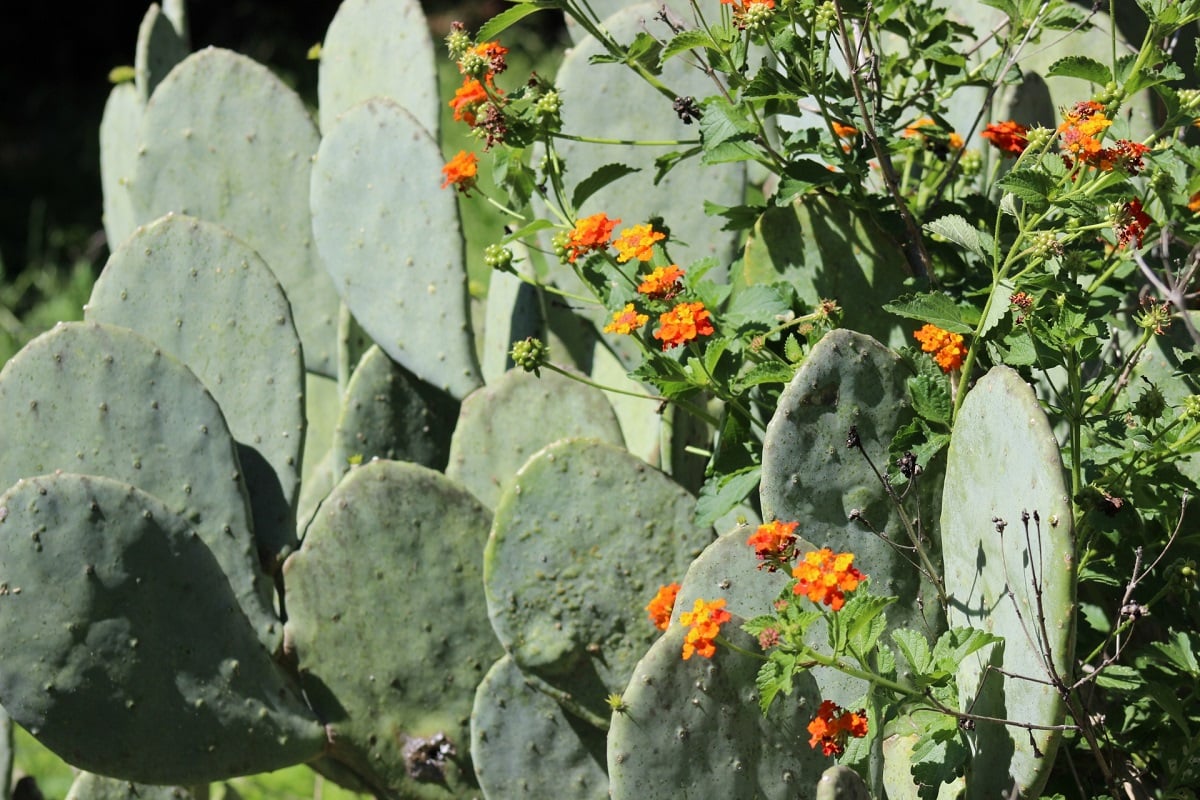
Main Image: Prickly pear cactus with bright orange lantana. Image Credit: Needpix
Related Posts: