| Key Takeaways |
|---|
| ● Large, lawn-heavy counties have the most potential to benefit from switching to electric, like Harris County, Texas (Houston), Los Angeles County, California, and Maricopa County, Arizona (Phoenix). ● Florida, Texas, and Georgia have preemption laws prohibiting local bans on gas-powered equipment. Florida’s law took effect in July 2026, overriding bans in Miami Beach, South Miami, Key Biscayne, and Pinecrest. 4 Florida counties rank in our top 25, led by Palm Beach County (No. 9). ● Our top 5 counties cover just 2% of the land area we analyzed, but account for nearly 9% of the ozone-forming VOC emissions from lawn equipment out of the counties in this report. |
As fall cleanup ramps up, Baltimore and Alexandria, Virginia, are moving to ban gas-powered leaf blowers, and New York is creating a statewide rebate program for electric lawn care equipment. But in Florida, a new state law overrides local bans.
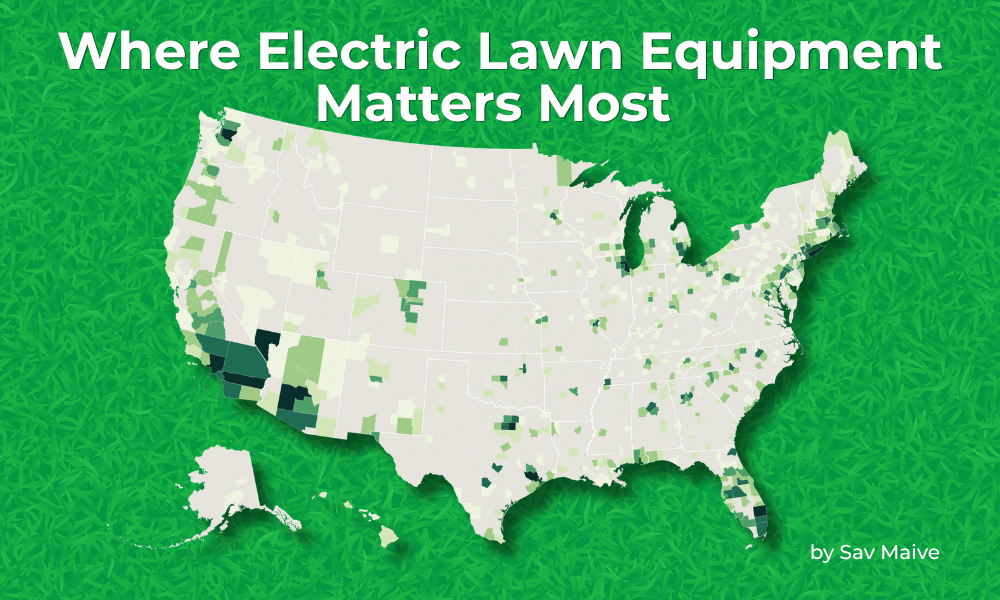
With loud leaf blowers revving up across the U.S., LawnStarter looked at over 650 U.S. counties to map Where Electric Lawn Equipment Matters Most.
We ranked counties based on how much pollution their lawn equipment produces, how much lawn and green space there is to maintain, and how much air pollution residents already face, factors that together indicate where switching to electric equipment could have the greatest potential benefit.
See how your county’s air quality could be impacted below, with insights from fully electric lawn care crews, clean air advocates, and local government leaders. To learn more about the data we used, check out our methodology.
Contents
- Relevant Terms: Pollutants from Gas-Powered Lawn Equipment
- Map: Lawn Care Emissions by County
- 5 Counties Where Going Electric Could Have the Biggest Impact
- Lawn Pro Perspectives: Benefits of Electric Equipment
- Advocates and Local Leaders on Making the Switch
- Ranking and Methodology
- Better for the Environment, and Better for You
Relevant Terms: Pollutants from Gas-Powered Lawn Equipment
Key Definitions
- Small Off-Road Engines (SORE) | Spark-ignition engines rated at 19 kilowatts or below that are commonly used in lawn care and gardening. In California, smog-forming emissions from SORE are projected to be nearly 2X those of light-duty passenger cars by 2031.
- 2-Stroke Engines | The type of engine commonly found in leaf blowers, string trimmers, and chainsaws. These accounted for an estimated 82% of PM 2.5 emissions from lawn equipment nationwide in 2020.
- 4-Stroke Engines | The type of engine commonly found in lawn mowers and garden tractors. They are more fuel-efficient than 2-stroke engines because lubricating oil is kept separately from the fuel, while in 2-stroke engines, oil and fuel are mixed and expelled in the exhaust.
- PM 2.5 | PM means particulate matter, which is a combination of solid pollution particles and liquid in the air. PM 2.5 are fine particles with a diameter of 2.5 micrometers or smaller. Exposure can increase the risk of heart disease, stroke, and lung cancer.
- CO2 | Carbon dioxide is a greenhouse gas, produced when gasoline is burned to power gas-powered equipment.
- NOx | Nitrogen oxides (a combination of nitric oxide and nitrogen dioxide) can form lung-damaging ground-level ozone and also contribute to acid rain.
- VOC | Volatile organic compounds come from unburned fuel in equipment exhaust and from fuel evaporating during use and refilling.
- CO | Carbon monoxide is a toxic, colorless, and odorless gas emitted from gas-powered equipment that can cause headaches, fatigue, dizziness, and cardiovascular stress.
- O3 | Ground-level ozone is a gas that’s formed when NOx and VOCs react, typically spiking on hot summer days. This colorless gas can cause respiratory issues and can also impact plant growth.
Map: Lawn Care Emissions by County
See how each county fared in our ranking:
Notes:
- PM 2.5 emissions are noticeably lower in California, where state and local governments have spent decades promoting electric equipment and restricting gas-powered leaf blowers. “These minuscule particles get absorbed deeper into the lungs than other hazardous chemicals from combustion, and from there into the bloodstream and the rest of the body,” says Judy Walton, co-founder of Quiet Clean Alliance.
Map source: U.S. Census Bureau
5 Counties Where Going Electric Could Have the Biggest Impact
Our top 5 counties cover just 2% of the land area we analyzed, but account for nearly 9% of the lawn-equipment VOC emissions in this report. Across the 5 counties, CO2 emissions from lawn equipment in 2020 were equivalent to roughly 370,000 passenger vehicles’ annual emissions.
Counties are shown in rank order, 1 to 5.
Lawn Pro Perspectives: Benefits of Electric Equipment
Upgrading equipment can be a big investment, especially for lawn care pros whose commercial mowing equipment costs significantly more than residential lawn mowers.
But beyond saving the environment, electric equipment can help crews save money on fuel and also avoid the health impacts from noise pollution and spending hours inhaling exhaust fumes.
We turned to Kevin Boodram of Serenity Robotic Lawncare and to Oscar Ortega and JT Wilkinson, maintenance care managers for FormLA Landscaping, Inc., to learn more about their experiences switching to electric. Read their insights below.
Note: While both companies below utilized local incentives for purchasing electric equipment, it’s important to keep in mind that not all rebate programs are alike. Some have requirements, like turning in a working gas-powered device. Some are more substantial than others.
- What sparked the switch to electric lawn care equipment?
- Did you participate in any local rebate programs when upgrading your equipment? If so, what was that experience like?
- How has working without direct gas exhaust and fuel fumes affected the daily physical health and energy levels of your crew?
- Do your clients notice a difference in your equipment choices?
- What operational realities (battery rotation, charging logistics) should other contractors know if they want to reduce their fleet’s environmental footprint?
- Did savings on fuel and oil costs offset the upfront cost of commercial battery banks as quickly as projected?


Advocates and Local Leaders on Making the Switch
We also spoke with advocates and local officials working to cut gas-powered leaf blower use. Ban Gas Blowers Chicago is pushing for a citywide ban in Chicago. It is part of the Quiet Clean Alliance (QCA), a national advocacy group working to eliminate gas leaf blowers, and we also heard from their co-founder, Judy Walton. Their answers reflect an advocacy perspective.
The City of Highland Park in Lake County, Illinois (No. 30), offers a look at a different approach. In 2021, it helped form a regional working group to study gas leaf blower rules. Highland Park now limits gas blowers to operate in April, October, and November, and city staff shared how they enforce the rules, educate landscapers, and are weighing incentives.
Explore their insights below.


Ranking and Methodology
We compared 652 U.S. counties with populations above 50,000 across 15 metrics.
Our metrics covered 4 main themes:
- Lawn Equipment Pollution Rank (~42%): Tons of PM 2.5 (2023), CO2 (2020), NOx (2023), VOC (2023), and CO (2023) emissions from gas-powered lawn equipment.
- Mowing Intensity Rank (~29%): Total residential yard area (2024), golf courses per 100,000 residents (2026), share of single-unit detached homes (2024), and acres of developed open space (2024).
- Air Quality Burden Rank (~17%): Median AQI (2025), PM 2.5 concentration (2020), number of unhealthy AQI days (2025), and the annual mean of the daily 8-hour average ozone concentration (2022).
- Community & Economic Context Rank (~12%): The number of landscaping businesses per 100,000 residents (2023 and 2026 data) and population density (2024).
For each of the 652 counties with available data and populations above 50,000, we then gathered the most recent data available on each metric from the sources listed below.
Finally, we calculated scores (out of 100 points) for each county to determine its rank in each metric, each category, and overall. A county’s Overall Score is the weighted average of its scores across all metrics and categories. The highest Overall Score ranked “Highest Potential Impact” (No. 1) and the lowest “Lowest Potential Impact” (No. 652).
Notes:
- The lowest rank among individual factors may not be No. 652 due to ties.
- Lawn Equipment Pollution metrics only include mowers/tractors/turf equipment and leaf blowers/trimmers/edgers across gas/diesel/LPG variants. They exclude chainsaws and snowblowers.
- Car conversion data are calculated using EPA’s figure that a typical passenger vehicle emits 4.6 metric tons of CO2 per year.
- To estimate total residential lawn area, we multiplied average yard size by the number of single-unit detached homes.
- To calculate the developed open space, we counted pixels from the National Land Cover Database of "Developed, Open Space" — residential lawns, parks, golf courses, cemeteries, and low-impervious developed land.
- Unhealthy AQI days include the number of days in 2025 that were recorded as Unhealthy for Sensitive Groups Days, Unhealthy Days, Very Unhealthy Days, and Hazardous Days by the EPA.
Sources: Centers for Disease Control and Prevention, County Health Rankings & Roadmaps, U.S. Bureau of Labor Statistics, U.S. Census Bureau, U.S. Environmental Protection Agency, U.S. Federal Housing Finance Agency, U.S. Geological Survey, and Open Street Map
Better for the Environment, and Better for You
Reducing pollution isn’t the only reason for switching to electric lawn equipment.
Noise Reduction
For Kevin Boodram of Serenity Robotic Lawncare, “Noise was the biggest motivation. I was in school during the pandemic, and gas leaf blowers kept waking me up and interrupting my remote classes.”
Boodram’s customers noticed a difference: “One customer described us as ‘ninjas.’ They would go into a meeting with an overgrown lawn, come out to find it cut, and never realize we had been there,” he says.
“We didn’t promote the shift in advance, so we had clients check to see when we’d be in their gardens,” says Oscar Ortega of FormLA Landscaping, Inc. “We were so quiet, they didn’t notice that we’d already come and gone. Now, they brag about us, and appreciate that we don’t wake babies or interrupt Zoom meetings.”
Saving Fuel (and Time)
“Even before grants and rebates were available, we almost instantaneously recouped costs,” says JT Wilkinson of FormLA Landscaping, Inc. “Some of the cost savings were 100% unexpected. For example, our teams used to spend valuable time at the gas station: 20 minutes to fuel trucks, equipment, backup cans, and get snacks. Now they leave our yard ready for the day.”
Ban Gas Blowers Chicago makes a similar case: “With electric blowers there’s no more
need to buy gas (a growing expense these days), let alone oil, spark plugs, and filters.
Maintenance and repair costs are also significantly less with electric tools. Within a year or so, landscapers reach a break-even point where the extra up-front cost, if any, of purchasing an electric blower has been recouped, and then it’s pure savings for the landscaper compared to having a gas blower,” says Bryan D.
Health Benefits
Judy Walton, co-founder and co-chair of the Quiet Clean Alliance, says gas equipment emissions aren’t just a general air quality issue. “They have a highly localized, close-up, and intense effect on operators and everyone nearby, even inside buildings,” Walton says.
“In my experience, electric equipment makes the workday much less physically taxing,” Boodram says.
Wilkinson agrees: “We feel better. We hear better. We smell better. No exhaust fumes or gasoline spilled on our clothing or skin. Our team members feel better letting their kids hug them when they walk in the door. It means we are more approachable, even as we are working. It’s become an impact we mention in recruiting.”
Main Photo Credit: Sav Maive, map shapefile from U.S. Census Bureau
Related Posts: