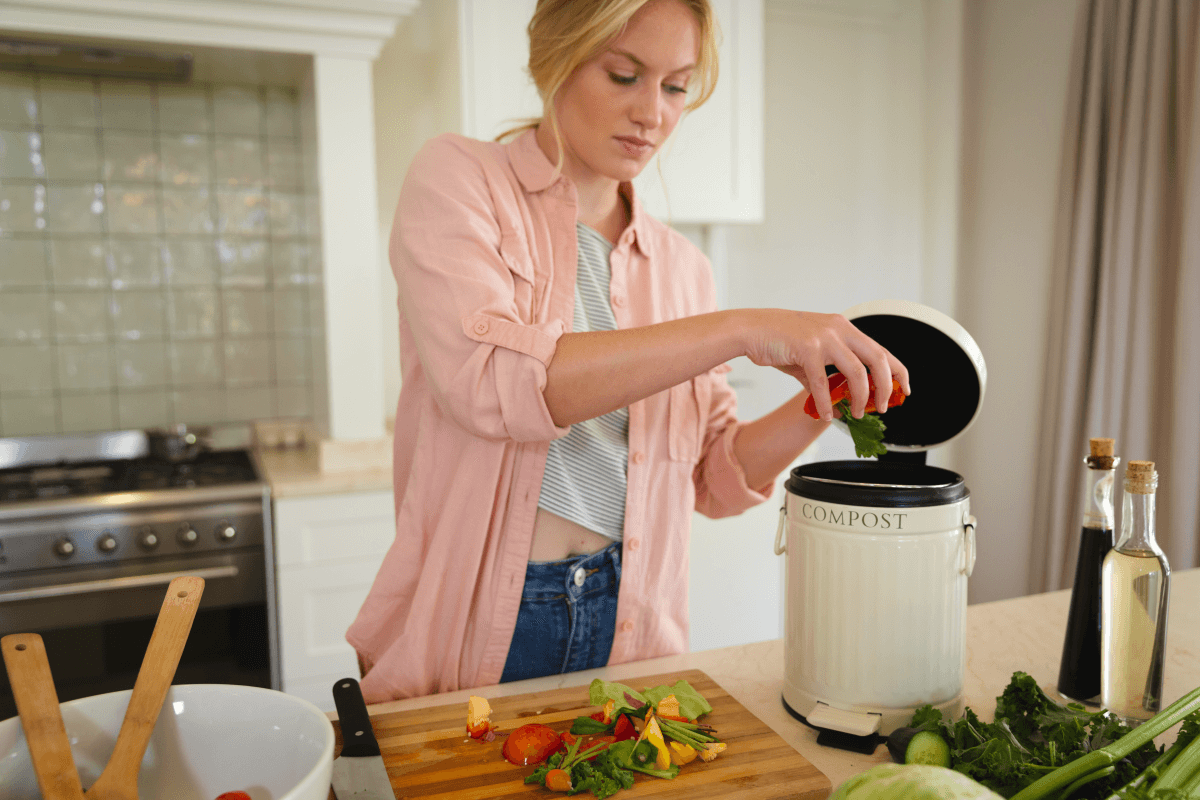
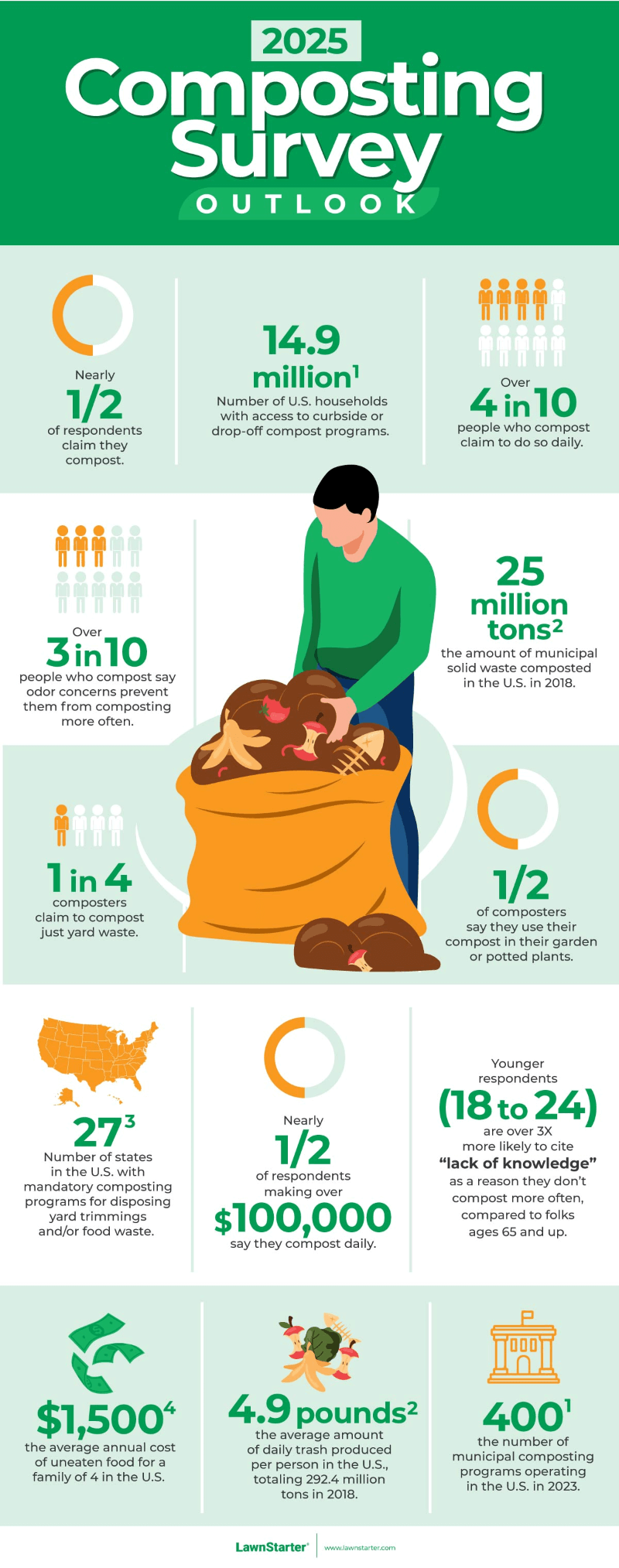
Composting isn’t small potatoes anymore. Nearly half of U.S. residents say they let Mother Nature recycle kitchen and yard waste for use in their own or their friends’ gardens.
With a new year for setting resolutions around the corner and numerous cities (and California) looking to hit a zero-waste target in 2025, LawnStarter surveyed over 2,100 U.S. residents on their composting habits and opinions and ranked 2025’s Best Cities for Composting.
For the city rankings, we compared the 500 biggest U.S. cities based on 5 categories. More specifically, we factored in access to municipal and private composting programs, zero-waste initiatives, yard size, and local interest in composting, among 11 total metrics.
Dig in to our survey results and ranking below. To learn how we ranked the cities, see our methodology.
Why does LawnStarter care about composting? Half of U.S. states require grass clippings and yard waste to be composted or collected separately from their other trash.
Cities like New York are currently rolling out mandatory composting programs. Curious about composting practices in the Big Apple? Read through our NYC composting survey.
Contents
- 2025 U.S. Composting Survey Outlook
- U.S. Composting Survey Results
- Survey Key Insights
- Behind the Survey
- City Rankings
- Top 5 Close Up
- City Rankings Key Insights
- City Rankings Methodology
- Final Thoughts: Trash into Treasure
2025 U.S. Composting Survey Outlook
U.S. Composting Survey Results
Survey Key Insights
- A BioCycle survey from 2023 demonstrates that residential access to food waste collection has increased by 49% between 2021 and 2023, bringing curbside or drop-off compost programs to 14.9 million households.
Age
- Younger folks (18 to 24) are over 4X more likely to compost at a community garden or compost site than people who are 65 and older.
- With Age Comes Wisdom (and Time): Younger respondents (18 to 24) are over 3X more likely to cite “lack of knowledge” as a reason they don’t compost more often, compared to those ages 65 and up. The younger generation is also 2X more likely to say time constraints are keeping them from composting more.
- At 63.38%, respondents over 65 are most inclined to use compost in their garden and for potted plants.
Race + Ethnicity
- Black (41.50%) respondents are most likely to say they compost every day. At 21.43%, multiracial respondents are more likely to compost monthly.
Income
- Nearly 1/2 of respondents making over $100,000 say they compost on a daily basis.
- Odor concerns are keeping more than 1/2 of high-income respondents (making over $150,000) from composting more often.
- Those making over 6 figures are most likely to live in an area where their HOA prohibits composting — 12.39% for those making $100,000 to $149,999 and 10.45% for households with incomes above $150,000.
Education
- Respondents without a diploma or GED are almost 3X more likely to compost through a work program than those with a doctorate, advanced, or professional degree.
- Degrees Don’t Always Know Best: Those with advanced degrees are almost 2X more likely than those with no schooling to claim a lack of knowledge as an excuse for not composting. Those with advanced degrees are also 2.5X more likely to worry about odor and HOA restrictions than those with no schooling.
Gender
- Almost 55% more men than women claim their HOA prohibits composting.
- Almost 40% more men than women claim they dispose of their compost instead of repurposing it.
Behind the Survey
LawnStarter collected survey responses from a random sample of 2,165 U.S. residents aged 18 or older via Alchemer and Cint on October 22, 2024.
The first question includes responses from all 2,165, while the remaining 5 questions reflect data from 1,008 respondents who answered “yes” on the first question.
Each response was anonymized using a unique user ID generated and assigned by Cint.
Notes:
- This survey data does not stem from a probability sample, therefore no margin of error can be calculated.
- If comparing national data with our NYC survey results, note that some questions from the NYC survey allowed respondents to select multiple options (“select all that apply”), while within the U.S. survey respondents had to choose one option for the same questions.
City Rankings
See how each city fared in our ranking:
Top 5 Close Up
Check out the slideshow below for highlights on each of our top 5 cities for composting.

Access to Municipal Composting: 1 | Rank: 15 (TIE)
Access to Private Composting Programs: 1.5 | Rank: 1 (TIE)
Number of Local Composting Facilities: 5 | Rank: 4
Zero-Waste Initiatives: 3 | Rank: 1 (TIE)
Average Number of Very Cold Days: 0 | Rank: 1 (TIE)
Local tips: San Diego provides composting bins and pails to residents with a weekly pickup service, and has successfully increased organic waste collection by 106% over 2 years. Municipal participation has reportedly doubled since 2022. San Diego has a goal to divert 100% of the city’s waste by 2040
Residents can get free compost and mulch to help with their home gardening and landscaping projects.
Photo Credit: Lucas Fonseca / Pexels / Pexels License

Number of Community Gardens per Square Mile: 1.59 | Rank: 5
Access to Municipal Composting: 1.5 | Rank: 1 (TIE)
Access to Private Composting Programs: 1 | Rank: 21 (TIE)
Number of Local Composting Facilities: 3 | Rank: 12
State Policies: 2 | Rank: 1
Local tips: Boston’s curbside food scrap collection service is 100% free for city residents in buildings with 6 units or fewer.
Photo Credit: Nate Hovee / Pexels / Pexels License

Number of Community Gardens per Square Mile: 0.17 | Rank: 31
Access to Municipal Composting: 1 | Rank: 1 (TIE)
Zero-Waste Initiatives: 3 | Rank: 1 (TIE)
Average Humidity: 77.75% | Rank: 1 (TIE)
Google Search Interest (Adj. to 100K Residents): 108 | Rank: 97
Local tips: It all began in 1996 when San Francisco became the first city in the U.S. to implement a composting program, and later the first U.S. city to mandate composting in 2009.
Photo Credit: Juan Salamanca / Pexels / Pexels License
Access to Municipal Composting: 1.5 | Rank: 15 (TIE)
Zero-Waste Initiatives: 2 | Rank: 5
Average Humidity: 77.75% | Rank: 1 (TIE)
Average Number of Very Cold Days: 0 | Rank: 1 (TIE)
Google Search Interest (Adj. to 100K Residents): 134.9 | Rank: 51
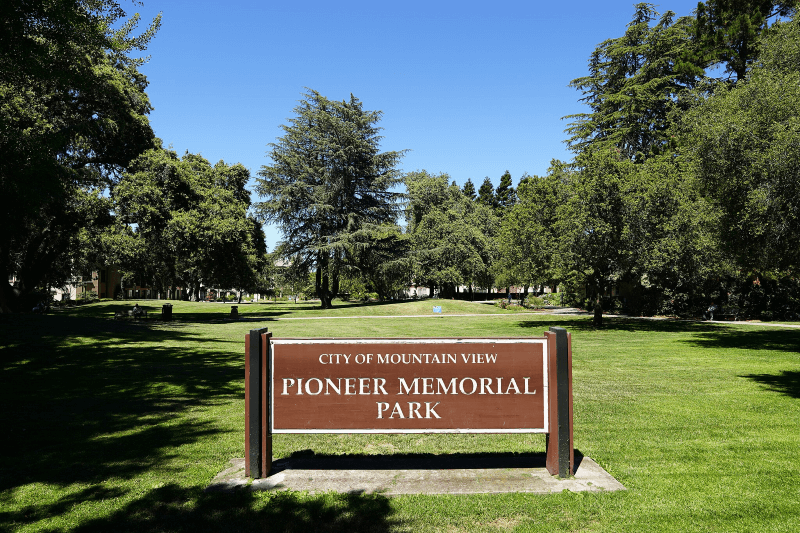
Local tips: Mountain View has a goal to divert 90% of trash from landfills by 2030. According to the most recent data available, the city has so far accomplished a 78% diversion rate.
Weekly curbside compost collection is built into the city’s waste management plan with an option for free food scrap drop-off. The city is also tackling disposable foodware by supplying local businesses with reusable alternatives.
Photo Credit: Steven Baltakatei Sandoval / Wikimedia Commons / CC BY-SA 4.0

Access to Municipal Composting: 1.5 | Rank: 1 (TIE)
Access to Private Composting Programs: 1 | Rank: 21 (TIE)
Number of Local Composting Facilities: 9 | Rank: 1
State Policies: 1 | Rank: 25
Zero-Waste Initiatives: 1 | Rank: 42
Local tips: New York City is currently rolling out its mandatory trash separation program. Are New Yorkers ready to compost? Explore Big Apple insights from our NYC Composting Survey.
Photo Credit: Michał Ludwiczak / Pexels / Pexels License
City Rankings Key Insights
81 cities in our ranking have access to curbside and/or drop-off composting programs implemented by their city. 143 cities in our ranking are home to at least 1 private composting hub and 168 cities are making strides with zero-waste initiatives.
All 117 California cities dominate in the top half of our ranking. Thanks to SB 1383, it is mandatory for local governments in the Golden State to provide organic waste recycling or composting services to all residents and businesses. Cali has a goal of diverting 75% of organic waste statewide by 2025.
Other states leading the way policy-wise are Massachusetts and Connecticut, requiring residents to separate yard trimmings and food waste from their trash. All 8 Connecticut and 13 Massachusetts cities finished in the top half of our ranking. Research shows that mandatory composting has had the most success in Massachusetts.
Many major U.S. cities with city-run composting programs tend not to have much yard space. Residents of cities like Cedar Rapids, Iowa (No. 78), Athens, Georgia (No. 85), and Missoula, Montana (No. 209), enjoy the best of both worlds, with access to municipal and private composting services in addition to ample lawn space for establishing their own compost pile.
Sort through more composting insights below.
City Rankings Methodology
First, we determined the factors (metrics) that are most relevant to rank the Best Cities for Composting. We then assigned a weight to each factor based on its importance and grouped those factors into 5 categories: Infrastructure & Accessibility, Waste Initiatives & Policies, Local Interest, Climate, and Residential Space. The categories, factors, and their weights are listed in the table below.
For each of the 500 biggest U.S. cities, we then gathered data on each factor from the sources listed below the table.
Finally, we calculated scores (out of 100 points) for each city to determine its rank in each factor, each category, and overall. A city’s Overall Score is the average of its scores across all factors and categories. The highest Overall Score ranked “Best” (No. 1) and the lowest “Worst” (No. 500).
Notes:
- It is challenging to capture all the nuances of a successful composting project. We were unable to factor in rates of successful waste diversion, compost contamination, incentives, costs, or community participation rates due to a lack of data.
- Some organic waste facilities use anaerobic digestion to create biofuel and electricity from organics instead of producing compost.
- Weights for “Access to Municipal Composting” were distributed as: 1 point for curbside pick-up services and 0.5 points for drop-off services.
- Weights for “Access to Private Composting” were distributed as: 1 point for curbside pick-up services and 0.5 points for drop-off services.
- Weights for “State Policies” were distributed as: 1 point for regulations requiring separate yard waste collection and 1 point for regulations requiring separate food waste collection.
- The “Worst” among individual factors may not be No. 500 due to ties.
Sources: American Community Gardening Association, Federal Housing Finance Agency, Google Keyword Planner, metroSTOR, National Oceanic and Atmospheric Administration, Sustainable Packaging Coalition, U.S. Composting Council, U.S. Environmental Protection Agency, Waste Dive, WtERT, Zero Waste International Alliance
Final Thoughts: Trash into Treasure
One person’s trash is another one’s treasure — so it’s no surprise that compost is nicknamed “black gold.”
Some U.S. cities are attempting to decrease trash production through zero-waste initiatives and mandatory composting programs.
NYC is unrolling its curbside composting program, with mandatory separation of yard waste, food scraps, and food-soiled paper as an attempt to combat the city’s rat problem. The trial period ends in Spring 2025 when residents who fail to comply will be subject to fines.
We also surveyed NYC residents to see if they’ve started composting and gather their thoughts on the practice.
Food waste is costly for us and our environment. Families spend an average of $1,500 on uneaten food per year. Studies show composting can redirect over 1/3 of your food waste and grass trimmings from landfills.
Composting and recycling can get confusing — every sanitary department and waste management company has its own guidelines for what’s accepted in their facilities. Always check with your local service on how to best dispose of your waste to avoid compost contamination.
Why Separate Organics? 5 Benefits of Avoiding the Dumpster
- Reduces emissions by 34–84%.
- Using compost benefits soil health.
- Compost and mulch help increase erosion control.
- Healthy soil improves water retention.
- Disposing of organic waste at anaerobic digestion facilities creates biofuel and electricity.
You can make a difference no matter where you live. Put a compost bin in your kitchen or garage and start your own compost pile to start producing organic fertilizer to keep your lawn, plants, and soil healthy and thriving.
No backyard? No problem. Community composting may be available in your area.
For more composting tips and information, explore our guides below.
- Composting 101: How to Start Composting
- How to Compost Grass Clippings
- 5 Best Compost Bins of 2024
- Mulching vs. Bagging Grass Clippings
- What is Organic Fertilizer?
- How to Make Your Own Fertilizer at Home
- A Guide to Organic Lawn Fertilizer
With the holiday season here, remember to compost your pumpkins, Christmas tree, and eligible food scraps instead of dumping them in the trash.
Call a local LawnStarter pro to help you set up a spot in your yard for your new compost pile.
Media Resources
Quotes from LawnStarter Editor-in-Chief, Jeff Herman:
- Nearly 2 in 10 (18.23%) respondents making less than $50,000 say they utilize a community garden or composting site.
- 4 in 10 respondents claim they compost daily overall, compared to less than 3 in 10 respondents ages 18 to 24. However, over 1 in 5 of the youngest generation surveyed (18 to 24) attest to composting weekly (55.94%).
- Low-income respondents (earning less than $20,000) are 3.5X more likely to compost at work than those earning over $150,000.
- At 31.34%, folks making over $150,000 are more likely to compost just yard waste.
- Respondents ages 45 to 54 have the biggest preference for using compost on their lawns or around trees (29.07%).
- Respondents ages 18 to 24 had a higher preference (34.27%) for composting yard waste than the other age groups.
- Younger respondents (18 to 24) are over 11X more likely to say they give their compost away compared to folks who are 65 and above.
- Folks ages 18 to 24 are 5X as likely to compost just paper products than people ages 65 and up.
- There’s no doubt that San Francisco (No. 3) is running a successful composting (and recycling) program. However, residents have access to only 1 municipal curbside program, which has been criticized by locals for overcharging residents and creating a monopoly. On top of that, average San Francisco homeowners have the smallest yards for starting their own compost pile at home.
- Minnesota cities — St. Paul (No. 19) and Minneapolis (No. 9) — have the highest local interest in composting out of the cities in our ranking, according to Google searches (population-adjusted). The Twin Cities enjoy curbside and drop-off municipal composting access. Gopher State residents are required to compost their yard trimmings, and Minneapolis has a goal to divert 80% of waste from landfills by 2030.
- Residents of some high-ranking cities with access to composting facilities show low interest in composting, at least according to Google search results, like Jersey City, New Jersey (No. 53), Anchorage, Alaska (No. 84), and San Antonio (No. 56). Meanwhile, several low-ranking cities demonstrate among the highest local interest in composting — such as Woodbury, Minnesota (No. 308), Richmond, Virginia (No. 316), and Westminster, Colorado (No. 478).
- Atlanta (No. 103) and suburb Johns Creek (No. 221) demonstrate high local interest in composting, but lack municipal composting services.
- Don’t Mess With Texas: Austin (No. 34) and San Antonio (No. 56) lead the Lone Star State in our ranking with access to city-run curbside composting services and local private composting businesses. Austin has a goal of reducing waste by 90% by 2040 and San Antonio is aiming to divert 60% of organics and recyclables from landfills by 2025.
- 3 Colorado cities — Denver (No. 72), Boulder (No. 114), and Longmount (No. 148) — land in the top half with municipal composting services. Colorado Springs (No. 457) and Aurora (No. 463) tie with 18 other U.S. cities for having access to privately managed compost hubs offering both pick-up and drop-off services. Composting at home can be more challenging in the Centennial State due to its dry and cold climate.
- Las Vegas (No. 459) falls behind due to a lack of legislation and low local interest, but some are introducing creative composting solutions to manage the city’s casino-driven food waste. One business in the city accepts food scraps to feed over 27,000 livestock. Caesars is implementing AI technology to track and manage kitchen food waste. The city is also launching free composting services.
- Pittsburgh (No. 82) outranks Philadelphia (No. 108) with better access to community gardens and significantly higher local interest in composting.
- Recent legislation is expanding composting services throughout Washington state, with mandatory composting on the horizon for some single-family residents. Municipal codes in Seattle (No. 33) ban residents from trashing compostable and recyclable materials.
- Washington (No. 21) currently offers free food scrap drop-off sites — with plans to divert 80% of waste by 2040. Residents demonstrate high interest in composting.
Main Photo Credit: wavebreak3 / Adobe Stock / License
Related Posts: