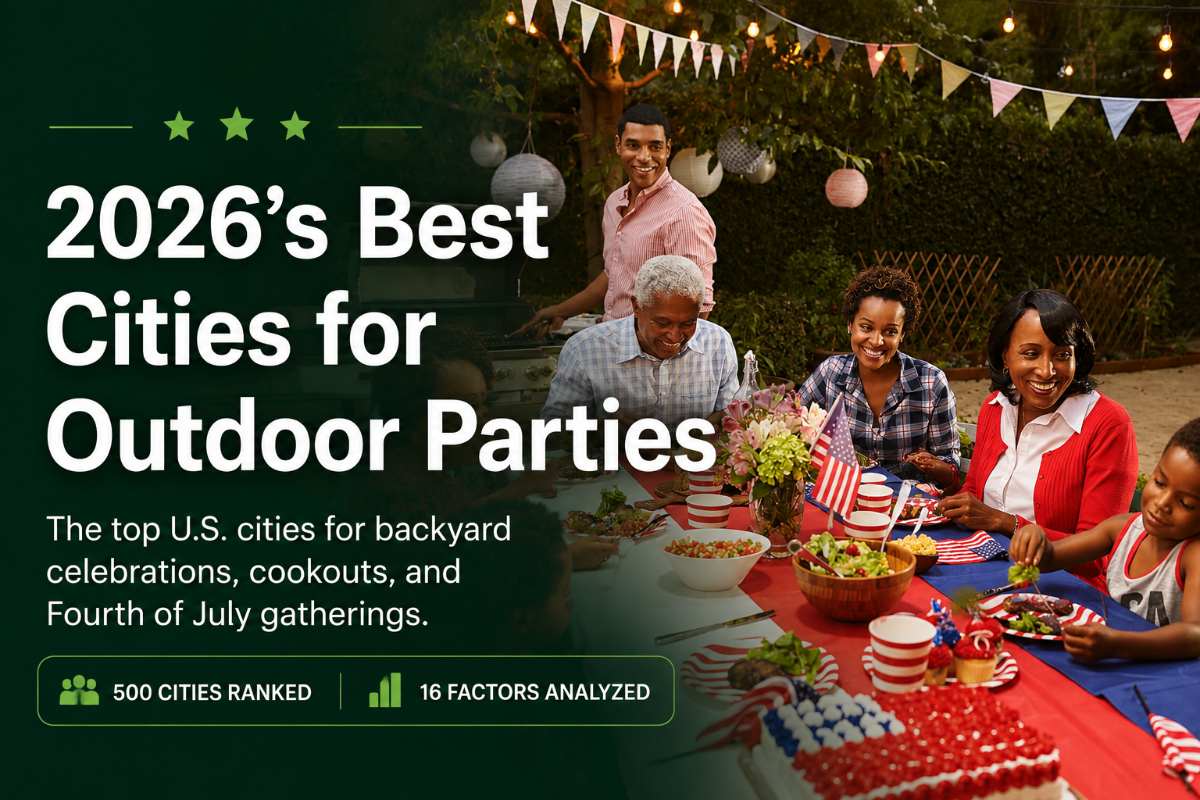
Planning an unforgettable outdoor party for the 4th of July this year? It takes more than just a big backyard.
While we love a spacious green lawn, there is a lot more to consider, like reliable weather, local party resources, and access to parks when space is limited.
To mark America’s 250th birthday, LawnStarter ranked 2026’s Best Cities for Outdoor Parties, comparing the 500 largest U.S. cities across 16 key factors. We looked at yard size, park access, climate, air quality, and the availability of outdoor venues, rental equipment facilities, and party supplies.
Curious where your city landed? Check out the full ranking below, and explore our methodology to see how this party came together.
See the slideshow below for a closer look at the 5 cities that topped our 2026 ranking of the best places to host an outdoor party.
No. 1: New York | Overall Score: 67.72
Number of Outdoor Event Venues: 138 | Rank: 1 Number of Rooftop Restaurants, Bars, and Lounges: 1,132 | Rank: 1 Party Supply Stores: 251 | Rank: 2 Number of Party Equipment Rental Facilities: 512 | Rank: 3 % of Population Within a 10-Minute Walk to a Park: 99% | Rank: 6 (Tie)
Number of Outdoor Event Venues: 105 | Rank: 2 Number of Rooftop Restaurants, Bars, and Lounges: 748 | Rank: 2 Party Supply Stores: 276 | Rank: 1 Number of Party Equipment Rental Facilities: 562 | Rank: 1 Percentage of Land Used for Parks and Recreation: 14% | Rank: 62 (Tie)
Photo Credit: Monkey Business / Adobe Stock / LicenseNo. 3: Chicago | Overall Score: 48.26
Number of Outdoor Event Venues: 93 | Rank: 3 Number of Rooftop Restaurants, Bars, and Lounges: 522 | Rank: 3 Party Supply Stores: 92 | Rank: 6 Number of Party Equipment Rental Facilities: 299 | Rank: 14 % of Population Within a 10-Minute Walk to a Park: 98% | Rank: 13 (Tie)
Photo Credit: vichie81 / Adobe Stock / LicenseNo. 4: San Diego | Overall Score: 44.0
Number of Outdoor Event Venues: 44 | Rank: 6 Number of Rooftop Restaurants, Bars, and Lounges: 473 | Rank: 4 Party Supply Stores: 68 | Rank: 11 (Tie) Number of Party Equipment Rental Facilities: 387 | Rank: 6 Percentage of Land Used for Parks and Recreation: 22% | Rank: 22 (Tie)
Photo Credit: Julius Fekete / Adobe Stock / LicenseNo. 5: Miami | Overall Score: 43.54
Number of Outdoor Event Venues: 47 | Rank: 5 Number of Rooftop Restaurants, Bars, and Lounges: 345 | Rank: 8 Party Supply Stores: 150 | Rank: 3 Number of Party Equipment Rental Facilities: 449 | Rank: 4 % of Population Within a 10-Minute Walk to a Park: 89% | Rank: 62 (Tie)
Skyline views, bustling venues, and plenty of party supply shops show why these top-5 cities are built for outdoor parties.
No. 1 New York
Overall Score: 67.72
Most Rooftop Restaurants, Bars, and Lounges: NYC tops the charts in elevated dining. In a city where square footage is limited and skyline views are prized, rooftops double as social spaces. From 230 Fifth, New York’s largest indoor/outdoor bar, to Westlight in Brooklyn, New Yorkers make the most of their vertical real estate.
Strong Walkable Park Access Despite Urban Density: Yard space is scarce, but New Yorkers enjoy proximity to world-famous parks. Central Park covers 843 acres, while Prospect Park in Brooklyn and Flushing Meadows Corona Park in Queens offer other green escapes, turning a crowded city into a giant outdoor venue.
No. 2. Los Angeles
Overall Score: 58.51
Most Party Supply Stores and Party Rental Facilities: LA topped the charts for both metrics, giving residents unmatched access to everything from balloon arches and themed decor to tents, dance floors, and lighting for events of any size.
2nd-Most Rooftop Restaurants, Bars, and Lounges: Los Angeles shines with rooftop dining spaces, second only to New York. Rooftops here offer panoramic views of the Hollywood Hills, skyscrapers, and sunsets over the Pacific Ocean. Popular spots like Perch’s VIP Rooftop Garden Experience and Gemma (formerly The Rooftop Beverly Hills) draw crowds for cocktails and dining that often feel straight out of a movie.
High Walkable Park Access for Gatherings: Chicago ranks among the best for residents living within walking distance of a park, with Grant Park hosting citywide festivals, Lincoln Park offering lakefront lawns, and neighborhood spaces like Humboldt Park providing room for outdoor parties.
Strong Rooftop Dining Scene: The Windy City sets the stage for rooftop dining and nightlife, with Cindy’s overlooking Millennium Park and LH Rooftop’s tri-level terrace among standout destinations.
No. 4 San Diego
Overall Score: 44.0
4th-Most Rooftop Restaurants, Bars, and Lounges: San Diego’s rooftops pair ocean breezes with skyline views. Popular spots include ALTITUDE Sky Lounge overlooking the San Diego Bay and Petco Park, along with The Rooftop by STK in the Gaslamp Quarter and Kettner Exchange in Little Italy.
“San Diego is truly unmatched when it comes to outdoor celebrations,” says Heather and Christophe, the husband and wife team behind Willmus Weddings. “With year-round sunshine, oceanfront views, and venues that range from chic rooftops downtown to sprawling wineries and coastal estates, the city offers an incredible canvas for hosting memorable weddings. There’s a natural blend here between laid-back California lifestyle and elevated event culture, which makes every celebration feel both effortless and extraordinary.”
3rd-Most Party Supply Stores:Miami’s pool culture starts at home, where backyard pools and patios double as gathering spaces year-round. The city’s abundance of party supply stores makes it easy to stock up for any occasion, whether it is a casual poolside barbecue, themed birthday, or an upscale celebration.
High Number of Party Equipment Rental Facilities: Residents and party planners alike can easily transform any outdoor space into a party venue. Companies like All Miami Party Rental and Soiree Party Rental provide essentials such as cabanas, lounge furniture, and even inflatable slides, alongside tents, lighting, and dance floors.
High Number of Outdoor Event Venues: The year-round warm climate supports a strong lineup of outdoor spaces. Bayfront Park hosts concerts and festivals downtown and provides a rentable outdoor amphitheater. Vizcaya Gardens offers historic courtyards and waterfront lawns for elegant gatherings, while rooftop terraces in Brickell and Wynwood bring a modern backdrop to private parties.
2026 City Rankings
Where would you most like to attend an outdoor party? Check out our ranking to see how each city fared, and find out if your favorite party city makes the cut.
Key Insights
Big-city celebrations at the top: No surprises here, the country’s biggest metros dominate the top 10 stretching from New York (No. 1) to Los Angeles (No. 2) and San Diego (No. 4) and including Chicago (No. 3), Washington, D.C. (No. 6), Boston (No. 8), and Seattle (No. 9). These cities may be crowded, but their scale means endless rooftops, outdoor venues, and public spaces ready to host an outdoor party.
In most of these metros, yard space is limited except in Atlanta (No. 7), where hosts enjoy more breathing room. Boston (No. 8) and San Francisco (No. 10), on the other hand, have walkable access to parks. Boston gets a nod for better air quality and lower grass allergen levels.
Outdoor advantages in the Pacific Northwest: Seattle (No. 9), Redmond (No. 15), and Bellingham (No. 16) in Washington, and Portland (No. 19), cracked the top 20. It might sound surprising considering the region’s gray skies, but the abundance of parks, walkable green spaces, and mild temperatures make up for the drizzle.
Two sides of Virginia: Suffolk (No. 12) boasts massive yards, averaging almost 30,000 square feet, along with sprawling parks. Just north in Alexandria (No. 24), lawns are smaller, but the city leans on urban parks, with dense clusters of rooftop dining, outdoor venues, and party rental shops.
Virginia Beach (No. 78) offers the best of both worlds. Big backyards and easy park access combine with beachfront venues that double as picture-perfect settings for weddings and large gatherings.
Washington, D.C., (No. 6) lacks yard space, but it makes up for it with one of the highest concentrations of outdoor venues and rooftop spaces in the nation, true to its reputation as a foodie hub. Drive a short distance to Frederick, MD (No. 256), and the options shrink.
Sunbelt struggles: Texas and Arizona didn’t shine. Nearly 80% of their ranked cities landed in the bottom half, many of them suburbs like Glendale, AZ (No. 495), Chandler, AZ (No. 494), Pasadena, TX (No. 473), and Irving, TX (No. 470), where smaller yards and limited access to rooftop venues, party supply stores, and rental facilities brought down overall scores.
Together, Texas and Arizona average around 118 extreme heat days each year, leaving long stretches on the calendar less than ideal for outdoor gatherings.
Poolside party scene in Florida: Warm weather, a near year-round pool culture, and abundant sunshine make it easy to imagine backyard barbecues and gatherings almost any weekend. Unfortunately, mosquitoes and love bugs swarming the family cookout could force the outdoor party indoors.
Cities like Jacksonville (No. 17), West Palm Beach (No. 29), North Port (No. 136), and Hollywood (No. 299) rise above some of their Florida neighbors with better park access. Still, outside of Miami (No. 5) and West Palm Beach, most Florida cities come up short on rooftop venues, rental facilities, and party supply stores.
Comfort factors outdoors: The setting can make or break an outdoor gathering. Cities with fewer natural hazards, lighter drought risk, and lower exposure to mosquitoes or grass allergens make the party more pleasurable for hosts and guests.
In Roanoke, VA (No. 135), Lynchburg, VA (No. 166), and Warner Robins, GA (No. 368), outdoor gatherings come with fewer worries about natural disasters. California metros face the opposite challenge. Cities such as Santa Barbara (No. 63), Sacramento (No. 71), and Napa (No. 96) carry higher drought risk, where restrictions can trigger burn bans and complicate hosting.
Comfort shows up in smaller ways, too. Chicago (No. 3) and its suburbs join Spokane, WA (No. 100) and Fargo, ND (No. 138), as places where mosquitoes are less of a nuisance. Grass allergies are not as bad in Fort Myers, FL (No. 244), and Minnesota suburbs like Bloomington (No. 48) and Plymouth (No. 69), as well as Lakewood, CO (No. 88).
💨 Honolulu, HI (No. 11), Bellingham, WA (No. 16), and Santa Rosa, CA (No. 28), reported the best air quality in the ranking.
🌱 The biggest yards belong to Suffolk, VA (No. 12), followed by Murfreesboro, TN (No. 213), Tyler, TX (No. 45), and Santa Fe, NM (No. 225), respectively.
🌴 44% of the land in West Palm Beach, FL (No. 29), is dedicated to parks and recreation. Fremont, CA (No. 44), follows close behind.
🔥 Arizona cities logged the most extremely hot days. The fewest were found in Duluth, MN (No. 105), and across Bay Area cities in California.
Ask the Experts
From backyard barbecues to park picnics and rooftop receptions, outdoor parties are a staple of American social life. These gatherings bring neighbors, families, and friends together, but not every city makes it easy to host them. Access to green space, local rules, and even community investment can shape how and where people celebrate.
We asked a panel of experts what cities can do to better support outdoor gatherings. Read their insights below:
What are three key factors that make a city well-suited for outdoor parties and gatherings?
What role do public spaces, such as parks, beaches, and rooftops, play in supporting outdoor celebrations?
What are the three biggest challenges to organizing outdoor parties in urban areas?
How can local governments and communities encourage more opportunities for safe and vibrant outdoor social gatherings?
Maggie Daniels, PhD
Professor, Tourism and Events Management
George Mason University
What are 3 key factors that make a city well-suited for outdoor parties and gatherings?
The 3 key factors that will elevate a city’s success in hosting outdoor parties and gatherings are established spaces, onsite amenities, and nearby lodging. The lens we are focusing on here is offering events to the public with the financial backing of local governments and sponsors. Event development supports quality of life for residents while also acting as an economic catalyst through tourism.
With the above in mind, the first consideration is space. Based on the scope of the event, this will typically involve permits and potentially also necessitate street closures. Capitalize on space that is already available rather than building costly new infrastructure.
The second “must have” is onsite amenities, including food, beverage, and restrooms. The goal here is to maximize the length of stay at the gathering.
Finally, nearby lodging will encourage overnight stays for tourists. Keeping in mind that lodging is the primary contributor to the economic impact of an event, cities should capitalize on this fact by promoting local lodging alongside the gathering itself.
What role do public spaces, such as parks, beaches, and rooftops, play in supporting outdoor celebrations?
Public spaces such as parks, beaches, and rooftops are ideal sites for outdoor celebrations because rental fees tend to be significantly lower than private spaces, and these areas typically provide an excellent backdrop for marketing and social media beauty shots.
For public spaces that do not readily evoke a “Wow!” response, the event planners should invest in the strategic design of a vantage point using reusable, eye-catching signage with the city logo as a must-have photo opportunity.
What are the three biggest challenges to organizing outdoor parties in urban areas?
The 3 biggest challenges to organizing outdoor parties in urban areas are competition, cost, and transportation. The ideal scenario for an outdoor gathering is that visitors want to return year after year. As such, it is imperative to make the gathering easy to enjoy.
From an organizer’s perspective, urban cores are a competitive jungle of social opportunities, so you must plan well in advance to secure the location and keep it within the same timeframe on an annual basis.
Design and implementation costs are higher in urban settings; therefore, revenues from ticket sales (if applicable), retail goods, and ancillary services must outpace the costs in terms of direct expenditures and tax revenue.
In light of transportation, the provision of off-site parking and associated public transport to the gathering site will simplify the arrival and departure process should the location not be walkable from available parking areas.
How can local governments and communities encourage more opportunities for safe and vibrant outdoor social gatherings?
Increasing the opportunities for and safety of public gatherings comes down to funding.
When you take a close look at the disbursement of a jurisdiction’s general funds, community development tends to receive a very small slice of the pie. For local governments that collect transient occupancy taxes (lodging) and food & beverage taxes (restaurants), a portion of those revenues should be earmarked to support the development of social gatherings and the associated public safety, as the benefits accrued through attendance at these events often circle back to these same hotels and restaurants.
Mitchell J. Silver, FAICP, Hon. ASLA
Principal
Mitchell J. Silver, City Planning and Design Agency, Raleigh, NC
“People may eat and sleep in their homes or apartments, but they thrive in public spaces. Outdoor spaces make our cities livable by providing social gathering spaces where we can connect and experience fun, joy, and happiness.”
What are three key factors that make a city well-suited for outdoor parties and gatherings?
Low barrier to entry — free or low-cost for events and concessions
Accessible by public transit, people of all abilities, and restrooms
Offers a diversity of cultural experiences.
What role do public spaces, such as parks, beaches, and rooftops, play in supporting outdoor celebrations?
Parks and public spaces enhance physical health, nurture mental well-being, enrich cultural life, and connect people.
What are the three biggest challenges to organizing outdoor parties in urban areas?
The permitting process and bureaucracy embedded in approvals.
Liability insurance.
Security and event management.
How can local governments and communities encourage more opportunities for safe and vibrant outdoor social gatherings?
Streamline the permitting process. Have a list of preferred locations for outdoor social gatherings. Make liability insurance affordable. Ensure the events offer a diversity of cultural programming. Have a plan that ensures safety measures are in place for the actual events and for load-in and load-out. Have a one-stop shop for approvals.
Deborah Parker Wong, MSc, DipWSET
Instructor, Wine Studies
San Jose State University, Department of Hospitality, Tourism & Event Management
What are three key factors that make a city well-suited for outdoor parties and gatherings?
Climate. Nothing beats a warm Mediterranean climate for al fresco events. With no humidity, typically no rain during the spring, summer, and early fall months, and very mild temperatures year-round, cities that benefit from these conditions are ideal.
Scale. Smaller cities that are within easy access to major airports. Less noise, less pollution, and less traffic are all factors.
Proximity. Waterfront venues, wine country venues, iconic and scenic view venues, etc., are always a value add.
What role do public spaces, such as parks, beaches, and rooftops, play in supporting outdoor celebrations?
Affordable and accessible public spaces can help alleviate the costs of hosting an al fresco event. For example, San Francisco’s Golden Gate Park has lawns that are free of charge and gorgeous spaces that can be rented for very nominal fees.
What are the three biggest challenges to organizing outdoor parties in urban areas?
Cost. Top-notch outdoor spaces will come at a premium, costing as much or more than indoor venues.
Transportation and parking. Access by public transit to outdoor venues can be limited, and parking can be problematic. With the increased use of ride share, many hosts won’t be as concerned.
Restrictions. There are often restrictions on amplified sound or live music, lights, and decor.
How can local governments and communities encourage more opportunities for safe and vibrant outdoor social gatherings?
Making spaces available for use or rent and keeping costs low.
Simplifying permitting with online applications and payments.
Being flexible about amplified sound.
Dr. Asli Tasci
Professor, Hospitality Management
University of Central Florida
What are three key factors that make a city well-suited for outdoor parties and gatherings?
Cities that excel at outdoor social life typically combine a favorable climate, well-designed infrastructure, and accessible public transportation.
A hospitable climate with moderate temperatures and manageable humidity, coupled with shade availability, invites residents to spend more time outside and reduces event-planning risks.
Equally important is an infrastructure that includes pedestrian-friendly streets, flexible open spaces, reliable lighting, and safety features, all of which support comfort and usability.
Finally, easy transportation access, whether through walkability, bike lanes, or public transit, allows diverse groups of residents and visitors to participate without logistical barriers, fostering social cohesion and vibrant participation.
What role do public spaces, such as parks, beaches, and rooftops, play in supporting outdoor celebrations?
Public spaces act as social stages where community life happens. Parks offer flexible green areas that naturally support picnics, concerts, and festivals; beaches add a recreational and symbolic dimension that encourages relaxation and connection; and rooftops provide elevated gathering points that extend social life into underused vertical space.
Together, these environments create accessible, inclusive platforms where people can engage in leisure, celebrate cultural rituals, and foster community identity. Well-maintained public spaces also signal care, safety, and openness, which are the qualities that encourage frequent and diverse outdoor gatherings.
What are the three biggest challenges to organizing outdoor parties in urban areas?
Urban outdoor events often face challenges related to regulatory complexity, noise and crowd management, and environmental unpredictability.
Permission processes can be lengthy and confusing, especially when multiple agencies oversee public spaces.
Noise constraints, traffic concerns, parking limitations, and crowd-control requirements may further complicate event planning in dense neighborhoods.
Additionally, weather conditions like heat, rain, wind, or storms introduce uncertainty and may require costly contingency plans. These challenges make it crucial for organizers to coordinate closely with local authorities and invest in adaptive planning.
How can local governments and communities encourage more opportunities for safe and vibrant outdoor social gatherings?
Local governments can enhance outdoor social life by streamlining permitting, investing in multipurpose public spaces, and promoting community partnerships.
Simplified and transparent event-approval processes reduce barriers for small businesses, cultural groups, and residents to host gatherings.
Investments in infrastructure, such as shade structures, public seating, restrooms, lighting, and accessible green spaces, expand the city’s capacity to support frequent and diverse events.
Community-driven programming, such as neighborhood festivals and pop-up markets, strengthens social bonds. When governments collaborate with residents and businesses, they create a supportive environment where outdoor gatherings can flourish safely and vibrantly.
Methodology
To rank 2026’s Best Cities for Outdoor Parties, we compared the 500 biggest U.S. cities across 16 metrics. Due to insufficient data, we eliminated Anchorage, Alaska, leaving a final sample size of 499 cities.
Our party metrics covered four big themes:
Outdoor Venues & Infrastructure: We looked beyond the backyard to count spaces made for celebrating outdoors, including rooftop bars, restaurants, lounges, and dedicated event venues.
Outdoor Accessibility: This measures how easily residents can reach open-air spaces to host an outdoor party. We looked at yard size, park area per capita, walkability to parks, and the share of land used for parks and recreation.
Party Supply Resources: Even the best host needs the right party decor. This category captures the number of party supply stores and equipment rental facilities.
Climate & Environmental Comfort: Good weather can make or break an outdoor event. We factored in historical temperature extremes, air quality, mosquito and grass allergen exposure, and risks tied to natural hazards, drought, and home fires.
We assigned each metric a weight based on its impact. The categories, metrics, and weights are listed in the table below.
Each city earned a score out of 100 for every metric, category, and overall. A city’s Overall Score is the average of its score across all metrics. The city with the highest score ranked No. 1 (best), while the city with the lowest score ranked No. 499 (worst).
Notes:
The “Worst” among individual metrics may not be No. 499 due to ties.
Sources: U.S. Federal Housing Finance Agency, ParkServe, National Centers for Environmental Information, U.S. Environmental Protection Agency, Home Fire Risk Map, FEMA, Lawn Love, LawnStarter, tagvenue, PartySlate, Yelp, and Reference USA
Get Your Yard Party-Ready
Public spaces may bring crowds together this July 4th for the nation’s biggest Block Party, celebrating America’s 250th birthday, but the lawn is where the party feels personal.
Hosting outside is your chance to be the real King of the Hill, and it starts with the lawn. Consistent care and final touches make the difference when it is time to host.
Here’s what to focus on when getting your yard party-ready:
Prep the lawn: Keep up with regular mowing, watering, and fertilizing in the months and weeks leading up to any party. A consistent schedule ensures grass is healthy and resilient.
Get your yard party-ready: Mow a day or two before the event and edge along sidewalks or patios so everything feels fresh. Consider foot traffic and whether you want to use temporary surface protection like pallets or outdoor tiles to protect your turf.
Create shade and seating areas: Use patio umbrellas, pergolas, or shade trees to keep guests cool, and arrange lawn furniture for conversational clusters.
Kimberly Magerl is a writer and editor rooted in Illinois, with time spent living in Hawaii and Texas. She has covered lawn care and landscaping for LawnStarter since 2022, bringing an environmental lens to every project. A longtime plant lover, she’s especially passionate about ocean conservation and sustainability.