| Key Takeaways |
|---|
| • Most lawns need 1 to 1.5 inches of water per week in summer, delivered in 2 to 3 sessions rather than daily. • The best time to water is early morning between 4 a.m. and 8 a.m. to reduce evaporation and prevent fungal growth. • Your grass type, soil type, and climate zone determine how often you should water, so use all 3 to build your personal schedule. |
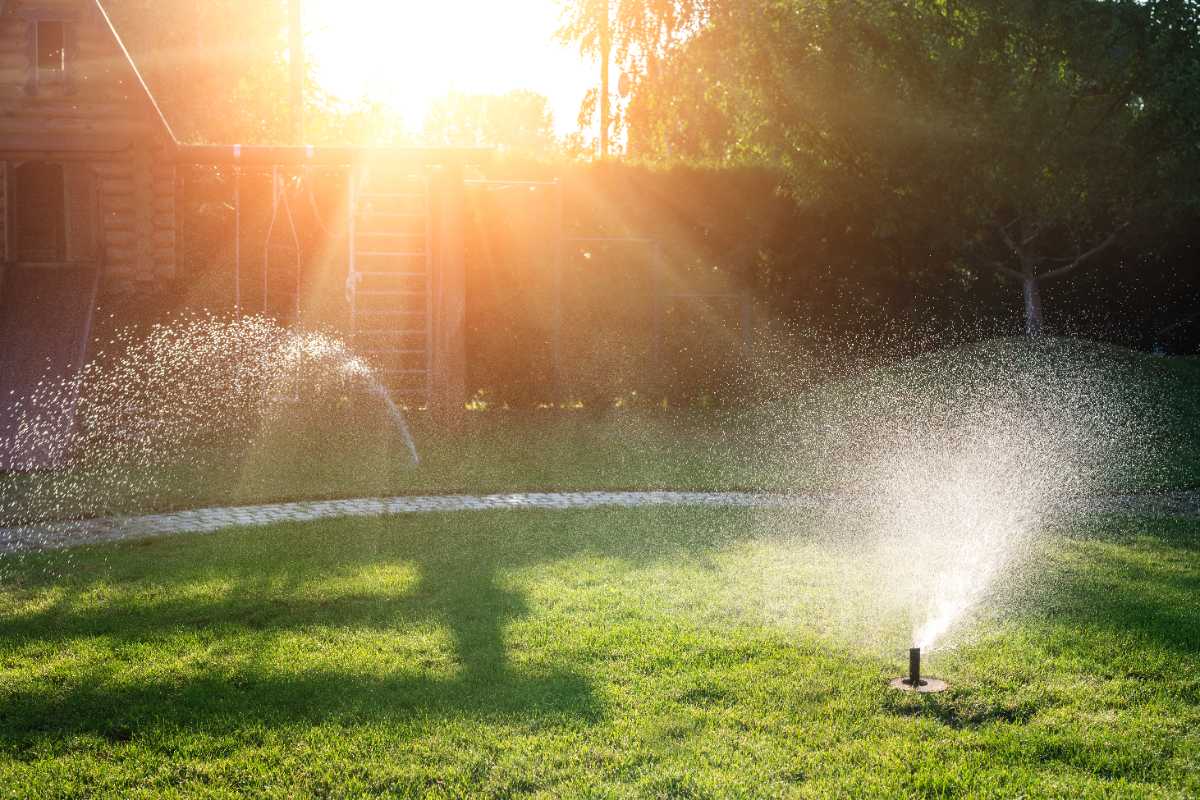
Watering your lawn 2-3 times per week in summer is usually enough.
Figuring out how often to water your grass in summer seems complicated, but it’s easier than you’d think. Once you know your grass type, soil type, and climate zone, building a summer watering schedule takes about 5 minutes.
In addition to consistent watering, consistent mowing also helps your lawn thrive. While you tweak your watering schedule, let one of LawnStarter’s mowing pros handle weekly or biweekly mowing to keep your lawn looking sharp all summer.
How Much Water Does Your Lawn Need Each Week?
Summer Lawn Watering Schedule
Your Personalized Watering Schedule
💡 Important Tips:
- Best time to water: Early morning (4 AM – 8 AM) to reduce evaporation
- Check the weather: Reduce watering after rainfall
- Monitor your lawn: Adjust based on grass appearance and soil moisture
- Deep watering: Less frequent, deeper watering is better than daily shallow watering
Your turfgrass needs 1 to 1.5 inches of water per week during summer, including rainfall. This weekly target applies to nearly all established lawns. Grass type, soil, and climate determine how you divide it up.
“Lawns technically only need watering 2 to 3 times a week, even in the summer,” says Scott Culala of the Lawn Cypress in Gardner, Kansas. “I just wish people knew not to overwater.”
What applies to every lawn is the need to follow the deep-and-infrequent watering rule rather than watering daily. This way of watering the lawn encourages deeper roots, making your grass more drought-tolerant and resilient against summer heat.
| Watering Method | Frequency | Result |
| Deep and infrequent | 2-3 times per week | Deep roots, drought-tolerant lawn |
| Shallow and daily | Every day | Shallow roots, weak lawn |
How Long to Run Your Sprinklers
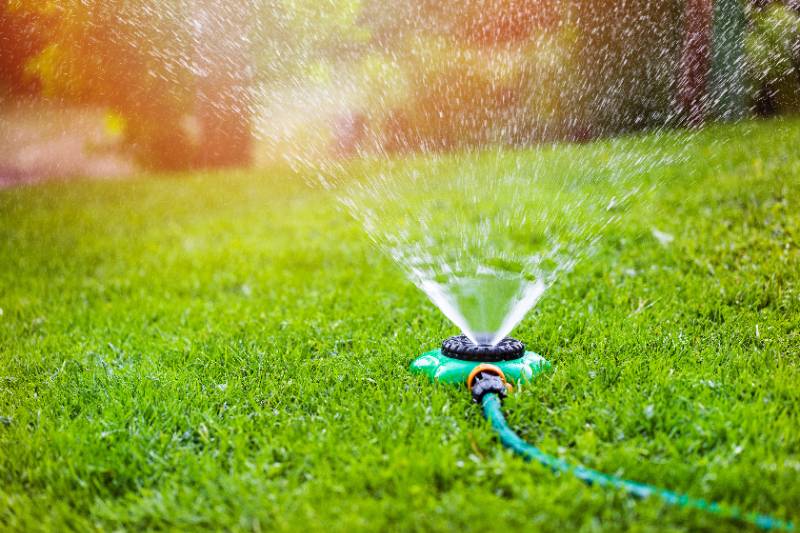
Different types of sprinklers apply water at different rates, with output ranging from 0.5 to 2 inches per hour. Most homeowners with conventional spray heads land in the 20- to 30-minute range, but rotor systems take longer.
You can check your sprinklers’ rate and estimate the right running time using the tuna can test:
Place at least 3 empty tuna cans around your yard.
Run your sprinklers for 15 minutes.
Measure the water depth in each can and average the results.
If you collect 0.25 inches in 15 minutes, run your sprinklers for 30 minutes per session to deliver 0.5 inches.
When to Water Your Lawn in Summer
Water your lawn in the early morning, between 4 a.m. and 8 a.m., according to Cornell’s College of Agriculture and Life Sciences.
Avoid watering midday. The sun evaporates moisture before roots can absorb it.
Skip evening watering too: Wet grass overnight invites fungal disease that can be costly to treat.
Not sure if your lawn is thirsty? Use these 3 quick checks:
The footprint test: Walk across your lawn. If footprints stay depressed for more than a few seconds, your grass needs water.
The color test: A blue-gray tinge or dull olive tone means the grass is stressed.
The blade test: Grass blades that fold or curl lengthwise are trying to conserve moisture. Water within the day.
See Related: Best Time to Water Your Grass
Watering Frequency by Grass Type

More water isn’t better. Many homeowners overwater, says Sushant Mehan, assistant professor at South Dakota State University, causing soggy soil and surface pooling.
Cool-season grasses like Kentucky bluegrass often go dormant in summer heat. That’s normal, and more water won’t always stop it. Warm-season grasses like Bermudagrass are drought-tolerant and don’t need daily soaking.
| Grass Type | Frequency | Amount Per Session |
| Cool-season | 2-3 times per week | 0.5 inch |
| Warm-season | 1-2 times per week | 0.75-1 inches |
Cool-Season Grass (Northern Regions)
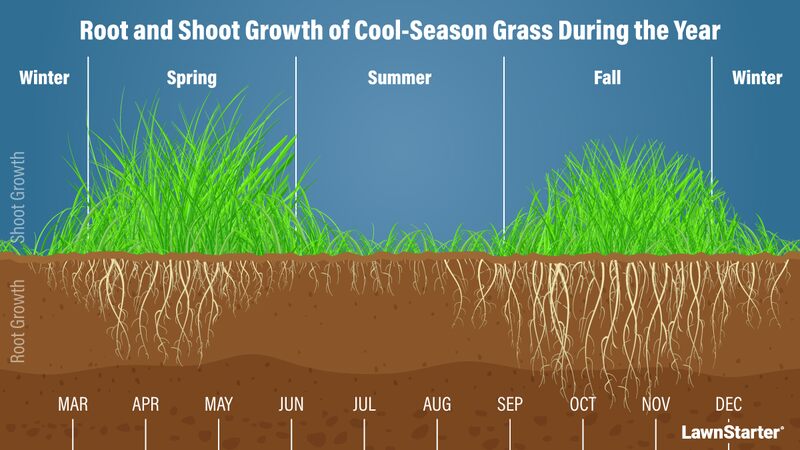
Cool-season grasses like tall fescue, Kentucky bluegrass, and perennial ryegrass need more water during summer while they’re still growing.
| Watering for Cool-Season Grasses |
| Frequency: 2-3 times per week Amount: 0.5 inches per session Weekly Total: 1-1.5 inches |
Warm-Season Grass (Southern Regions)
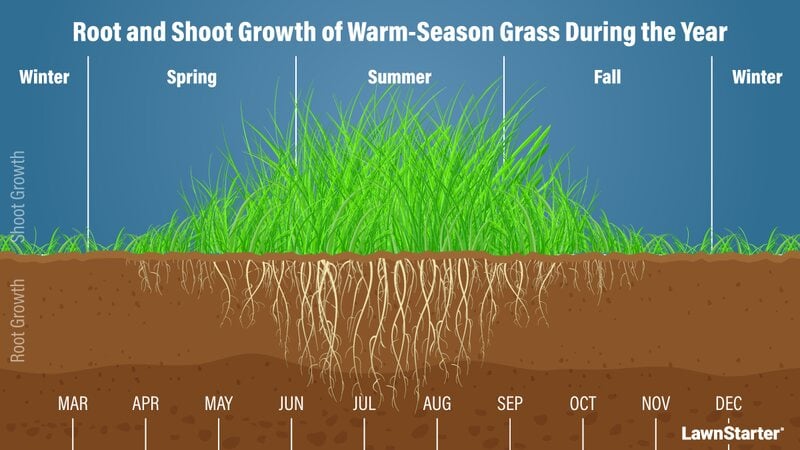
Warm-season grasses such as Bermudagrass, Zoysiagrass, and St. Augustinegrass reach peak growth in summer. These drought-tolerant grasses thrive in heat and are better adapted to handle drought.
| Watering for Warm-Season Grasses |
| Frequency: 1-2 times per week Amount: 0.75-1 inch per session Weekly Total: 1-1.5 inches |
Adjusting Water Frequency by Soil Type
Your soil type determines how long water stays in your lawn’s root zone. According to Mehan, watering based on soil conditions can stabilize soil moisture levels, preventing drought conditions.
| Soil Type | Frequency | Amount Per Session |
| Sandy | 3-4 times per week | about 1/3 inch |
| Clay | 1-2 times per week | about 1 inch |
| Loamy | 2-3 times per week | 0.5 inch |
See Related: How to Test Soil Moisture
Sandy Soil: Water 3 to 4 Times Per Week
Sandy soil has loose particles that allow water to drain rapidly. Because water doesn’t stay in the root zone long, you’ll need more frequent, shallow watering.
| Watering for Sandy Soil |
| Frequency: 3-4 times per week |
| Amount: 0.3-0.4 inches per session |
| Weekly Total: 1-1.5 inches |
See Related: How to Amend Sandy Soil
Clay Soil: Water 1 to 2 Times Per Week
Clay soil retains moisture longer but absorbs water slowly, making it prone to surface runoff and standing water. For clay soils, use the cycle-and-soak method: Divide each watering session into shorter cycles of 10-13 minutes with 30- to 60-minute breaks.
| Watering for Clay Soil |
| Frequency: 1-2 times per week (cycle-and-soak method) |
| Amount: 0.75-1 inch per session |
| Weekly Total: 1-1.5 inches |
Loamy Soil: Water 2 to 3 Times Per Week
With a balanced mix of sand, silt, and clay, loam soil offers good drainage and adequate moisture retention. It’s more forgiving if you miss a session.
| Watering for Loamy Soil |
| Frequency: 2-3 times per week |
| Amount: 0.5 inches per session |
| Weekly Total: 1-1.5 inches |
Summer Watering Frequency by Climate Zone
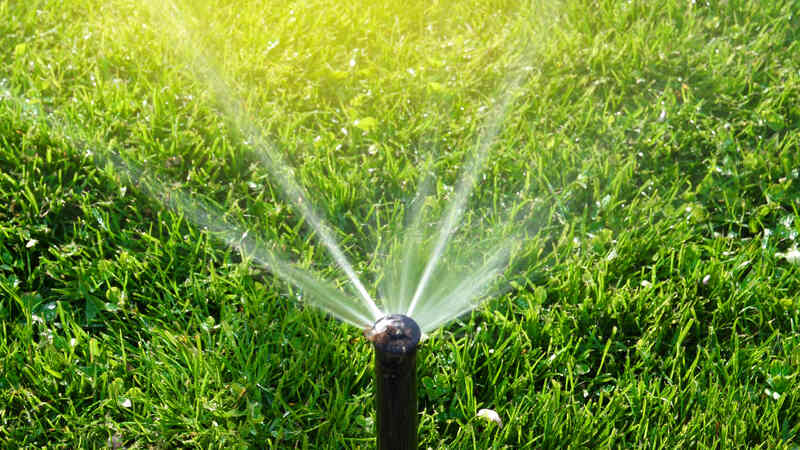
Local climate is another key factor. Lawns in hot, arid areas will require more frequent watering during summer than those in regions with milder, wetter summers.
| Climate Zone | Frequency | Amount Per Session |
| Hot and arid | 2-3 times per week | 0.4-0.5 inches |
| Hot and humid | 2-3 times per week | 0.5 inch |
| Moderate summer | 1-2 times per week | 0.5-0.75 inches |
Hot, Arid Regions (Southwest, Southern California)
Lawns in hot, dry climates like Nevada and inland Southern California face intense sun with very low humidity and rely mostly on irrigation.
However, if you’re in Arizona or New Mexico, the summer monsoon (mid-June through September) changes the math. Storms are too spotty to count on, but when one drops 1/2 inch or more, skip your next watering.
| Watering for Hot and Arid Regions |
| Frequency: 2-3 times per week Amount: 0.4-0.5 inches per session Weekly Total: 1-1.5 inches |
See Related: How to Care for Your Summer Grass in Arizona
Hot, Humid Regions (Southeast, Gulf Coast)
Florida, Georgia, and the Southeast experience high temperatures, humidity, and frequent afternoon storms. This moisture-heavy environment slows evaporation and naturally meets some of your lawn’s watering needs.
| Watering for Hot and Humid Regions |
| Frequency: 2-3 times per week (when it’s not raining) Amount: 0.5 inches per session Weekly Total: 1-1.5 inches |
See Related: Lawn Watering Tips for Florida
Moderate Summer Regions (Pacific Northwest, Northeast)
Regions like Washington, Oregon, and New York enjoy milder summer temperatures. Lawns here typically don’t face extreme heat stress, making watering more manageable.
| Watering for Moderate Summer Regions |
| Frequency: 1-2 times per week Amount: 0.5 – 0.75 inches per session Weekly Total: 1-1.5 inches |
Special Situations That Change Your Watering Routine

New lawns, dormant grass, and heat waves all play by different rules.
New Lawns
New lawns need different care in the first 2 to 3 weeks:
New seed: Keep the surface slightly moist to support germination
New sod: Water more deeply but still frequently to help roots bond with the soil
Follow grass-specific timing for best results.
| Watering for New Lawns (First 2 to 3 Weeks) |
| Frequency: 2-3 times per day (seeded); 1-2 times per day (sod) Amount per session: 0.1-0.25 inches (seeded); 0.25 inch (sod) Weekly Total: 1.5-5.25 inches (seeded); 1.75-3.5 inches (sod) |
Note: After the first 2 to 3 weeks, reduce watering to 1 to 2 times per day for seeded lawns and once every other day for new sod lawns.
See Related:
Dormant Lawns
“It’s OK if your yard goes dormant; it’s not killing it. It’s a normal, natural process,” says Justin Stultz, owner of Wildflower Lawn Care, in Hutto, Texas.
Dormant grass doesn’t need frequent watering, but it shouldn’t be ignored. If your lawn enters dormancy, Michigan State University recommends providing 0.5 inches of water every 2 to 3 weeks to keep the crown hydrated.
| Watering for Dormant Lawns |
| Frequency: Once every 2-3 weeks Amount: 0.5 inch per session Weekly Total: Not needed weekly; occasional deep soak |
Note: Water just enough to keep the roots alive without encouraging new growth.
During Heat Waves (95 Degrees and Up)
Even the healthiest lawns struggle when temperatures hit the mid-90s. Water deeply and more frequently to help your grass resist stress. Look for the same warning signs mentioned earlier in this article.
| Watering During Heat Waves |
| Frequency: 3-4 times per week Amount: 0.4 inches per session Weekly Total: 1.2-1.6 inches |
Alternative: If your grass can’t handle the heat, consider replacing it with drought-tolerant ground covers that can survive scorching summers.
FAQs
Watch for persistently soggy areas, standing water, a spongy feel underfoot, or mushrooms and algae on the soil surface. You may also notice thinning grass and more weeds. If these signs appear, reduce your watering days and confirm the output with the tuna can test.
Yes. Sunny spots dry out faster and need more water, while shady areas need less water to avoid fungal problems caused by poor evaporation.
Water early in the morning with deeper soakings per session to encourage deep root growth. Mow higher and mulch clippings to reduce water loss. You can also consider a subsurface drip irrigation system. Drip is often exempt from day-of-week rules, but check local restrictions before investing.
Work on Your Tan, Not Your Lawn
With a watering schedule tailored to your grass, soil type, and climate, your lawn can thrive in the heat. But it will still require extra care, such as weekly mowing.
If you’d rather spend time on the beach, get an instant quote from LawnStarter and hand over the mowing to a local lawn mowing pro who knows exactly what your grass needs.
Main Image: Lawn sprinkler watering grass in a lawn. Photo Credit: Kirill Gorlov / Adobe Stock
Related Posts: