| Key Takeaways: |
|---|
| ● One-time catch-up costs (grub treatment, soil correction, dethatching, aeration) should be categorized separately from the recurring lawn care budget. ● Recurring lawn care costs run roughly $100-$410 per month depending on the service and your lawn size. ● A realistic first-year budget combines one-time costs with 12 months of recurring lawn care costs, not just one or the other. |

You just bought a home, and now you’re wondering how much to budget for lawn care expenses. A new homeowner’s lawn care budget for the first year looks different from what a long-time homeowner spends on annual lawn care.
As a new homeowner, you’re likely facing catch-up costs from whatever issues the previous owner left behind in addition to the recurring costs of regular upkeep. Separating the 2 lawn care costs is the key to accurately budgeting instead of guessing.
Our guide combines the one-time costs for the services a new lawn might need along with the recurring costs of regular maintenance to help you build a realistic first-year budget.
If you’d rather skip the math, get an instant lawn care quote for both catch-up work and ongoing service from LawnStarter.
What a New Homeowner’s Lawn Care Budget Actually Covers
A new homeowner’s lawn care budget has 2 separate parts:
- One-time catch-up costs for whatever lawn conditions you inherited
- Recurring costs for regular upkeep going forward
Most cost guides cover only the second part. If you haven’t already assessed your yard’s grass type, soil, and condition, start there. Our guide on how to assess a lawn tells you which catch-up costs actually apply to your lawn.
One-Time Catch-Up Costs You Might Not Have Budgeted For
If your assessment turned up grubs, thatch, compacted soil, or an off-balance pH, expect one or more one-time treatments before your lawn returns to a normal maintenance schedule.
“New homeowners are often surprised by the smaller lawn costs that start adding up after they move in,” says Loren Taylor, owner of Outdoor Fountain Pros in Camas, Washington.
“You may also discover that the soil needs compost or topsoil, or that part of the yard needs better drainage. If you plan to handle the lawn yourself, tools can be another big expense.”
Note: The costs below are for professional services. If you DIY, you have only the material or equipment costs to pay.
- Grub treatment: Cost varies by infestation severity and lawn size. Confirm you’re seeing signs of grubs (instead of drought stress or a lawn disease) before committing to pay for treatment.
- Dethatching: Expect dethatching costs to be around $65 to $165 for a professional visit.
- Aeration: Aeration is often better bundled with dethatching or overseeding for a lower combined price, rather than booking it separately. Lawn aeration typically costs $107-$202.
- Correcting soil pH: Informed directly by your soil test report. A severe imbalance may require repeat lime or sulfur treatments over 1-2 seasons. Costs vary.
- Overseeding or sodding: “The most common problem I see in recently sold homes is thin, patchy grass with weeds and bare spots,” Taylor says. Costs depend on how much of the lawn needs to be replaced. A lawn that has been neglected for years can easily run well into 4 figures for a full renovation. The cost to seed a lawn usually ranges from $427 to $1,514. Installing sod typically costs $0.60 to $1.65 per square foot, depending on whether you DIY or hire a pro.
“One thing I have seen homeowners discover is that certain parts of a lawn were being kept alive through temporary fixes rather than proper maintenance,” says Lisa Martinez, CEO and founder of TX Cash Home Buyers in Houston, Texas.
“You might find areas that have recurring weeds, poor drainage, compacted soil, or grass that never really grows properly.”
Recurring Costs: What Ongoing Lawn Care Costs
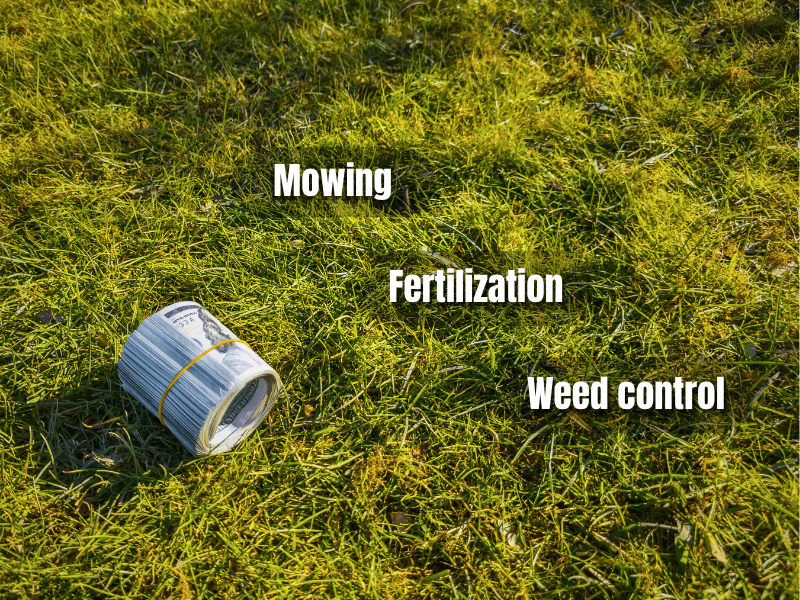
Once your catch-up work is done, you need to establish a plan for recurring lawn care, including jobs such as mowing, fertilization, and weed control.
“Lawn care should be treated like home maintenance rather than a cosmetic expense,” Martinez says.
Recurring lawn care services typically cost $100 to $410 per month depending on your lawn size and which services you use.
Here’s a price breakdown by service type:
- Mowing costs $43 to $70 per visit for an average-sized lawn.
- Fertilization costs $67 to $405 per treatment.
- Weed control costs $50 to $210 per treatment, depending on factors like lawn size and the method used.
Your Realistic Year 1 Lawn Care Budget
To estimate the cost of your first year’s lawn care, add your one-time catch-up costs to 12 months of recurring service.
- Recurring lawn care costs alone, at $100 to $410 per month, come out to roughly $1,200 to $4,920 for the year.
- Catch-up costs add anywhere from a few hundred dollars (dethatching and minor soil correction) to several thousand (a full renovation for a severely neglected lawn).
“The mistake many first-time homeowners make is budgeting for maintaining the lawn they think they bought rather than budgeting for the lawn they actually inherited,” Martinez says.
How to budget in the first year: Plan for approximately $1,200 to $5,000 to cover 12 months of recurring service, plus add the expenses for one-time lawn services for whatever catch-up work your yard needs. This is a wide range because catch-up needs vary so much from yard to yard.
The single biggest variable in your budget isn’t the cost for recurring services, but how much catch-up work your new yard needs. That’s exactly what your walk-through and lawn assessment should tell you before you commit to paying for lawn care services to resolve the issues in your lawn.
DIY or Hire? How That Decision Changes Your Budget
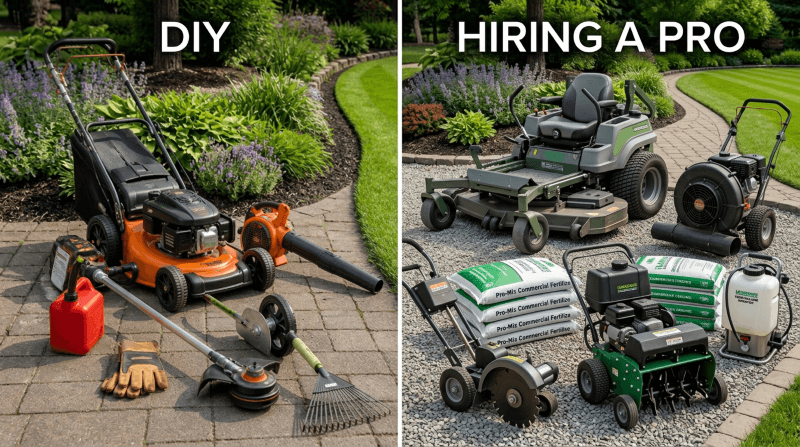
To decide whether you should handle lawn maintenance yourself or hand off the job to a local provider, here are the factors to consider in your decision:
Hire a Lawn Care Provider
Hiring costs more per visit but requires no upfront equipment purchase. It also saves you time, which can be beneficial when you are still moving in. However, it costs $43-$70 per mow for most yards.
“Once a lawn reaches around a quarter acre, or has major drainage, irrigation, grading, or sod problems, I usually suggest getting professional help. Slopes and complicated planting areas can also make the job much harder than it first appears,” Taylor says.
Handle Lawn Care Jobs Yourself
DIY costs less per mow (or per task) but requires buying tools and equipment first. A new mower can be purchased for under $300, so for small, flat lawns with long growing seasons, the cost of a mower and other basic equipment may be cheaper than hiring mowing help for the entire season.
“A mower, trimmer, blower, hoses, and a spreader can quickly turn into a serious first-year cost,” Taylor says. But “for smaller, fairly healthy lawns, doing the work yourself can make sense, especially if you enjoy being outside.”
Run a cost-benefit analysis to weigh the costs of a new mower and equipment upkeep against hiring a provider.
See Related: Lawn Care Tools Every New Homeowner Needs
Combine DIY with Hiring Out the Work
There’s no need to stick completely to either a DIY plan or to resolve to hire out every lawn care job. Instead, you can do both, by handling the easier tasks yourself and hiring out the more challenging or time-consuming jobs to a pro.
“I would take a hybrid approach,” Martinez says. “There is no reason to pay someone every time the grass needs mowing or edging if you have the time and don’t mind doing it yourself. Where I would spend the money is on jobs where a mistake can become expensive, such as irrigation repairs, drainage work, tree removal, grading, or significant pest problems.”
We break down how to weigh time, physical ability, and yard condition in Just Moved In? A New Homeowner’s Guide to DIY Lawn Care or Hiring a Pro.
How to Prioritize Spending in Your First Year
If money is tight right after closing costs and moving expenses, prioritize your spending to deal with the most pressing lawn issues rather than tackling everything at once.
Start by assessing your lawn, then write out the list of issues that need to be addressed. Once you have a list, you can determine how to prioritize lawn care tasks:
- Priority 1: Do right away. Don’t hold off on dealing with anything actively harming the lawn, such as a confirmed grub infestation or soil compaction severe enough to block water and nutrients to your grass.
- Priority 2: Handle sometime this season: Correcting soil pH and dethatching are not usually urgent, but do eventually require attention. These set up everything else (fertilizer, seed, water) to work.
- Priority 3: It can wait: Cosmetic overseeding, non-essential upgrades, and anything that’s annoying but not actively damaging the lawn.
FAQ
It depends. DIY lawn care gives you long-term savings, but the upfront cost can be high. Lawn mower prices vary depending on the mower type:
• Reel mower: $129 on average
• Rotary mower: $110-$6,000
• Push mower: $130-$800
• Self-propelled lawn mower: $330-$2,000
On the other hand, hiring a lawn care provider costs $43-$70 per mow, which saves you time and means you avoid high upfront costs.
Lawn care prices vary depending on the region, yard size, and other factors, but our guide to lawn care costs provides a quick overview of the different price ranges by service.
If you’re interested in exact pricing for your yard, get an instant quote from LawnStarter.
Hire a Local Lawn Care Pro
Getting your lawn care budget right takes practice, the right equipment, and time – all things you may not have as you’re moving into your new home.
If you’d rather leave it to someone who does this every day, LawnStarter makes it simple: Get an instant quote for services like mowing, leaf removal, bush trimming, and many other lawn care services. Sign up, choose a time, and a background-checked local pro will handle the rest.
Get a free estimate near you →
Sources:
Lisa Martinez, CEO and founder of TX Cash Home Buyers in Houston, TX. Personal interview.
Loren Taylor, owner of Outdoor Fountain Pros in Camas, WA. Personal interview.
Main Image: A spacious house with a brick exterior and well-kept lawn. Photo Credit: WavebreakMediaMicro / Adobe Stock
Related Posts: