Keeping a lawn green through summer can feel like a losing battle, but the fix often comes down to timing. The best time to water your lawn in hot weather is between 5 a.m. and 9 a.m.
Morning wins every time, no matter your grass type or location. While summer heat makes timing especially critical, the same principles apply year-round: Water early, water deeply, and let the soil dry between sessions.
This guide covers how much to water, how often to water, and which factors to consider for your yard. And if the full routine feels like too much to manage on your own, LawnStarter’s local pros can help with lawn mowing services and more.
| Key Takeaways |
|---|
| • The best time to water your lawn is between 5 a.m. and 9 a.m., when evaporation is low, and the sun is just rising. • Most lawns need 1 to 1.5 inches of water per week, delivered in deep, infrequent sessions. • Watering in the evening is risky because wet grass overnight invites fungal disease. |
The Best Time to Water Your Lawn
Water your lawn between 5 a.m. and 9 a.m. That’s the single best answer, regardless of your grass type, climate, or sprinkler setup.
This early-morning window keeps evaporation low, lets water reach the roots before the sun peeks out, and gives wet grass blades time to dry before nightfall, reducing the risk of fungal lawn diseases.
See Related: Common Lawn Diseases and How to Identify Them
Morning vs. Evening: Which Is Better?
| Morning (5–9 a.m.) | Evening (after 6 p.m.) | |
| Evaporation | Low: Water soaks in efficiently | Low: Water has time to soak in, but the grass stays wet overnight |
| Disease risk | Low: Blades dry before nightfall | High: Damp foliage invites fungus |
| Root penetration | Deep: Cool, calm conditions help | Adequate, but offset by disease risk |
| Verdict | Best choice | Use only as a last resort |
If evening is your only option:
Start as early as possible to give the grass blades time to dry before nightfall.
Water deeply and less frequently to reduce the number of irrigation nights per week.
Install an automatic irrigation timer and set it up to water right before dawn.
See Related: Types of Sprinklers for Your Lawn and Garden
When Not to Water Your Lawn
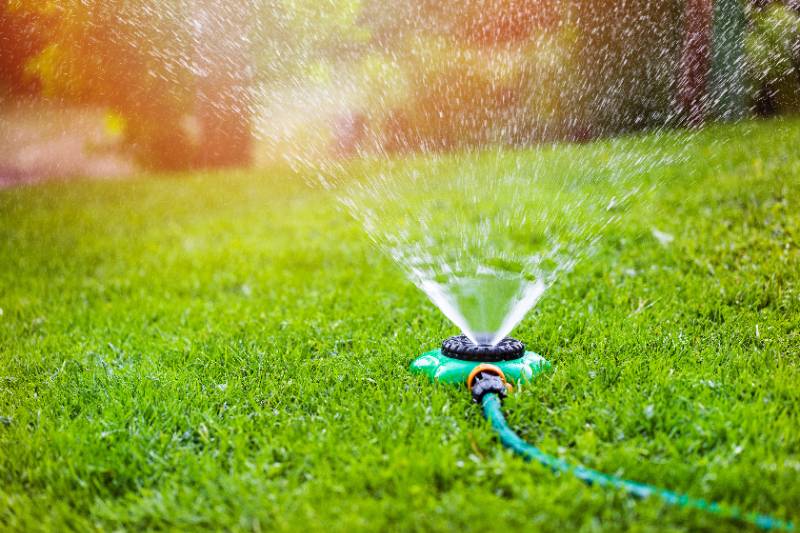
10 a.m. to 4 p.m.: Midday heat causes rapid evaporation before water reaches the roots.
Late evening (after 6 p.m.): Grass stays wet overnight, creating ideal conditions for fungal diseases.
Right after heavy rain: Pause your irrigation schedule and let the soil dry out before resuming.
Why Timing Matters
Water at the wrong time, and you might as well leave the sprinklers on.
According to the U.S. Environmental Protection Agency (EPA), homeowners use 30% to 70% of their water outdoors. About 50% of that outdoor water is lost to evaporation, wind, or runoff.
Watering at the right time keeps that wasted water and money in your pocket. Correct timing also helps prevent diseases and reduces pest pressure.
How Much Water Does Your Lawn Need?
Most lawns need between 1 and 1.5 inches of water per week, from irrigation, rainfall, or both.
In extremely hot weather, you can bump that up to 2 inches per week, depending on your grass type and soil conditions.
How to know if you’re hitting the mark: Place empty tuna cans around your lawn, run your sprinklers for 30 minutes, then measure the water depth with a ruler. That’s your system’s output rate.
Chuck Vogt, owner of Metro Lawns and a LawnStarter pro in Atlanta, recommends the same method for measuring how many inches of rain your lawn receives. It’s a good strategy to avoid overwatering during rainy weeks.
See Related: How Long to Water Your Lawn in Summer
How Often Should You Water Your Lawn?
If there is no rain, water your grass 1 to 3 times per week for about 30 minutes each session.
Grasses in drought-prone areas may even need watering more often, but this varies from situation to situation. Water your lawn until it looks fresh again and bounces back when you step on it. In case of rainfall, you can stop altogether and start back up in a few days as needed.
The golden rule: Water deeply, not often. Longer, less frequent sessions push roots deeper into the soil where moisture stays cooler and more stable. Frequent shallow sessions grow shallow roots that burn out at the first sign of drought.
Research shows that light, frequent irrigation predisposes turfgrass to disease problems.
Eric DeBoer, assistant professor of turfgrass management at Louisiana State University in Baton Rouge, says the most important idea to keep in mind about summer watering is, “Deep and occasional beats shallow and daily.”
Factors That Affect How You Water
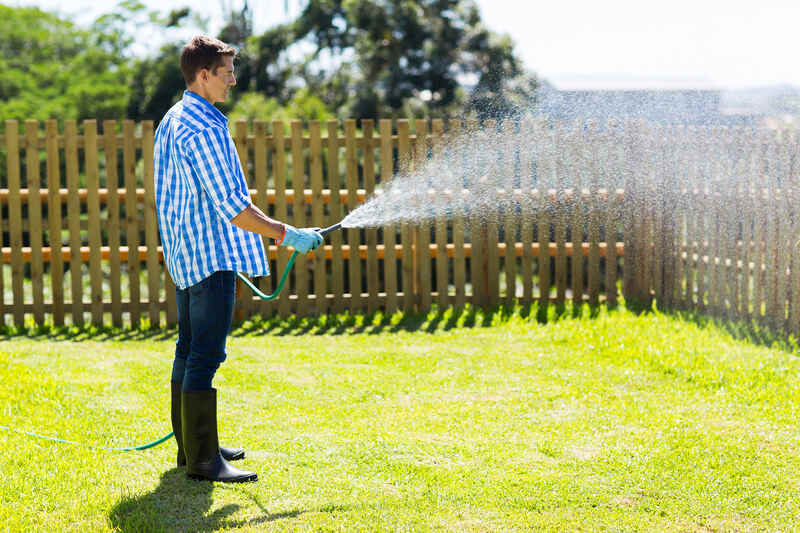
Several factors influence how you should adjust your watering routine. Here are the main ones to consider for your yard.
Your Soil Type
Your soil type controls how fast water drains. If you’re watering with the wrong timing for your soil, you’re either drowning your roots or letting water run straight past them.
| Soil Type | Characteristics | Watering Schedule |
| Clay | Holds water well; slow absorption and slow drainage | 1 inch weekly in cycles of 5 to 10 minutes on and 30 to 60 minutes off |
| Sandy | Drains very quickly; amend sandy soil for better retention | 1 to 1.5 inches per week; 2 to 3 times per week with ⅓ to ½ inch of water per session |
| Silty | Moderate drainage; prone to erosion | ½ inch of water, twice per week |
| Loamy | Balanced drainage and retention | 1 inch of water, once per week |
Pro Tip: To check your soil’s moisture, press the tip of a screwdriver into the ground. It should easily penetrate the top 6 inches of soil. If it doesn’t, the soil is dry, and it’s time to water.
Your Grass Type
The same amount of water does not apply to every grass type. Research how much water your variety needs and stick to that schedule.
| Grass Category | Water Needed Per Week | Common Varieties |
| Warm-season | 1 to 1.5 inch | Bermudagrass, bahiagrass, Zoysiagrass, buffalograss, St. Augustinegrass |
| Cool-season | 1 to 2 inches | tall fescue, Kentucky bluegrass |
Warm-season grasses are better equipped to handle heat and need up to 25% less water than cool-season grasses in the same weather conditions.
Warm-season grasses thrive between 75 and 90 degrees and grow most from late spring through early fall. Your warm-season grass should receive 1 to 1.5 inches of water per week during summer.
Cool-season grasses prefer 60 to 75 degrees and are sensitive to drought. Give cool-season grasses 1 to 2 inches per week. If that’s not possible during extreme heat, most cool-season grasses will go dormant until conditions improve.
Your Sprinkler System
Not all sprinkler heads deliver the same amount of water per hour. Pop-up heads deliver more water in less time, while rotor heads deliver a slower flow and take longer to provide the same amount of water.
| Sprinkler Head Type | Inches per Hour |
| Pop-up heads | 1.5 inches per hour |
| Rotor heads | 1/4 to 3/4 inches per hour |
Source: Colorado State University
Broken sprinkler heads and clogged pipes can also affect how you water the lawn during summer. Running a sprinkler audit helps ensure your system is working at its best. Check the following:
Nozzle condition: Nozzles and heads are in excellent condition and distribute water evenly across the grass.
Water pressure: Calibrate to your lawn’s needs and soil type. Too much leads to waterlogging; too little causes dry patches and dead spots.
Leak check: No leaks are present that could waste water or oversaturate parts of your lawn.
You can save water and avoid watering mistakes with smart irrigation systems. According to the U.S. Department of Energy, smart irrigation controllers can achieve water savings of 20% to 50% compared to traditional timer-based systems.
Common Lawn Watering Mistakes
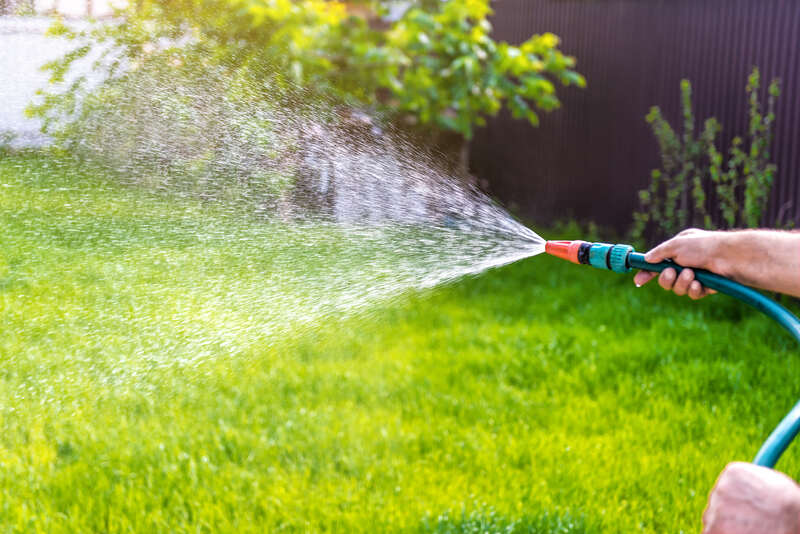
Most lawn problems that look like disease or drought stress are actually watering mistakes in disguise. The 2 most common extremes, too much or too little, are easy to diagnose once you know the signs.
Underwatering Your Lawn
Here are the key indicators your lawn is not getting enough water:
Yellow, brown, or gray grass: Most often a sign of underwatering.
Footprints that linger: When grass cannot spring back after being walked on, it is too dry.
Dry, crispy texture: Grass that crunches underfoot is severely dehydrated.
Slow or no growth: This can be temporary or permanent, depending on how long the grass went without water.
See Related: 8 Signs Your Lawn Needs Watering
Overwatering Your Lawn
Giving your lawn more water than it needs sets it up for failure. Watch for these symptoms:
Persistent puddles: Water pooling long after irrigation suggests compacted soil or oversaturation.
Fungal diseases: A clear sign of a chronically damp environment that may require lawn fungus treatments.
Squishy grass: If it squishes underfoot, the soil is holding too much water.
Yellow grass: Overwatering deprives roots of oxygen, turning grass yellow.
Weeds and pests: These thrive in damp conditions and can quickly overrun a waterlogged lawn.
Thatch buildup: Overwatered roots grow close to the soil surface, contributing to thatch buildup. Saturated soil also deprives soil microorganisms of oxygen, slowing down decomposition.
To help an overwatered lawn bounce back:
Allow the soil to dry between sessions.
Watch the forecast to avoid combining irrigation with rainfall.
Improve yard drainage to prevent waterlogged conditions going forward.
See Related:
Let LawnStarter Handle Your Lawn Care
You now know when to water your lawn during summer, how much to apply, and what signs to watch for to spot overwatering and underwatering. But lawn care is not only irrigation, and not everything can be automated with a timer.
If you’d rather spend your Saturday morning doing anything other than mowing, edging, fertilizing, or treating for diseases, LawnStarter’s local lawn treatment pros can handle the full routine and keep your yard healthy season after season.
Get an instant quote from LawnStarter and take the whole to-do list off your plate, starting with the weekly job of lawn mowing.
FAQs
Usually, no. Shaded areas lose water more slowly and can stay wet longer, which increases the risk of disease. Water shaded zones less often, but still water deeply when you do. If your system cannot separate zones, reduce overall run time and spot-water sunny dry areas as needed.
Most residential systems need about 25 to 30 minutes per zone to deliver about half an inch of water when output is close to 1 inch per hour, but your zone runtime should still be based on water pressure and sprinkler type. Use the tuna can test to measure your system’s exact output.
Main Image: Sprinklers watering green lawn in summer heat. Image Credit: bilanol / Adobe Stock