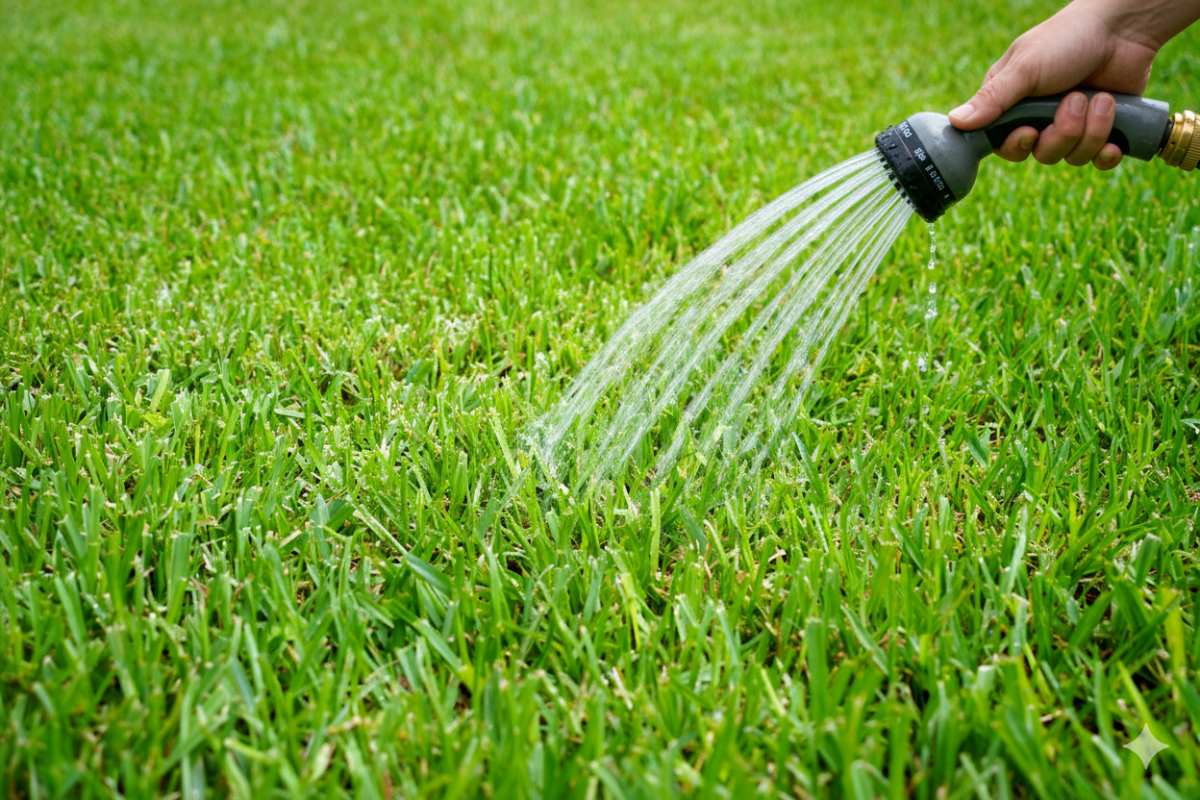
Watching your St. Augustinegrass turn brown during a hot spell or seeing yellow patches appear after heavy watering is frustrating. Finding the right balance can feel like guesswork.
St. Augustinegrass needs about 1 inch of water per week while actively growing to stay healthy and vibrant. Despite tolerating heat and humidity well, this warm-season grass is only moderately drought-tolerant, making proper watering critical for a thick, green lawn.
| Get a lush, healthy lawn without the guesswork. Connect with local LawnStarter mowing pros who know exactly how to care for St. Augustinegrass in your area. |
| Key Takeaways |
|---|
| • St. Augustinegrass requires about 1 inch of water weekly during active growth. • Water deeply but infrequently to encourage strong, drought-tolerant roots. • Winter watering drops to 1/2 inch every 3-4 weeks once dormant. |
How Much to Water St. Augustinegrass by Season
St. Augustinegrass Water Requirements at a Glance
| Season | Water Amount | Frequency |
| Spring (Mar-May) | 1 inch/week | 1-2 sessions/week |
| Summer (Jun-Aug) | 1-1.5 inches/week | 2-3 sessions/week |
| Fall (Sep-Nov) | 1 inch/week | 1-2 sessions/week |
| Winter (Dec-Feb) | 0.5 inch | Every 3-4 weeks |
St. Augustinegrass is more finicky than other warm-season grasses. During peak summer growth, it may need up to 1.5 inches weekly with more frequent watering sessions.
While you still want to water deeply and infrequently to encourage strong roots, the key is keeping the soil consistently moist without overwatering. You’ll quickly see signs your grass needs watering (for example, straw-colored grass, footprints that remain on the lawn) if you let the soil dry out too much.
The seasonal breakdown below shows you exactly how to adjust.
See Related: Guide to Growing Warm-Season Grasses
Spring (March to May)
Spring is when St. Augustinegrass transitions out of dormancy and begins greening up. Consistent watering helps it prepare for summer.
Watering guidelines:
- Established grass needs 1 inch of water per week, including rainfall.
- Water once per week; twice weekly in sandy soil.
- Water between 3 a.m. and 9 a.m. to discourage fungal diseases, especially large patch.
Important: New sod and plugs have different watering requirements.
Summer (June to August)
Summer is peak growing season with the highest water demand due to heat and increased evaporation.
Watering guidelines:
- Grass needs 1 to 1.5 inches of water per week, including rainfall.
- Water twice per week; 3 times for sandy soil.
- Water between 3 a.m. and 9 a.m. to minimize evaporation.
Important: Be careful not to overwater. Overwatering increases thatch buildup and creates ideal conditions for fungal diseases and insect problems, such as chinch bugs. Signs of overwatering include puddles forming or spongy ground.
See Related: How Often to Water Grass in Summer
Fall (September to November)
As temperatures cool, St. Augustinegrass growth naturally slows, reducing water needs. St. Augustine enters dormancy when soil temperatures consistently drop below 55 degrees.
Watering guidelines:
- Grass needs 1 inch of water per week (including rainfall).
- Water once per week; twice weekly in sandy soil.
- Water between 3 a.m. and 9 a.m. to discourage fungal diseases.
- Reduce frequency as temperatures drop.
See Related: How to Water Your Lawn in Fall and Winter
Winter (December to February)
St. Augustinegrass is typically dormant in winter, turning brown in most areas. However, in South Florida and coastal areas, it may remain semi-active throughout the winter.
Watering guidelines:
- Water dormant grass with 0.5 inch every 3 to 4 weeks.
- Water green grass with 0.5 inch every 10-14 days.
- Increase frequency during extended dry, windy periods.
Important: Watch your grass for brown patches or a crunchy texture — signs of desiccation (drying out) — and adjust watering if necessary. According to NC State Extension, occasional winter watering may help prevent dehydration in dry winter weather.
Watering St. Augustinegrass by Soil Type

Your soil type significantly affects how often and how much you should water because it dictates how long water stays in the root zone.
The key for all soils is to water deeply each time, and to wait as long as possible between irrigation sessions. This approach encourages St. Augustinegrass to extend roots as far as possible into the soil.
Sandy Soil
Sandy soils are common throughout Florida and coastal areas. They drain quickly, so apply smaller amounts of water more frequently. This prevents water from draining below the root zone before your grass can absorb it.
Watering adjustments:
- Water 3 times per week during summer.
- Apply 1/2 inch per session for 1.5 inch weekly amount.
- Wet the soil about 6 inches down.
Note: If needed, you can increase watering to 4 times per week, splitting the 1.5 inches into 4 irrigation sessions.
Clay Soil
Clay soils are common in parts of Texas and inland areas. They retain moisture much longer than sand but absorb water slowly. Water in shorter cycles to prevent puddling and runoff.
Watering adjustments:
- Water 1-2 times per week during summer, splitting the weekly amount if you water twice.
- Use the cycle-and-soak method: Water slowly until runoff starts, wait 30 minutes, then resume until water penetrates 4 to 6 inches deep.
Loamy Soil
Loamy soil is the ideal middle ground, offering good drainage while still retaining adequate moisture. With loam, follow the standard watering guidelines for St. Augustinegrass without major adjustments.
Watering adjustments:
- Water twice per week during summer, splitting the weekly amount if you water twice.
- Wet the soil 4 to 6 inches down.
Not sure what soil type you have? Squeeze moist soil: Sandy soil falls apart immediately, clay forms a tight ball, and loam holds its shape but crumbles with light pressure.
Effective Watering Tips for St. Augustinegrass

Beyond knowing how much and when to water, these techniques will maximize every drop:
- Test soil moisture: Insert a screwdriver 6 inches into the soil. If it goes in easily, moisture is adequate. If it’s difficult, the lawn needs water.
- Watch for drought stress: Water when you see a bluish-gray color, folded leaf blades, or footprints that don’t bounce back.
- Water deeply and infrequently: Apply 1/2 to 3/4 inch per session to encourage deep root growth and drought tolerance.
- Test your coverage: Place cans around your lawn, run sprinklers for 15 minutes, and measure to ensure even distribution.
Special Watering Situations
New Sod: Water 2-3 times daily for the first week to keep sod and top 1 inch of soil moist, then reduce to once daily in week 2. By week 3, the roots should take hold, and you can transition to the normal schedule for established grass.
For in-depth guidance, see our new sod care guide.
New Plugs: Water St. Augustine plugs 2-3 times daily for the first two weeks to keep the top 1 inch of soil moist. In weeks 3 and 4, cut back to watering once daily. Once roots are established and runners appear, transition to the normal schedule based on soil type.
Regional Watering Tips
Florida: Florida’s sandy soils drain quickly, requiring a more frequent watering schedule outlined above. Coastal areas may need occasional deep watering to leach accumulated salts. Most municipalities enforce mandatory twice-weekly watering restrictions, so plan accordingly.
See Related: Restrictions and Tips for Watering Your Orlando Lawn
Texas: Central and North Texas follow the seasonal guidelines (1 inch weekly in summer) above. South Texas has year-round growing conditions, similar to Florida. West Texas may need supplemental water even in the spring due to lower humidity. Check local municipality restrictions.
See Related:
— The Challenges of Growing a Lawn in Coastal Areas
— How to Keep Your Lawn Watered with Water Regulations in Austin
Frequently Asked Questions
During extreme heat, water early in the morning (4 a.m.-6 a.m.), avoid foot traffic on stressed areas, don’t fertilize until recovered, and maintain a 3-4 inch mowing height (taller grass provides better soil shade). With consistent care and cooler weather, your lawn will bounce back.
Most sprinklers require 30-60 minutes to apply 1 inch of water, but your system or sprinkler heads (fixed vs. rotary) may vary.
Test your sprinkler system’s output by placing shallow containers (tuna cans work well) throughout the watering area. Run the sprinklers for 15 minutes, then measure the water depth in each container. Use this measurement to calculate the runtime needed for 1 inch.
Signs of overwatering St. Augustinegrass include:
• Spongy soil
• Persistent puddles
• Yellowing grass
• Increased fungal disease (especially circular brown patches)
• Excessive thatch buildup
Reduce watering frequency immediately if you notice these symptoms.
Let the Experts Handle Your St. Augustine Lawn
St. Augustinegrass watering varies by season and soil type, but the fundamentals stay the same: Aim for 1 inch weekly during active growth, and water deeply but infrequently. As temperatures change, you’ll adjust your schedule to accommodate.
Want the best care for your lawn? Let local LawnStarter mowing pros handle all your lawn care needs. With expert help, you’ll have a gorgeous, lush lawn in no time.
Read More:
- How to Care for St. Augustinegrass
- 11 Essential Lawn Watering Tips for Florida
- How Often Should I Water My Lawn?
- When to Stop Watering Your Lawn
Main Image: Watering St. Augustinegrass. Image Credit: Jennifer / Adobe Stock edited using Canva Pro
