| Key Takeaways: |
|---|
| • Wait until grass is 3-4 inches tall (usually 2-4 weeks). • Cool-season grasses are usually ready in 2-3 weeks, warm-season in 4-6 weeks. • Do a tug test: Grass should resist pulling before you mow. |
Overseeding takes patience, and it’s normal to worry about mowing too soon. Wait 2 to 4 weeks after overseeding before mowing, or until your new grass reaches 3 to 4 inches tall.
Mowing too early can uproot seedlings and damage shallow roots, wasting your overseeding effort. However, the exact timing depends on your grass type and growing conditions.
This guide covers when to mow after overseeding, how to tell when your lawn is ready, and best practices to protect your new grass.
Rather hire a pro instead? Get matched with local lawn care pros who can handle overseeding, mowing, and ongoing maintenance.
How Long to Wait to Mow After Overseeding
According to Alison O’Connor, professor of horticulture with Colorado State University Extension, mowing is an essential part of seeding into an established lawn. “Mowing will encourage ‘tillering,’ which results in better root growth,” she says.
The standard waiting period is 2 to 4 weeks, but timing shifts based on grass type, weather, and soil conditions. Here’s what matters most.
Grass Height: The Primary Indicator
Mow when new grass reaches 3 to 4 inches in height. This ensures roots have grown deep enough (typically 2-3 inches) to anchor the plant securely.
Before that first mow, do a simple tug test: Gently pull on a few grass blades. If they resist and stay firmly in the soil, roots are established. If blades pull up easily with soil attached, wait another few days and test again.
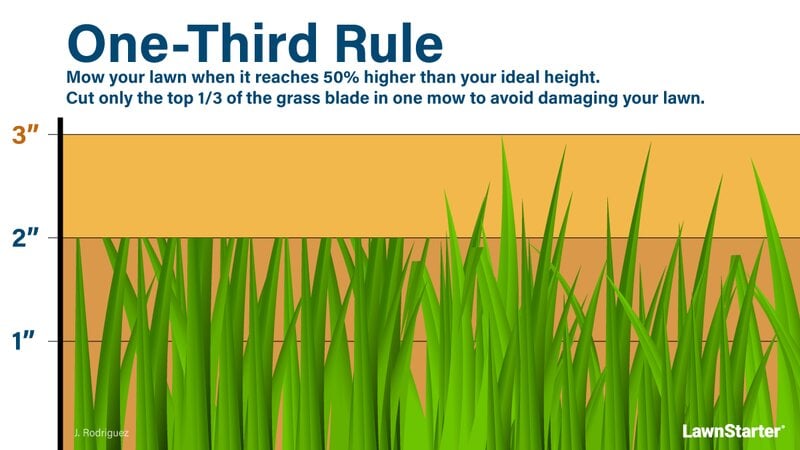
When you do mow, follow the one-third rule: Remove no more than one-third of the grass blade length. For example, for 4-inch-tall grass, set your mower to cut at 2.5 to 3 inches. “Don’t let seedlings get too tall — removing too much of the seedling height with mowing can kill the seedling,” O’Connor explains.
Grass Type and Germination Timelines
Different grass species establish at different rates:
| Grass Type | Germination Time | Ready to Mow |
| Bermudagrass | 10-30 days | 4-6 weeks |
| Centipedegrass | 10-21 days | 4-6 weeks |
| Fine fescue | 6-15 days | 2-3 weeks |
| Kentucky bluegrass | 14-30 days | 3-4 weeks |
| Perennial ryegrass | 5-10 days | 2-3 weeks |
| Tall fescue | 5-12 days | 2-3 weeks |
| Zoysiagrass | 10-28 days | 4-6 weeks |
- Cool-season grasses (ryegrass, fescue, bluegrass) grow actively at 60-75 F air temperatures and typically establish within 2-4 weeks.
- Warm-season grasses (Bermuda, St. Augustine, Zoysia) thrive when air temperatures are 75-90 F and typically require 4 to 6 weeks to develop strong root systems.
Choosing the right grass seed for your region makes a significant difference in establishment success.
Weather and Growing Conditions
Weather also impacts your mowing timing:
- Ideal conditions (65-75 F with regular moisture): Grass may be ready in as little as 2 weeks for fast-growing varieties like ryegrass.
- Hot, dry weather: High temperatures slow germination. Wait the full 4 weeks minimum, and maintain a consistent irrigation schedule — new seed needs about 1 inch of water per week.
- Cool, wet weather: Mild temps with adequate rainfall create perfect conditions for faster root establishment.
- Excessive rain: Too much water can wash away seed or cause fungal issues. If your lawn is soggy, wait until the soil firms up before mowing.
How to Know Your Lawn Is Ready to Mow
Before you mow, here are a few tips to confirm your new grass has properly established:
1. Height Test
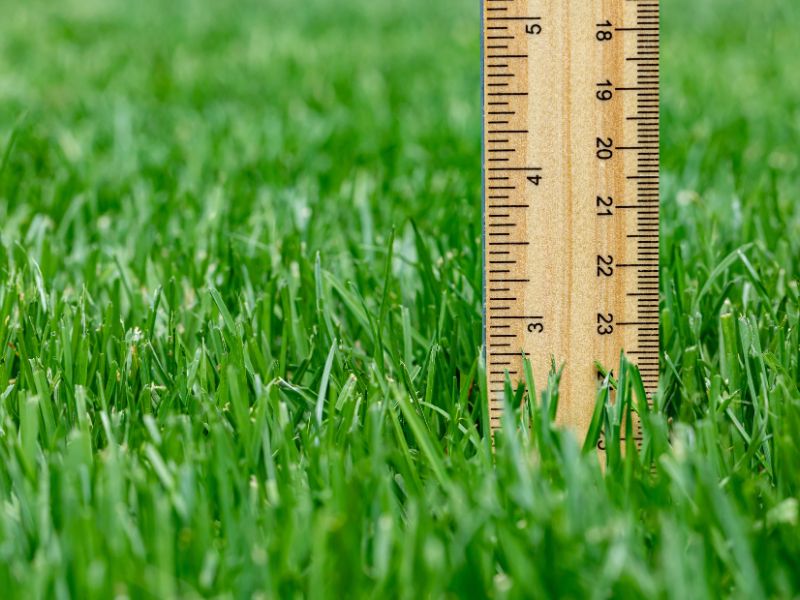
Measure grass height in multiple spots. New grass should be 3 to 4 inches tall consistently across overseeded areas, not just in patches.
2. Root Check (Tug Test)
Gently tug on grass blades in different sections:
- Strong resistance = ready: Grass stays firmly in place
- Easy pull-up = not ready: Grass lifts out with roots attached
The tug test is your most reliable indicator.
3. Visual Inspection
Look for these establishment signs:
- Uniform green color (not pale or yellowish)
- Grass blades standing upright
- Visible new shoots growing from the base
- No bare soil patches between grass plants
What Happens If You Mow Too Early
Mowing before the grass is ready causes several problems:
- Root damage: Mower wheels and vibration can dislodge shallow roots (less than 1 inch deep), killing seedlings.
- Stunted growth: Early mowing forces grass to divert energy from root development to blade regrowth, weakening the plant.
- Weed invasion: Damaged grass leaves bare spots where weeds quickly establish.
- Wasted investment and effort: Quality seed costs $2-$40 per pound, and professional overseeding services cost $427-$1,514 for an average-sized lawn. Mowing too early can undo all that work.
Best Practices for Your First Mow after Overseeding
When your grass is ready to be mowed, you’ll want to mow it the right way so you don’t damage the new shoots. Here’s how to do it:
- Use sharp mower blades: Dull blades tear grass and stress plants. Sharpen your mower blades before mowing newly overseeded areas.
- Choose dry conditions: Mow when the grass and soil are dry. Wait 24-48 hours after rain or irrigation to prevent clumping and soil compaction.
- Mow at the highest setting: Set your blade to remove only the top one-third of grass length. Higher mowing encourages deeper root growth.
- Leave clippings on the lawn: Skip the grass catcher for the first few mows. Short clippings decompose quickly and return nitrogen to the soil, feeding your new grass.
- Vary your mowing pattern: Change directions each time to prevent soil compaction and encourage upright growth.
Timing for Different Scenarios
Fall and spring overseeding follow different timelines, especially when it comes to how soon your lawn is ready for its first mow:
Fall Overseeding
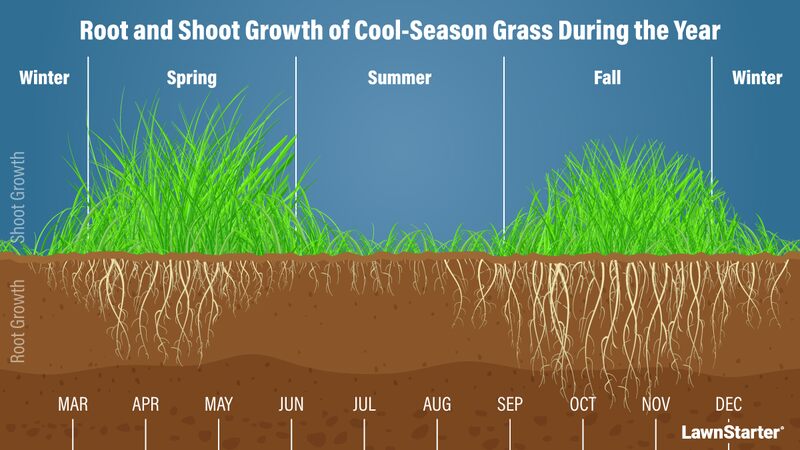
Fall is the prime season for overseeding northern cool-season grasses. According to O’Connor, “Seeding in the fall can result in quicker germination because soils are warm, but may require more frequent irrigation because temperatures are warm.”
- Overseed: Mid-August to mid-September
- First mow: 2-4 weeks later
Spring Overseeding
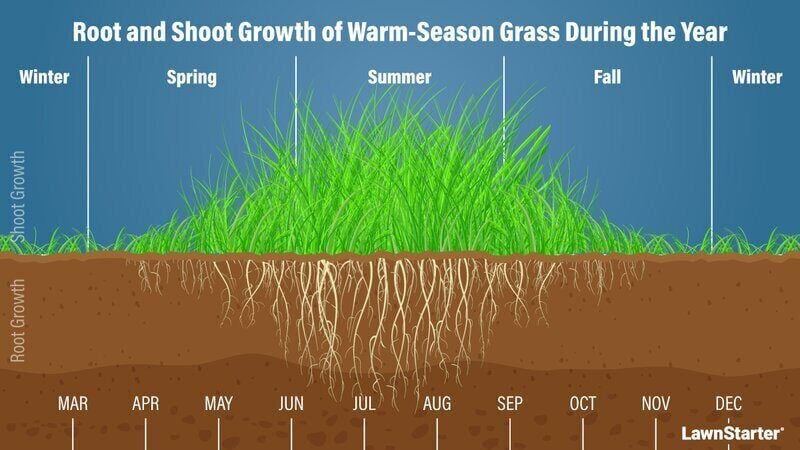
Spring is the best time for overseeding warm-season grasses, which thrive in hot southern climates.
For cool-season grasses, overseeding in early spring can be more challenging. As O’Connor notes, “Seeding in the spring may result in delayed germination, since soils may be too cold.” It also comes with more weed competition.
- Overseed: Late spring, around May (warm-season); March to May (cool-season)
- First mow: 2-6 weeks later, depending on the grass type
For more information, check out our article: When to Overseed in Spring
FAQ
Tall fescue doesn’t spread to repair bare spots, which is why fall overseeding is the best way to fix damage. Luckily, it germinates quickly, so you’ll only have to wait 2-3 weeks before mowing it for the first time.
• Germination: 5-12 days
• First mow: 2-3 weeks after overseeding
• Target: Wait until 4.5 inches, mow to 3 inches
See related: How to Overseed in the Fall With Fescue
If you’re overseeding a Kentucky bluegrass (KBG) lawn with more KBG seeds, wait at least 3 to 4 weeks for the first mowing, as this grass germinates slowly.
For homeowners seeking faster results, it is often recommended to overseed with perennial ryegrass, a fast-germinating grass that blends well and helps repair damage quickly. If you overseed KBG with ryegrass, you may be able to mow it as soon as 2 weeks after overseeding, provided the new grass reaches 3 to 4 inches tall.
Minimize foot traffic for around 3-4 weeks after overseeding. Repeated traffic compacts soil and disturbs germinating seeds. Keep kids, pets, and activity off overseeded areas until after the first mow.
Get Professional Help for a Thicker Lawn
Overseeding transforms thin, patchy lawns into thick, healthy turf, but what happens after seeding matters just as much. Mowing at the right time and the right height protects new grass and keeps all that effort from going to waste.
If you’d rather not risk that critical first mow, hire a local LawnStarter pro who can handle mowing and ongoing maintenance while your new grass establishes.
Sources:
- Alison O’Connor, professor of horticulture with Colorado State University Extension. Personal interview.
- “Planting and Maintaining a Fine Fescue Lawn.” By Eric Watkins, turfgrass professor, and Kristine Moncada, turfgrass scientist. University of Minnesota Extension.
Main Image: Lawn mower cutting grass in a lawn. Image Credit: Mariusz Blach / Adobe Stock
Related Posts: