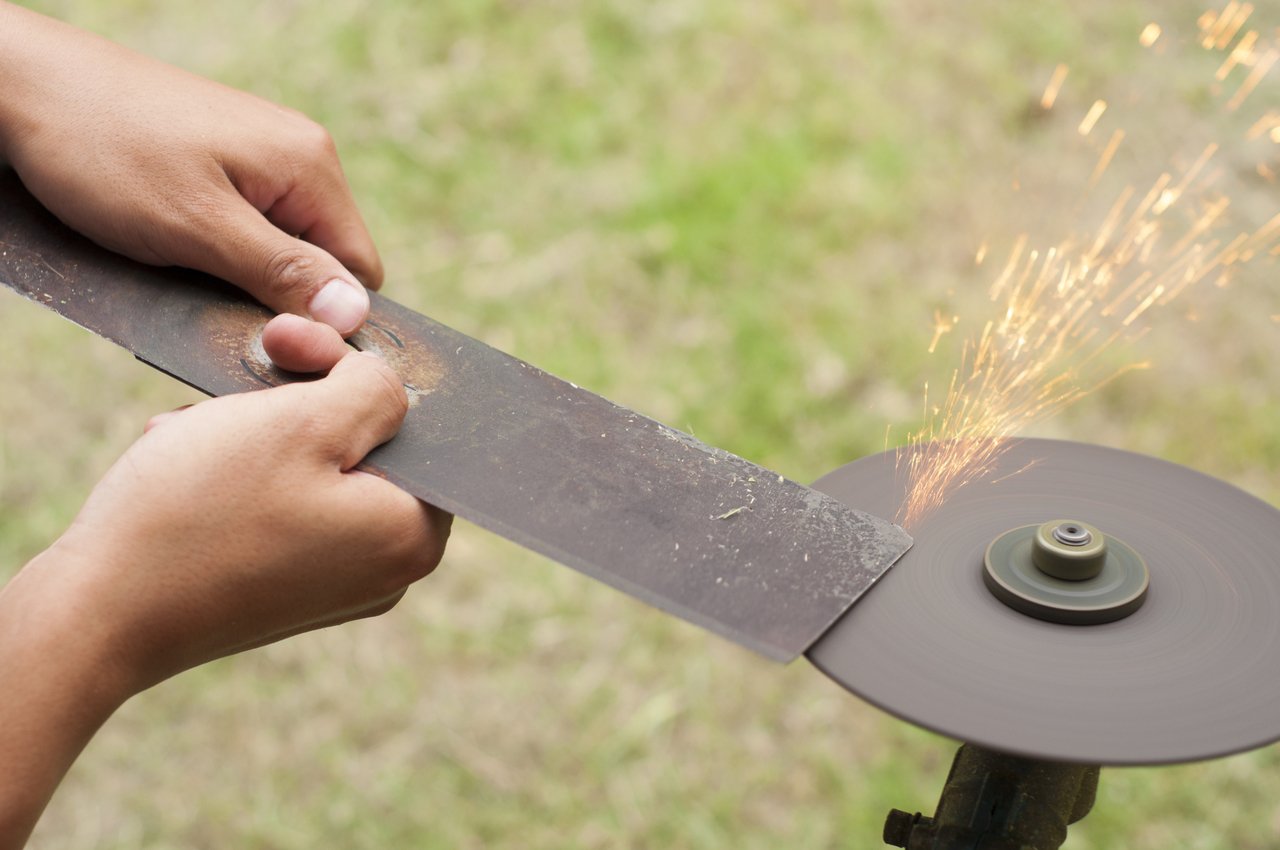
Sharp lawn mower blades cut cleanly through grass, keeping your lawn healthy and green. Learning how to sharpen lawn mower blades is doable, even for beginners: Remove the blade, sharpen at a 30- to 45-degree angle, balance it, and reinstall.
Homeowners should sharpen blades twice per season or after every 25 hours of mowing. If your grass looks ragged after mowing or the mower requires extra effort to cut, it’s time to sharpen.
Don’t want to maintain your own equipment? LawnStarter connects you with our local lawn care pros who use professionally maintained mowers and keep your lawn looking pristine. Get a free quote in seconds.
| Key Takeaways: |
|---|
| • How often to sharpen mower blades: Every 25 hours of use or twice per season • Time required: 5-45 minutes, depending on the method • Cost: $60-$110 for DIY tools; $5-$30 for professional sharpening |
Tools You’ll Need
If you’re handy with tools, you likely already own most of the essentials. Here’s a checklist of tools you need to sharpen your mower blades:
| Tool | Why You Need It |
| Wrench or Socket | To loosen nuts and bolts |
| WD-40 or another brand of penetrating oil | To loosen stuck nuts and bolts |
| Permanent marker or spray paint | Marks the blade orientation in the housing |
| Rag or cloth | To clean and dry the blade |
| Putty knife, wire brush, or paint scraper | To clean the blade and the mower housing |
| Vise or C-clamp | Holds the blade while sharpening |
| A wood block or a blade lock | Keeps the blade from spinning |
| Sharpening tool (metal file, sharpening stone, drill attachment, or angle grinder) | Sharpens the blade |
| Blade balancer, screwdriver, or a nail | To balance the blade |
| Work gloves and safety goggles | For personal protection |
See Related: How Much Does Lawn Mower Repair Cost?
Step-by-Step: How to Sharpen Mower Blades
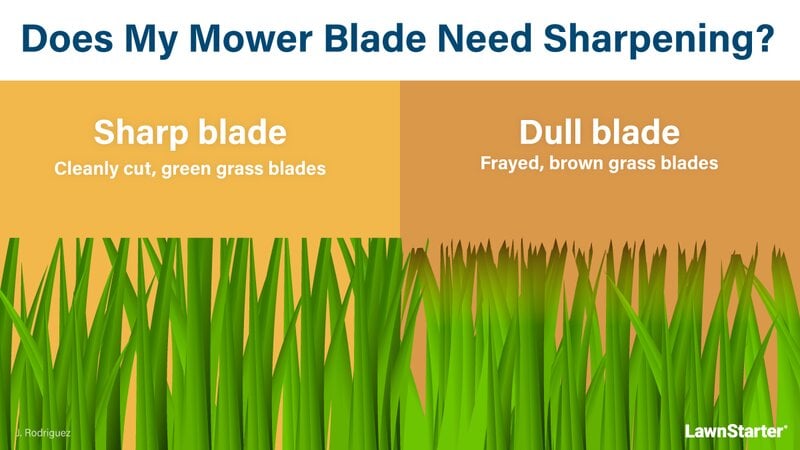
1. Disconnect Power and Remove the Blade
Safety first: Disconnect the spark plug on gas mowers or remove the battery on electric mowers. Blades spin at 3,000 RPM and can cause severe injury.
To remove the blade:
- Tilt mower on its side (air filter should face up for gas mowers).
- Wedge a wood block between the blade and the housing.
- Mark the blade’s grass-facing side with a permanent marker.
- Loosen the mounting bolt counterclockwise with your wrench.
- For stuck bolts, apply WD-40 and let it soak for several hours. Then try again.
To protect yourself while sharpening a mower blade, wear thick work gloves, hearing protection, and safety goggles.
Pro Tip: A long-handled wrench provides more leverage for stubborn bolts.
See Related:
- Lawn Mower Safety Tips
- 13 Yard Work Safety Tips, With Advice From a LawnStarter Pro
- Gas vs. Electric Lawn Mowers: Which Should You Choose?
2. Clean and Inspect
Remove grass clippings, mud, and dirt with a rag. A wire wheel and a drill can help remove stubborn grime. Soak heavily soiled blades in penetrating oil or degreaser. Dry completely before sharpening.
Inspect for damage:
- Minor dents and dullness: Safe to sharpen
- Cracks, large chunks missing, or severe bends: Replace the blade
While the blade is off, clean the mower deck undersurface by rinsing off grass clippings and dirt. If the dirt is caked onto the mower, use a paint scraper, a putty knife, or a wire brush to scrape it off.
3. Choose Your Sharpening Method
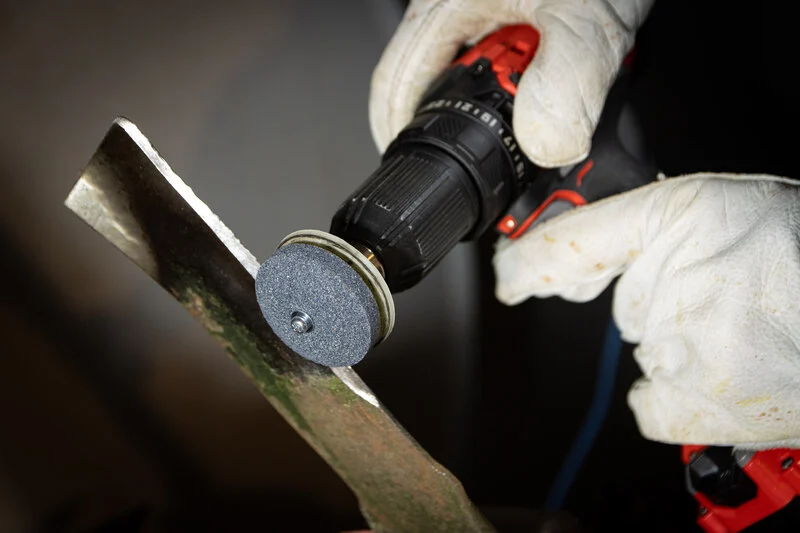
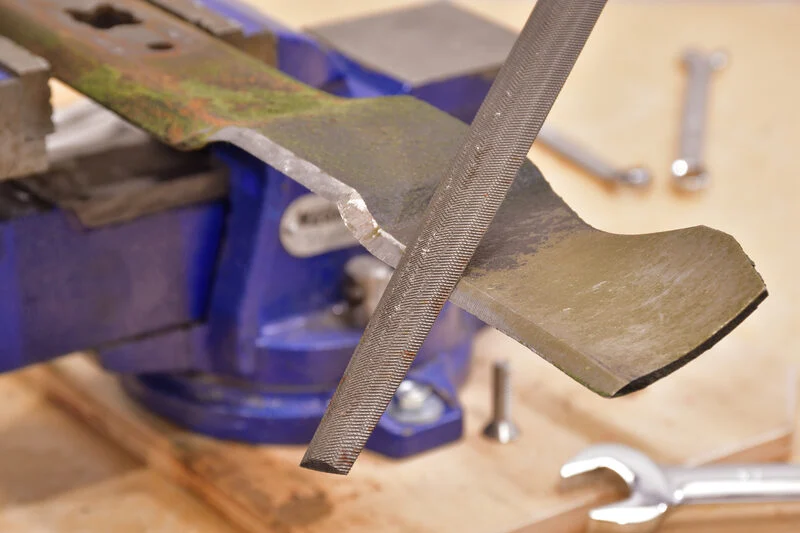
Secure the blade in a vise with the cutting edge facing up. Choose one of these 3 sharpening methods:
| Method | Time | Difficulty | Best For |
| Metal File | 30 – 45 minutes | Beginner-friendly | Occasional users who want precision |
| Drill Attachment | 15 – 20 minutes | Easy | Regular maintenance |
| Angle Grinder | 5 – 10 minutes | Requires experience | Frequent sharpening, confident DIYers |
How to Sharpen With a Metal File: The metal file method is the most forgiving method for beginners. Use a 10-inch metal file, a.k.a. Mill File (Bastard Cut).
Follow these steps:
- Clamp the blade in a vise.
- Position the file at the same angle as your mower blade (30-45 degrees).
- Push the file in only one direction, from the inside edge to the outside edge. “Use long, smooth strokes,” says Jason Keeley, lawn care expert and founder of Mowing Magic in North Garden, Virginia.
- File the blade edge, evening out nicks until it’s straight and you see a shiny silver edge (about 50 strokes total).
- Flip the blade and repeat on the other edge.
Aim for butter knife sharpness that doesn’t cut your skin.
How to Sharpen With a Drill Attachment: A drill attachment uses a sharpening stone bit with a guide attachment. This method offers the best balance of speed and control.
Follow these steps:
- Clamp the blade in a vise.
- Insert the sharpener bit into the drill and tighten. Pull the drill trigger to ensure it’s attached securely.
- Align the grinder stone (keep the flat side pressed against the blade’s back). The beveled stone should be aligned with the 30-degree cutting edge of the blade.
- Run the drill and glide the sharpener back and forth along the blade’s edge about 4-5 times. “Apply light, steady pressure to avoid overheating the metal,” Keeley says.
- Flip and repeat on the other edge.
Common mistake: Not clamping the blade. Always secure it in a vise for consistent results.
How to Sharpen With an Angle Grinder: Using an angle grinder is the fastest way to sharpen a lawn mower blade at home, but it demands precision. “If using a grinder, apply light, steady pressure to avoid overheating the metal,” Keeley says.
Follow these steps:
- Clamp the blade in a vise.
- Align the flap wheel with the blade edge and follow the angle of the blade (usually 30-45 degrees).
- Move the grinder slowly, from the inside edge to the tip, to smooth out the nicks.
- If the blade gets hot, dunk in water immediately.
- Flip and repeat on the other edge.
Pro Tip for Beginners: Try out this method first with a flap wheel instead of a grinding disk. Flap wheels remove less metal, protecting the blade’s integrity. If using a flap disk, use a medium-fine disk with 60-80 grit.
Common mistakes: Excessive pressure, overheating, and an inconsistent sharpening angle.
4. Balance the Blade
An unbalanced blade vibrates excessively and damages your mower’s deck, shaft, and bearings. Only install the blade after you ensure it’s balanced.
The best tool for checking a mower blade’s balance is a blade balancer — a cone-shaped device you can buy for $5 to $15.
How to balance:
- Place the blade on the cone balancer, nail, or screwdriver through the center hole.
- Let your blade settle.
- If the blade is level, it’s ready to install.
- If one side drops or leans, sharpen that side slightly more.
- Recheck until balanced.
5. Reinstall the Blade
Follow these steps to reinstall your mower blade:
- Position the blade onto the mower shaft with the marked side down.
- Lightly oil the bolt to prevent rust.
- Put the bolt back on and screw it tight to keep the blade in place.
- Insert a wood wedge to prevent the blades from spinning.
- Tighten firmly with a wrench until secure.
- Reconnect the spark plug or battery.
- Test mower; listen for unusual noises or excessive vibrations.
Pro Tip: Keep a spare sharpened blade on hand. When your current blade dulls or gets damaged, swap it immediately and sharpen the dull one later.
Mower Blade Maintenance Schedule
Sharpen mower blades at least twice a year (spring and mid-summer).
Here’s how often you should sharpen your mower blade:
- After every 25 hours of lawn mower use
- If you hit a rock or hard object while mowing
- If grass looks ragged or torn after cutting
- When mowing requires more effort than usual
Here’s a basic seasonal maintenance guide:
| Season | Task |
| Spring | Complete blade sharpening and full mower maintenance |
| Summer | Check blade every 25 hours of use |
| Fall | Deep clean, rust treatment, replace worn blades |
See Related: DIY Lawn Mower Maintenance Guide
When to Replace vs. Sharpen
As a general rule, consider replacing the blades every 1-2 years. Replace the blade if:
- It has severe cracks or bends
- Deep nicks won’t sharpen away
- More than 1/3 of the blade material is worn away
- Blade is less than 1/2-inch thick
Read More: 11 Signs It’s Time to Replace Your Lawn Mower
FAQ About Sharpening Mower Blades
Technically yes, you can sharpen mower blades without removing them, but it’s not recommended. Sharpening without removal is unsafe, prevents proper cleaning and inspection, and makes it impossible to balance the blade afterward, which can damage your mower.
Aim for butter knife sharpness. A razor-sharp edge dulls faster and chips more easily. Sharpening at the factory bevel angle of 30-45 degrees provides the best balance of cutting performance and edge retention. “This ensures durability while maintaining a sharp cutting edge,” Keeley says.
To prevent mower blades from getting dull:
• Remove rocks and debris before mowing
• Avoid cutting grass too short
• Clean the blade after each use
• Treat with penetrating oil to prevent rust
• Alternate between 2 blade sets
• Upgrade to blades with hardened steel edges
Let LawnStarter Handle Your Lawn Care
Skip the blade sharpening and equipment maintenance entirely. LawnStarter connects you with our local lawn mowing professionals who use commercial-grade, professionally maintained equipment. Get consistent, expert mowing service without touching a single tool.
Get your free instant mowing quote and see why thousands of homeowners trust LawnStarter for hassle-free lawn care.
Read More: How to Mow Your Lawn: A No-Nonsense Guide
Source:
Jason Keeley, founder of Mowing Magic in North Garden, Virginia.
Main Image: Hands sharpening lawn mower blade on grinder. Image Credit: iStockPhoto