Proper soil sample preparation is key to precise data on your soil’s pH, nutrient levels, and the exact soil amendments your lawn needs.
The process is simple: Collect 8 to 10 soil cores from your lawn, mix them in a bucket, transfer the mixture to a sample container, label it, and send it to your state’s Extension service for testing.
Follow these steps, and you’ll get accurate results and tailored recommendations for your lawn. Short on time? A local lawn treatment pro can interpret the soil test results and apply the right fertilizers for you.
Step 1: Choosing a Testing Lab
Your state’s Cooperative Extension Service is the best choice for lawn soil testing. Why? Extension labs know your region’s soil inside and out, use calibrated equipment, and tailor the recommendations to your local climate. Plus, they’re also affordable — most labs charge $10 to $25 per sample for a standard soil test.
Search online for “[your state] Cooperative Extension soil testing,” or just call your county Extension office. They’ll point you in the right direction.
Step 2: Collect Your Soil Cores
Soil test accuracy starts with how you collect soil samples. Your goal? Gather multiple small samples (called cores) that together represent your lawn’s average condition.
Choose the Right Tool
A soil sampler probe makes collection easiest and most consistent. Don’t have one? No worries — a clean stainless steel or chrome-plated shovel or garden trowel works just as well.
Pro Tip: Avoid brass, bronze, or galvanized tools. They can contaminate your sample with copper and zinc, skewing test results.
Proper Collection Technique
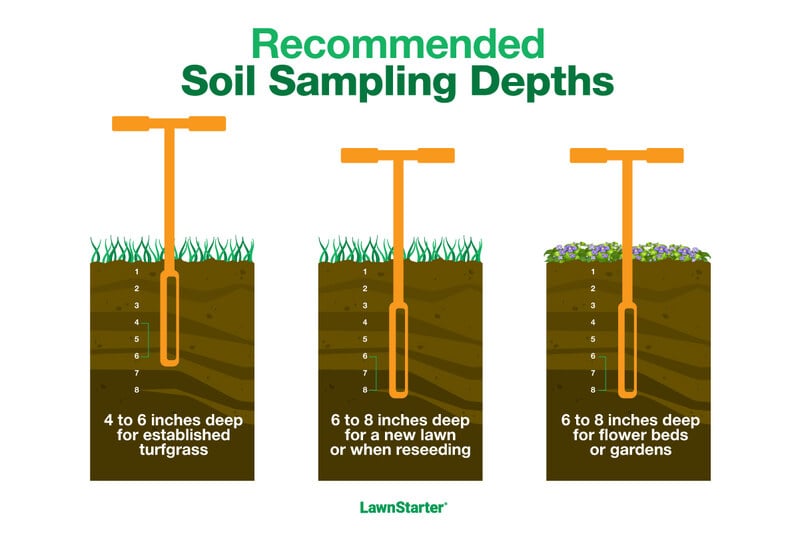
Remove debris and thatch from the sampling spot. Insert your soil probe straight down, pull it back out, and drop the core into a clean plastic bucket. Using a shovel or trowel instead? Dig a small hole, then cut a thin vertical slice (about 1 inch thick) from the side. Trim away the edges so you’re left with a ribbon of soil about 2 inches wide.
How deep to dig? Generally, 4-6 inches for established lawns and 6-8 inches for new lawns and flower beds — but this can vary by lab. For example, Virginia Tech Soil Testing Lab recommends a sampling depth of 4 inches for lawns, while the University of Missouri (MU) Lab uses 6 inches.
“This is the depth used to calibrate our fertilizer and soil health recommendations. It’s important to match it,” says Muhammad Rasel Parvej, director of the MU’s Soil and Plant Testing Laboratory and Soil Health Assessment Center.
Pro Tip: Maintain the same depth for all samples. Nutrient levels, pH, and organic matter change with depth, so mixing 2-inch and 6-inch samples can give misleading results, Parvej explains.
Take Enough Samples
For each composite sample, take 8-10 cores in a zigzag pattern from one area of your yard. Sample several areas separately. “The higher the number of composite samples, the better the recommendations will be,” says Parvej.
Pro Tip: Avoid collecting samples when the soil is too dry, frozen, or waterlogged.
See Related: How to Plant Grass Seed
Where to Sample (and Where Not To)
Collect cores only from areas with similar characteristics — same grass type, sun exposure, and care history. Avoid sampling near sidewalks, driveways, fence lines, fertilizer spill spots, bare patches, mossy areas, and low spots with standing water.
Areas with poor grass growth or yellowing? Sample those separately. Mixing troubled spots with healthy areas will dilute your results and mask the specific issues you’re trying to solve.
Pro Tip: Test your front and back lawn separately. They often have different soil conditions and varying sun exposure and drainage.
See Related: Why Does My Lawn Have Brown Spots?
Step 3: Mix the Sample Thoroughly
Start by breaking up any large clumps and removing thatch, rocks, roots, twigs, and other debris. “Labs want mostly mineral soil, not yard waste,” says Parvej.
Stir the soil thoroughly for at least a minute. Hard to mix? It may have too much moisture. “If soil is very sticky, smears on the tool, or forms a solid ‘snake’ or ball that doesn’t crumble, it’s probably too wet,” says Parvej.
He recommends letting the soil air-dry at room temperature until it’s crumbly. Spread it on newspaper sheets and leave it in a shaded spot for a few hours or overnight. Never use heat — ovens or direct sunlight can damage the sample and throw off results.
Once it’s dry enough to handle, give it another good stir. Then, scoop out 1-2 cups of the blended soil and transfer it to your sample container.
Most Extension services provide bags or boxes with a fill line — don’t go over it. Using a plastic storage bag instead? Squeeze out extra air and seal it tight.
Now that you know how to take a soil sample, here’s how to label it.
Step 4: Label Your Sample Correctly
Accurate labeling ensures your results come back to you (not your neighbor!) and that you can match recommendations to the right part of your lawn. Include these details with every sample you submit:
Your contact info: Full name, mailing address, email address, and phone number.
What you’re growing: Specify your grass type (Bermudagrass, Zoysiagrass, tall fescue, etc.). Different grasses have different nutrient needs. This helps the lab tailor its recommendations.
Sample identifier: Give each sample a unique name or number (especially important if you’re submitting more than one). Use descriptive labels like “Front Yard,” “Backyard Shady Area,” or “Problem Spot Near Driveway.” Keep a record or map of what each label means.
Additional context: Note any concerns you have (poor growth, yellowing, bare spots) and recent treatments, such as fertilizer or lime applications. The more context you provide, the more useful your recommendations will be.
Most Extension services include a submission form with their sample kits. Fill it out completely — incomplete forms will just delay your results.
Step 5: Send Your Sample for Analysis
Package your sample securely so it doesn’t leak in transit. Include all required forms and payment, then ship it as soon as possible for the most accurate results. Can’t ship it right away? Keep samples in a cool, dry place.
Most Extension services take 2-4 weeks to analyze your sample and send back results via email or mail. What will you get? A report with the current nutrient levels, pH readings, and specific recommendations for amendments, including exactly how much fertilizer or lime to apply for your lawn’s needs.
Pro Tip: Many Extension offices will ship your soil sample to the state lab at no additional charge. Ask your county office if they offer this service.
See Related:
- How to Read a Soil Test Report
- 9 Reasons Why Soil Testing Is Important for the Lawn
- How to Tell If Your Lawn Needs Lime (6 Signs)
Common Soil Sampling Mistakes to Avoid
Even when you know how to prepare a soil sample for testing, a few common slip-ups can throw off the results. “A frequent mistake is taking soil from a single ‘convenient’ or ‘best-looking’ area and sending that to the lab,” says Parvej. “This rarely represents the whole lawn.”
Here are other details to pay extra attention to:
- Sampling too soon after fertilizing: Wait at least 6-8 weeks after applying fertilizer or lime. Recent applications can artificially bump up nutrient readings.
- Taking too few samples: Eight to 10 cores is the minimum for a representative sample on a lawn that’s 10,000 square feet or smaller. Fewer cores may miss important variations.
- Mixing problem areas with healthy areas: Always sample troubled spots separately to avoid masking specific issues.
- Sampling at the wrong or inconsistent depth: “Homeowners often take shallow scoops or mix topsoil with deeper subsoil, which can mislead results,” says Parvej.
- Using contaminated tools and containers: Avoid metal buckets and tools with fertilizer or lime residues, as they can contaminate samples. Stick with clean plastic instead.
FAQ
You can collect soil samples any time the ground isn’t frozen or overly wet, but late summer and early fall are ideal. Testing then gives you time to apply amendments before winter so they can work into the soil before spring growth kicks in.
See Related: When to Test the Soil pH of Your Lawn
Test established lawns with clay or loam soil every 3 to 4 years. Growing grass in sandy soil? Its chemistry changes faster: Test every 2 to 3 years. If dealing with ongoing problems and treatments, test annually for the first few years to track changes.
While home test kits are handy for quick pH checks, they can’t match the accuracy of professional lab testing. Extension labs use calibrated equipment and give you detailed recommendations tailored to your grass type and region. For important lawn care decisions, professional soil testing is worth the investment.
See Related: How to Use a Soil Test Kit
Let LawnStarter Handle Your Lawn Care

Preparing a soil sample is easy when you follow proper technique. Once you receive your test results, you’ll have a science-based roadmap for improving your lawn — but implementing those recommendations takes time and expertise.
That’s where LawnStarter comes in. Our lawn treatment pros can interpret your soil test results, apply the right amendments at the correct rates, and create a fertilization schedule for your lawn’s specific needs. We serve homeowners nationwide with comprehensive services, including custom fertilization programs, professional mowing and edging, aeration and overseeding, and seasonal clean-up.
Ready to take the guesswork out of lawn care? Get a free lawn treatment quote from LawnStarter and connect with top-rated lawn care professionals in your area.
Sources:
“Collecting Soil Samples.” By Christopher Enroth, horticulture educator. University of Illinois Urbana-Champaign.
Muhammad Rasel Parvej, Director of MU Soil and Plant Testing Laboratory and Soil Health Assessment Center (SHAC), assistant professor and state Extension specialist in soil testing and interpretation within the Division of Plant Science and Technology and the School of Natural Resources, University of Missouri. Personal interview.
“Soil Sampling Depth and Collection Techniques for Soil Fertility and Soil Health Testing.” By Md. Rasel Parvej, assistant professor and director, Soil and Plant Testing Lab and Soil Health Assessment Center, Donna Brandt, research specialist lead, Soil Health Assessment Center, Kelly Nelson, professor and state Extension specialist in agronomy, and Robert Myers, director, Center for Regenerative Agriculture. University of Missouri.
“Soil Sampling for the Residential Areas.” By Steve Heckendorn, soil testing laboratory manager, Virginia Tech, and Rory Maguire, professor and Extension nutrient management specialist, School of Plant and Environmental Sciences, Virginia Tech. Virginia State University Cooperative Extension.
“Soil Testing and Soil Testing Labs.” By Jon Traunfeld, Extension specialist. University of Maryland Extension.
“Soil Testing.” Penn State University.
Main Image: A homeowner collects a soil sample. Photo Credit: Phoebe / Adobe Stock Free / License