Each year, about 230,000 people are treated for injuries caused by lawn or gardening equipment, according to the U.S. Consumer Product Safety Commission.
The good news? Most yard injuries are avoidable with proper training and safety precautions. With advice from a LawnStarter lawn care pro, we have the scoop on yard work safety to ensure your lawn chores are hazard-free.
But if you’d rather rely on someone else’s experience, hire a trained LawnStarter pro to get the job done safely and efficiently.
- 1. Warm Up Before You Work
- 2. Master the Power Position for Lifting
- 3. Prevent Repetitive Strain Injuries
- 4. Prevent Mower-Related Injuries
- 5. Use Tools That Match Your Body
- 6. Take Strategic Breaks to Stay Hydrated
- 7. Watch for Heat Stress
- 8. Protect Your Hearing
- 9. Dress for Protection, Not Fashion
- 10. Create a Safe Work Zone
- 11. Keep Children and Pets Away
- 12. Handle Chemicals With Care
- 13. Know When to Call Professionals
1. Warm Up Before You Work
Outdoor work requires a lot of physical exertion, so warm up by stretching your muscles before you get started. Start slowly and hold each stretch for about 20 seconds. By helping muscles to contract and perform, stretching decreases the chance of injury, according to Johns Hopkins.
2. Master the Power Position for Lifting
Yard work entails a lot of bending and lifting. To avoid injury, maintain the correct posture for lifting heavy objects:
- Keep your back straight.
- Squat and bend your knees.
- Lift with your legs, not with your back.
Avoid overfilling bags with grass clippings or leaves. Lighter bags are easier to carry and won’t put as much strain on your back. Have a friend help you move objects that are too heavy to lift by yourself.
3. Prevent Repetitive Strain Injuries
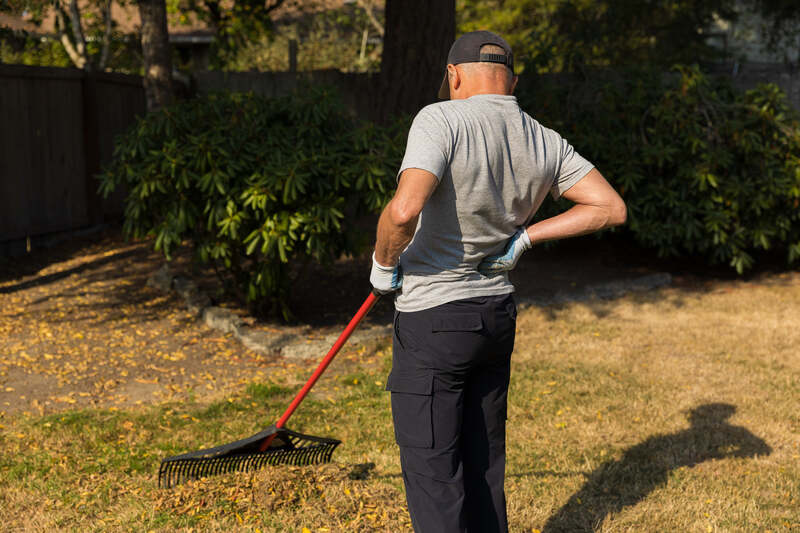
Yard work requires all sorts of repetitive motion, such as gripping the bail bar on the mower and frequent bending or reaching. Repeated motions put stress on your body and cause pain in your joints, fingers/toes, back, or limbs.
Watch out for these symptoms:
- Pain
- Swelling
- Tingling
- Numbness
- Heat-sensitivity
- Stiffness
- Weakness
If you don’t warm up before your lawn care chores, you increase the risk of repetitive strain injuries. Using power tools that vibrate can also increase your risk.
Here’s how to avoid repetitive strain injuries:
- Stretch and warm up before you start.
- Take regular breaks.
- Stop if your body is giving you warning signs.
- Give your body plenty of time to rest and recuperate after strenuous activity.
- Wear protective equipment, such as padded or anti-vibration gloves, to reduce the vibration from tools. Joint braces (knee, wrist, elbow, hand) may also help.
4. Prevent Mower-Related Injuries
According to a study in the journal Public Health Reports, about 6,400 lawn mower injuries occur in the U.S. every year. Here’s a breakdown of the most common mower-related injuries:
| Type of Mowing Injury | Injury Frequency |
| Lacerations | 46.7% |
| Fractures | 22.4% |
| Amputations | 21.5% |
Follow these lawn mower safety tips to prevent injury:
- Read the instruction manual. “Read up on the heavy equipment before you (use) it,” says Carlos Garza, LawnStarter pro and owner of NC Dip and Clip, a pool and lawn care company in San Antonio, Texas.
- Buy a model with safety features. The mower blades should stop rotating when the operator takes his hand off the control bar. Riding mowers should have a kill switch.
- Turn off your mower before cleaning it. Don’t forget to remove the battery or disconnect the spark plug wire.
- Opt for reel mowers. In a 25-year review of pediatric lawn mower injuries, JPRAS Open reports that riding mowers accounted for 76.1% of injuries, while the remaining 23.9% suffered injuries from push mowers. No reel mower injuries were reported.
- Clear lawn debris. Lawn mowers can fling objects, such as branches or rocks, and cause injury.
- Don’t speed. Walking too fast while pushing your lawn mower increases the risk of a mowing injury. Be especially careful with a self-propelled lawn mower, which pushes itself forward via a drive system, which can make it easy to lose control.
- Be cautious when mowing uneven surfaces or slopes. If you are using a push mower, mow across the slope. With a riding mower, mow up and down for slopes under 15 degrees. Never use a riding mower for slopes steeper than 15 degrees.
| Pro Tip: Garza says that his #1 tip for yard work safety is to “read up or watch a video on something before you do it. Educate yourself on the task (first).” |
See Related: Self-Propelled vs. Push Mowers
5. Use Tools That Match Your Body
Proper tools alleviate the strain on your body. Choose yard tools that match your strength and size and have ergonomic handles. If you have to kneel, use knee pads.
6. Take Strategic Breaks to Stay Hydrated
Dehydration is dangerous, and staying hydrated throughout the day keeps you healthy and boosts your productivity. You lose a lot of water due to sweat, so take regular breaks to rehydrate every 15-20 minutes.
When working in the heat of summer, aim for 24 to 32 ounces of water per hour to stay hydrated, according to the Arizona Department of Health Services.
7. Watch for Heat Stress
Yard work in extreme heat or humidity is dangerous. When possible, work in the coolest hours of the day to reduce the risk of heat stroke or dehydration.
Watch out for symptoms of heat stress:
- Cramps
- Rash
- Dizziness
- Headache
- Fatigue
- Muscle weakness
- Nausea
- Fainting
- Confusion
If you experience these symptoms, stop working immediately and cool down.
8. Protect Your Hearing
Hearing loss occurs when individuals are exposed to noise levels over 85 decibels for an extended time. To protect yourself, wear hearing protection when you turn on the lawn mower or any other powered lawn equipment, such as a leaf blower, chainsaw, or trimmer.
9. Dress for Protection, Not Fashion
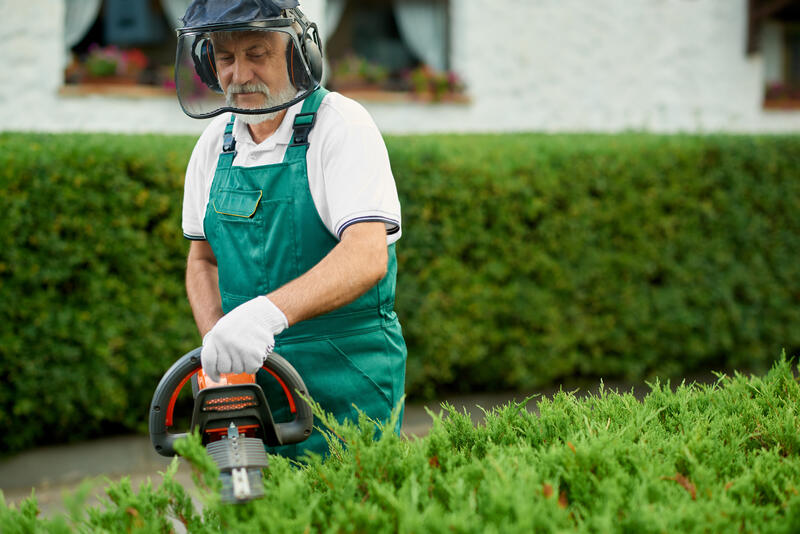
It may not be fashionable to don work gloves or eye protection, but these items protect you from serious injury. Here is what you should wear to protect yourself:
- Gardening gloves protect your hands from grime, cuts, lacerations, and skin irritation.
- Work boots significantly reduce the risk of severe yard work injury. Non-slip, sturdy work boots are ideal. Garza recommends steel-toe boots.
- Polycarbonate goggles or glasses keep debris and dust out of your eyes.
- Long sleeves and pants. Protective clothing reduces sunburn and the risk of injury.
- Wide-brimmed hat with neck flap. Protects you from the sun. (Sunscreen is also a must.)
- Hearing protection. Earplugs or noise-canceling headphones prevent hearing damage.
- Mask or face shield. Mowing kicks up dust and debris, so wear a face mask or bandana to cover your nose and mouth, especially if you suffer from asthma or other breathing problems.
- Warm winter clothing: If it’s cold or snowy outside, dress in layers and use water-resistant, breathable outerwear to stay warm and prevent frostbite.
| Tip: Don’t wear loose jewelry. Necklaces or bracelets can get caught on equipment, increasing the chance of an accident. |
| I have allergies and respiratory issues, so I always wear a face mask,” says Garza. “Whenever I wear a face mask, [it] greatly minimizes my issues because you are breathing up a lot of dust and crud and stuff, and that’s harmful to you. A lot of people don’t realize that.” Garza also advises homeowners to wear a face shield for protection: “It’s not if. You’re going to get hit in the face.” |
10. Create a Safe Work Zone
Before you start, take time to set up the safest environment possible to minimize any chance of a yard work accident.
- Use insect repellent to prevent mosquitoes, ticks, and other pests.
- Check outdoor conditions. Never work in dangerous weather conditions. Wet grass increases the chances of slipping or falling. Don’t work outside when the air quality is poor, especially if you are prone to asthma or other breathing problems.
- Clear the yard. Remove debris that can damage your mower or cause injury.
- Watch out for critters. Snakes or other critters hide in tall grass.
- Be careful on ladders. The most dangerous part of yard work is anything that involves getting on a ladder, says Garza. “If you’re not comfortable, don’t do it.”
| Garza shares the various types of injuries he’s suffered while doing lawn maintenance: • Cutting palm fronds down: “[I] didn’t realize that they had very sharp thorns.” • Mowing: “I’m weed eating, and the mower guy is mowing near me and kicks up a rock…it flung towards me and hit me, so I had a nice little bruise…like getting pegged with a baseball.” • Power washer: “I just got a power washer, and I was playing with it, and I power-washed my finger and had to go to the emergency room.” “Things like this happen all the time,” says Garza, even for a professional. |
11. Keep Children and Pets Away
According to a study in the journal Public Health Reports, lawn mower injuries, especially on the foot or toe, continue to be common for young children.
The authors explain that “based on our experiences treating these patients, this finding (makes sense).” “Young children (are) running into the yard while a family member is operating a lawn mower or sitting on the lap of a riding mower operator, falling, and their foot (is) trapped in the machine.”
To reduce the chance of mower-related injuries in children and pets:
- Keep children and pets out of the work zone.
- Never let a child ride with you on a riding lawn mower.
- Disengage the blades as you put the mower in reverse.
- Do not allow children to operate a push mower until they are 12 years old.
- Do not allow children to operate a riding mower until they are 16 years old.
See Related: Study: Half of Lawn Mower Injuries Involving Kids Require Amputation
12. Handle Chemicals With Care
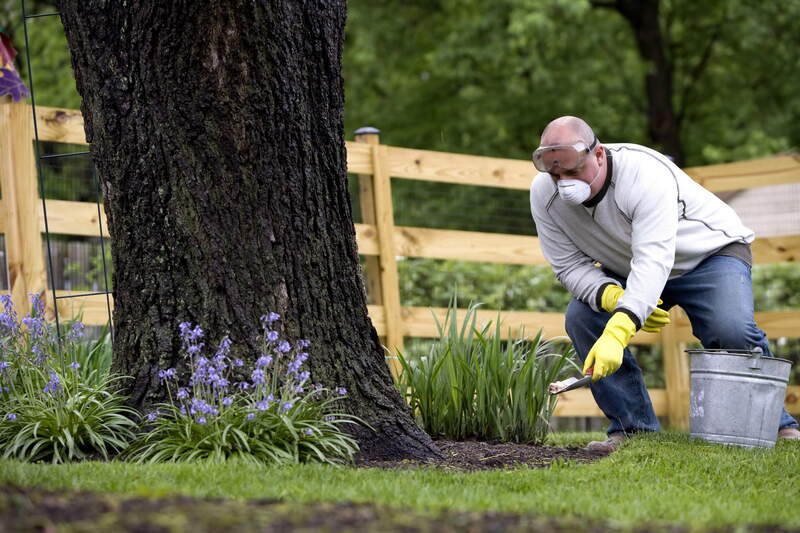
Working with chemicals is dangerous, so be careful when you apply fertilizers, insecticides, or herbicides. Carefully follow the label instructions, and avoid getting the chemical on your skin. Wear protective clothing during application.
When you’re done, store chemicals in a dry, safe space (for example, a locked cabinet) out of reach of children and pets.
13. Know When to Call Professionals
By practicing these yard work safety tips, you protect yourself from yard work-related injuries and potential hospital visits. Even so, you can’t completely eliminate every risk.
It may be time to call a pro if you:
- Have health problems or breathing problems
- Have limited mobility
- Don’t have time for lawn care
- Don’t have the right tools
If you’re still unsure about the potential risks of lawn maintenance, LawnStarter’s got you covered. Contact a local lawn care pro to handle all your yard work, including mowing, leaf removal, and more.
Read Next:
- Survey: 2024 Home Lawn Care Accidents
- 10 Tips for Staying Safe in the Garden
- Safety Tips for Lawn Care Pros
Sources:
“An Unusual Lawn Mower Injury: A Case Report.” By Maxwell Davison-Kerwood, David M. Langley, Alfredo Cordova, and Ashley Grant. Cureus.
“Ask an Expert – Three Tips for Preventing Injury in the Yard and Garden.” By Gabriela Murza, Extension associate professor. Utah State University.
Carlos Garza, owner of NC Dip and Clip, San Antonio, TX. Personal interview.
“CPSC Alerts Consumers to Lawn and Garden Care Dangers.” U.S. Consumer Product Safety Commission.
“Hydration is Key to Preventing Heat-Related Illnesses and Heat-Related Deaths.” By Eugene Livar, Chief Heat Officer. Arizona Department of Health Services.
“Incidence, Distribution, and Cost of Lawn-Mower Injuries in the United States, 2006-2013.” By Daniel G. Hottinger, anesthesiologist, Isam Nasr, associate professor, Joseph K. Canner, researcher, Deepa Kattail, anesthesiologist, Rahul Koka, assistant professor, and Deborah Schwengel, associate professor. Public Health Reports, 2018, Volume 133(5), pgs. 570-77.
“Lawn Maintenance Safety.” By David W. Smith, Extension program specialist. Texas A&M AgriLife Extension.
“Lawnmower Injuries a Persistent Source of Serious Injury and High Costs, New Study Affirms.” John Hopkins University.
“Pediatric Lawnmower Injuries: A 25-year Review.” By Ibrahim Khansa, Gregory D. Pearson, Kim Bjorklund, Alyssa Fogolin, and Richard E. Kirschner from the Department of Plastic and Reconstructive Surgery, Nationwide Children’s Hospital, Columbus, Ohio. JPRAS Open, 17 May 2021, Volume 29, pgs. 135-143.
“Preventing Sports Injuries.” Johns Hopkins University.
“Repetitive Strain Injury.” Cleveland Clinic.
“Safety Tips For Your Farm and Garden.” N.C. A&T State University.
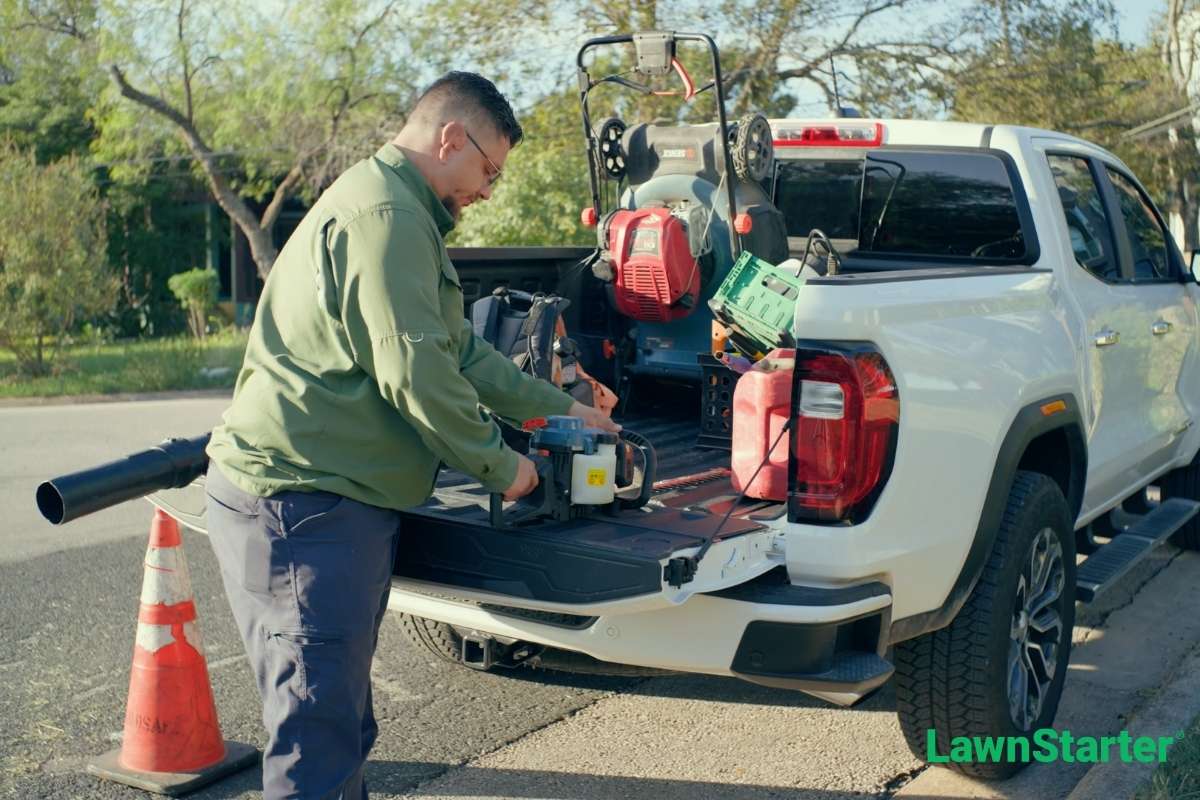
Main Image: Carlos Garza, LawnStarter pro. Photo Credit: Carlos Garza / LawnStarter.
Related Posts: