Struggling with yellow grass, puddles after rain, or bare patches? Your lawn might have compacted soil. You can tell by testing with a screwdriver — if it won’t easily push 6 inches into moist soil, you’ve got compaction.
Compacted soil prevents water, air, and nutrients from reaching grass roots, causing weak growth and lawn problems. Look for hard ground, poor drainage, shallow roots, thatch buildup, and wilting grass as telltale signs.
Need help fixing compacted soil? Get an aeration quote from local lawn care pros who can aerate the soil and recommend the best solutions to restore your lawn’s health.
What is Compacted Soil?
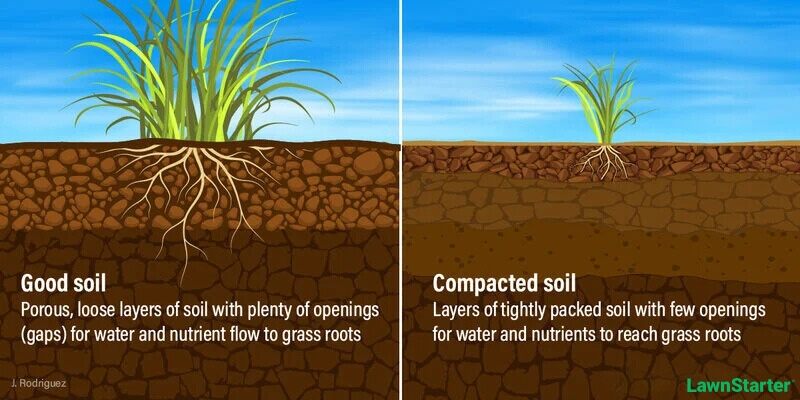
Healthy soil is about 50% pore space — tiny openings that let water, oxygen, and nutrients flow freely to plant roots. In compacted soil, particles are pressed so tightly together that these essential pores drastically shrink.
According to Steven Yergeau, an award-winning Rutgers Cooperative Extension agent, the resulting triple threat — restricted roots, limited water uptake, and poor nutrient absorption — is what makes compaction so damaging to soil health.
Plants grow slower, become more vulnerable to pests and diseases, and can’t withstand heat or drought.
Common causes of soil compaction:
- Heavy foot traffic or vehicles
- Construction equipment
- Clay-heavy soil that compresses easily
- Frequent mowing on the same path
- Intense rainfall on bare soil
See Related: Best Grasses for High-Traffic Yards
11 Clear Signs of Compacted Soil
1. Hard Ground You Can Barely Dig
The most obvious sign is when soil resists digging. Tasks like planting become frustratingly difficult — you can barely chip the surface with a trowel, and driving a shovel requires your full body weight just to penetrate a few inches.
For large or severely compacted areas, you’ll need a rototiller to break up the hard layers and make soil suitable for planting again.
2. Your Soil Fails the Screwdriver Test
It’s the most common lawn compaction test: Take a 6-inch screwdriver and push it into moist (not muddy) soil. In healthy soil, it should slide in easily. If you can’t push it all the way down, or it stops abruptly, you have compaction.
How to test properly:
- Wait 2-3 days after rain to test (dry soil always feels harder)
- Test multiple spots across your lawn
- Avoid rocks and roots
- For vegetable gardens, use a 2-3 foot metal rod since deep-rooted crops need loose soil much deeper
If the screwdriver won’t penetrate 6 inches into moist soil, your ground is compacted.
See Related: How to Test for Compacted Soil
3. Puddles Linger After Rain
When soil is compacted, water can’t seep through. Instead, rainfall pools in low spots and runs off raised areas, carrying valuable topsoil with it. It also washes away fertilizers and soil amendments before they can do any good, Yergeau says.
Scout your yard a few hours after normal rain. Puddles that remain long after other areas have drained indicate compacted zones. In yards of newly built homes, the entire lawn might stay flooded while neighbors’ lawns have absorbed the water.
See Related:
4. Yellow, Wilted Grass with Shallow Roots
Compacted soil can’t absorb water properly, so grass shows drought stress even with adequate irrigation. During hot summer days, you’ll notice patches where grass yellows, stops growing, and wilts while surrounding areas look healthy.
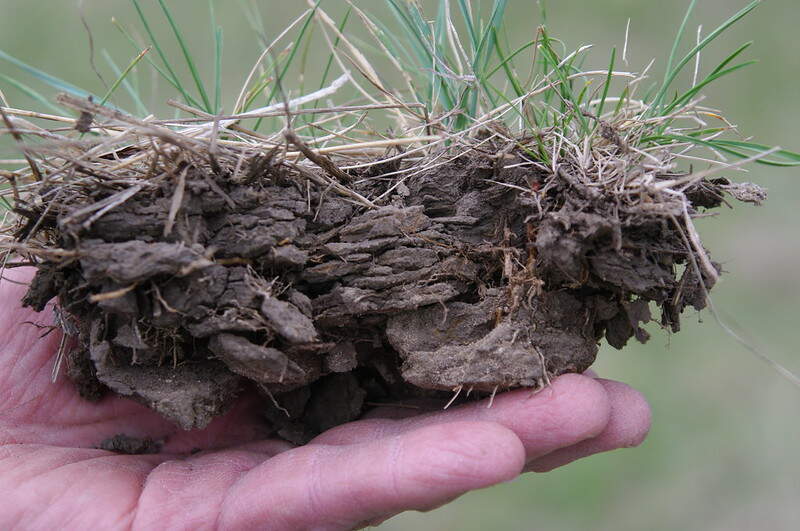
Dig up a sample — roots in compacted dirt grow in a shallow, pancake shape instead of growing downward. They spread horizontally in a tangled mass near the surface, making them extremely vulnerable to heat and drought.
“You will also see very few organisms living in the root zone (insects, worms, and the like) because the compacted soil is harder for these organisms to burrow through,” says Yergeau. Healthy soil should be teeming with life; compacted soil looks almost sterile.
5. Bare Patches and Erosion
When soil becomes severely compacted, nothing grows — not even weeds. You’ll see bald strips where pathways formed across the yard, or tire ruts if the mower follows the same route every time.
These bare areas turn muddy when wet and hard and dusty when dry. They’re the first to lose dirt particles through erosion caused by wind or rainfall.
See Related: How to Control Erosion in the Yard
6. Weeds With Taproots Take Over
When taproot weeds like dandelions, thistle, or Queen Anne’s lace spread across your lawn, suspect compaction. Nature uses these plants to break up hard layers — their strong, thick roots penetrate compact soil, improving drainage and aeration for future growth.
Other common weeds in compacted soil include chickweed, plantain, goosegrass, prostrate knotweed, and spotted spurge.
Note: Weeds can indicate other soil problems too. Dandelions also signal calcium deficiency, so check for multiple compaction signs before assuming the cause.
See Related: Reasons Why Weeds Grow in Your Lawn
7. Thatch Builds Up Quickly
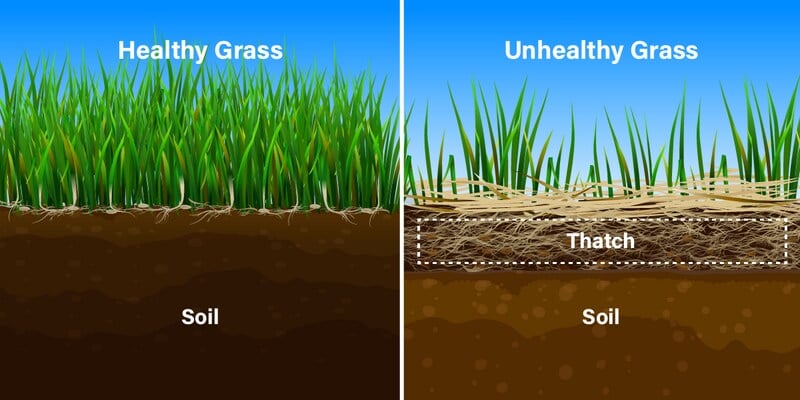
Thatch — the layer of dead and live grass between green blades and soil — decomposes slower on compacted ground.
Beneficial bacteria and fungi need air, water, and nutrients to break down organic matter. When soil is compacted, the microbial activity drops dramatically, which, as Yergeau explains, is precisely why thatch accumulates faster in compacted lawns.
When it’s over 1/2 inch thick, your lawn feels soft and spongy when you walk on it, but underneath, the ground is rock-hard. Remove the thatch layer and test with a screwdriver to confirm compaction.
Until you fix the compaction, dethatch more often to prevent turfgrass pests like grubs and chinch bugs from moving in.
See Related:
8. Fungal Diseases Appear
Compacted soil creates chronic stress for plants (limited water, restricted roots, poor nutrient uptake). According to Yergeau, “This stress can make lawns more susceptible to diseases from viruses, fungi, and other pathogens.”
Dense ground with poor drainage, often waterlogged after heavy rain, encourages lawn diseases like brown patch, pythium blight, and take-all root rot.
Compaction also reduces how well fungicides absorb into soil, making treatments less effective.
See Related: Common Lawn Diseases and How to Identify Them
9. Fertilizer Doesn’t Help
Experts at the University of Massachusetts found that compacted soil decreases nutrient uptake by 10%-30%. Yergeau confirms the connection: Compacted soil limits water reaching the roots, which in turn restricts nutrient absorption. This explains why grass looks chlorotic and thin even with proper fertilization.
Turfgrass in compacted soil has underdeveloped roots that can’t function properly. Adding more nitrogen won’t help — it can actually hinder root growth while forcing weak leaf growth, harming long-term turf health.
Instead of adding more fertilizer, fix the compaction first.
10. Grass Grows Slower
Soil compaction can decrease vertical leaf growth by up to 70%, according to turfgrass specialist Michael L. Agnew. Cramped roots with limited access to water and nutrients make grass grow noticeably slower.
If you compost grass clippings or use them as mulch, you’ll notice there’s less and less to collect after mowing.
See Related: Reasons to Use Grass Clippings as Mulch
11. Surface Crust Forms
Raindrops can compact bare soil and create a hard crust that prevents seedlings from breaking through. Surface compaction is typically under 1/2 inch deep but enough to stop germination.
This happens most often on clay-rich soil with fine particles and little organic matter. The hard crust is easy to spot: It looks smooth with many visible cracks, like alligator skin.
FAQ
Surface compaction from rainfall is usually less than 1/2 inch deep. Compaction from repeated foot traffic can extend 3-6 inches deep, while heavy equipment can pack down the soil up to 12 inches or deeper. Use a long metal rod or the screwdriver test to check depth.
Clay soil naturally has fine particles that sit closely together, while compacted soil has particles pressed together by external pressure (traffic, equipment, etc.). Clay soil is more prone to compaction, but even sandy soil can become compacted with enough pressure.
Mostly yes. “Hard dirt,” “packed dirt,” and “compacted soil” all describe ground where particles are pressed together with reduced pore space. The key difference is that “compacted” specifically refers to the reduction of air spaces that grass roots need to thrive.
Get Professional Help for Compacted Soil
Soil compaction is often hidden deep below the surface, making it hard to detect and treat on your own. If you suspect your lawn has compacted soil, the best solution is professional aeration.
Find a trusted lawn care pro with LawnStarter to help you identify problem areas and aerate your lawn properly. Professional core aeration pulls plugs from compacted soil, creating channels for air, water, and nutrients to reach roots and restore healthy, loose soil for the lush turfgrass you want.
Don’t let compacted soil ruin your lawn — get a free aeration quote today.
Sources:
- “Assessing and Addressing Soil Compaction in Your Yard.” By Steve Yergeau, county agent II, Ocean and Atlantic counties, Christine Raabe, Director, Ocean County Soil Conservation District, and Stephanie Murphy, Director, Rutgers Soil Testing Laboratory. Rutgers: New Jersey Agricultural Experiment Station.
- “Compaction and Cultivation.” UMass Extension Turf Program.
- “How Compaction Affects Tree Root Growth and Structure.” By Larry Morris, professor of Forest Soils. Warnell School of Forestry and Natural Resources. University of Georgia.
- “Learn to Read Your Weeds.” By Richard Bogren, professor emeritus, and Heater Kirk-Ballard, former LSU AgCenter horticulturist. Louisiana State University.
- “Soil Compaction.” By Jodi DeJong-Hughes, Extension educator. University of Minnesota Extension.
- “Soil Compaction Effects on Turf.” By Michael L. Agnew, former associate professor and turfgrass extension specialist at Iowa State University. Golf Course Magazine.
- Steven Yergeau, Ph.D., county agent II/associate professor with Rutgers Cooperative Extension of Ocean County and the New Jersey Agricultural Experiment Station. Personal interview.
- “Weeds as Indicators of Soil and Growing Conditions in Turf.” By Extension educators Victoria Wallace and Alyssa Siegel-Miles. UConn Extension.
- “What Makes Up a Healthy Soil?” By Hans Klopp, Extension soil health field specialist, Anthony Bly, Extension soils field specialist, and David Karki, assistant professor and Extension crop production specialist. South Dakota State University Extension.
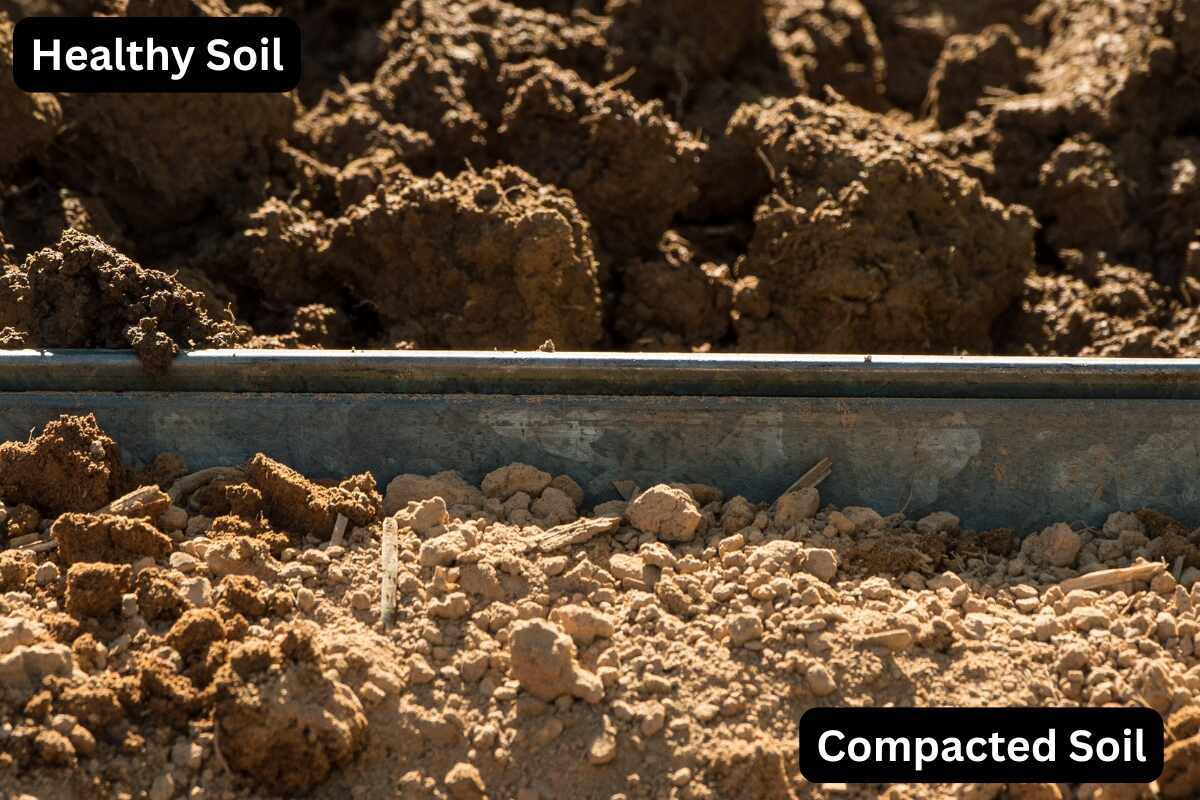
Main Image: Comparison of healthy soil and compacted soil. Image Credit: U.S. Department of Agriculture / Flickr with Text Overlay created using Canva Pro
Related Posts: