| Key Takeaways: |
|---|
| • Apply early morning or evening for best results • Always dilute per label instructions to avoid fertilizer burn • Expect visible greening in 24-48 hours |
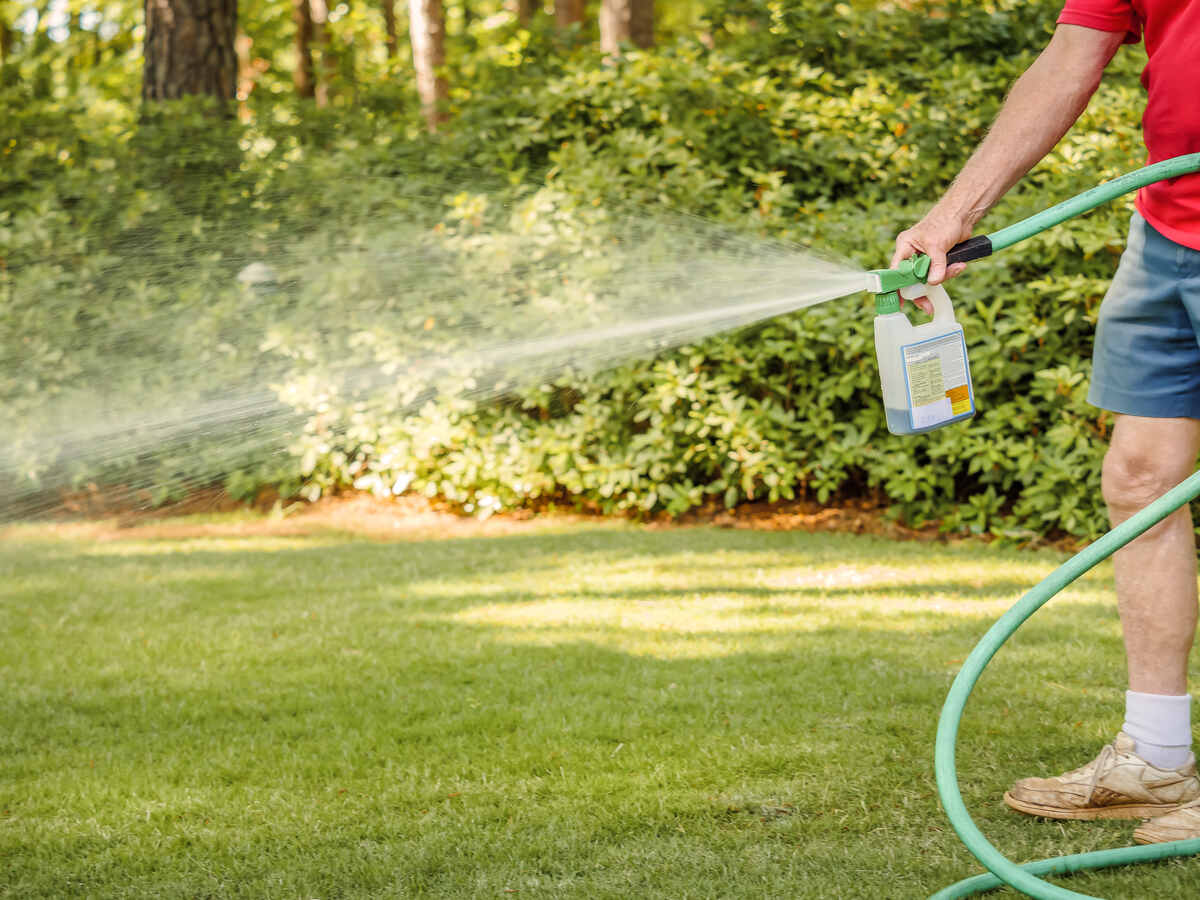
Applying liquid fertilizer is very straightforward, even if you’ve never done it before. Dilute the concentrate per label directions, then spray it evenly across your lawn, in the early morning, using a hose-end or pump sprayer.
Liquid fertilizers are ideal for quick fixes, mid-season boosts, or new grass. But timing and technique matter. Apply it wrong, and you risk fertilizer burn, patchy growth, or wasted money.
This guide walks you through 7 simple steps to apply liquid fertilizer correctly, including timing and equipment tips.
Need help? Get a free quote from lawn care pros for expert fertilization or weekly mowing and maintenance.
What is Liquid Fertilizer?
Liquid fertilizer is a nutrient solution applied to your lawn through spraying. Unlike granular products that break down over days, liquids are quick-release and deliver nutrients immediately to the plants or soil.
They’re available in 3 main types:
- Ready-to-spray formulas come pre-diluted and attach directly to your garden hose. No measuring or mixing required.
- Liquid concentrates require dilution with water. More economical for larger lawns, but need careful measuring.
- Water-soluble powders mix with water to create a solution. They have a long shelf life but require mixing before each use.
See our article, Liquid vs. Granular Fertilizer, for a complete comparison.
When to Apply Liquid Fertilizer

Timing your liquid fertilizer application can make a big difference in how well it works.
Scott Culala, owner of The Lawn Cypress in Gardner, Kansas, says, “When using a liquid fertilizer, you want to apply it in the early morning and when temperatures are below 80 F, so it can absorb into the grass instead of evaporating quickly.”
Take a look at these guiding tips:
Best season: Late spring through early fall during active growth
Best Time of Day:
- Early morning (6-8 a.m.): Dew helps nutrients cling to grass
- Evening (6-8 p.m.): Allows 8-12 hours of contact time before the sun
Conditions to Avoid:
- Right before heavy rain
- During drought/heat stress or midday applications
- When temperatures exceed 85 F
- On dormant or frozen grass
- Within 48 hours of herbicide use
How to Apply Liquid Fertilizer: 7 Steps
Once you’ve chosen the right time and conditions, applying liquid fertilizer isn’t complicated, but doing so in the right order matters. These step-by-step instructions will walk you through the process:
Step 1: Choose the Right Fertilizer
Start with a soil test, which will tell you which nutrients are present in your soil and what is missing.
Then, look at the three numbers on the fertilizer package, which represent nitrogen (N), phosphorus (P), and potassium (K) percentages, and pick the best one based on the soil test’s report. Example: 10-5-5 = 10% N, 5% P, 5% K.
For more information on picking a fertilizer, read our article: How to Choose the Right Lawn Fertilizer.
See Related: Reasons Why Soil Testing Is Important for the Lawn
Step 2: Prepare Your Lawn
Here’s what you need to do before actually applying the fertilizer to your lawn:
- 1-2 days before: Water lawn thoroughly (1/2 to 1 inch)
- 24 hours before: Mow to desired height; pull visible weeds
Important: If using herbicides, wait 7 days before fertilizing.
Optional but Beneficial:
- Aerate compacted soil
- Dethatch your lawn if thatch exceeds 1/2 inch
Step 3: Gather Equipment & Safety Gear
Liquid fertilizers are applied with a sprayer. If your fertilizer doesn’t come with a built-in sprayer, you can use either a pump sprayer or an attachment for your garden hose.
Inspect sprayers before use to check for clogs. Pump sprayers work best for lawns under 5,000 square feet, while backpack sprayers are for larger areas.
Here’s What You’ll Need:
- Hose-end sprayer OR pump/backpack sprayer
- Garden hose (for hose-end)
- Measuring cup
- Water source
Moreover, liquid fertilizer can cause skin/eye irritation and chemical burns at high concentrations. Don’t skip protection.
Safety Gear (Required):
- Safety glasses
- Long sleeves and pants
- Closed-toe shoes
- Chemical-resistant gloves
Step 4: Mix the Fertilizer
Next, mix your fertilizer (if necessary). Many fertilizers must be diluted in water to be used safely, but some don’t.
For Concentrates:
- Read the label for the dilution ratio (typically 2 to 8 ounces per gallon of water).
- Fill the sprayer halfway with water, add the fertilizer concentrate, then top it off with more water.
- Shake thoroughly or use a mixing paddle attached to a drill.
- Test the spray pattern on bare soil or gravel.
For ready-to-spray: Attach to hose, no mixing needed.
Critical: Never use undiluted concentrate. Culala says that fertilizer burn with liquid products is most common when the mixing ratio is off, which is why careful measuring is essential.
Step 5: Apply the Fertilizer
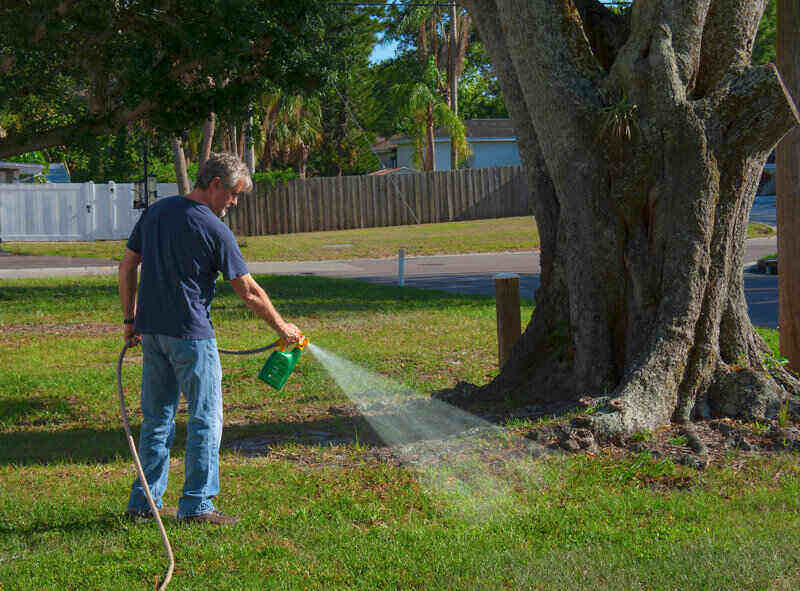
With everything mixed and ready, it’s time to start applying the fertilizer:
Application Technique:
- Start with the perimeter to establish the boundaries.
- Walk in straight, parallel rows like mowing.
- Hold the sprayer 12-18 inches above the grass.
- Overlap each pass by 6-12 inches.
- Maintain a steady pace (about 3 feet per second).
- Stop if puddling occurs to adjust your pace.
Culala says that even for pros, it is “hard to (achieve an) even application” with liquid fertilizers, which is why he tends to prefer granular fertilizers.
Common Mistakes:
- Stopping in one spot (causes burn)
- Missing areas (creates stripes)
- Over-applying (wastes product, burns grass)
- Spraying on windy days (uneven coverage)
Wait for wind under 10 mph. Wind above 15 mph causes significant drift.
Step 6: Inspect Your Lawn
After applying liquid fertilizer, take a few minutes to check your work, especially within the first 30 minutes:
- Look for missed patches
- Check for over-saturated spots
- Spot-treat if needed
Warning Signs 24-48 Hours Later:
- Discoloration or burned grass: That can mean over-application. Water heavily to dilute.
- No improvement: Wrong product or underlying pest/disease
- Excessive growth: Too much nitrogen
Step 7: Water Your Lawn (If Needed)
Do you need to water in liquid fertilizer? It depends. Most foliar liquid fertilizers don’t need to be watered in, and watering too soon can wash nutrients off before they’re taken up. As Culala explains, “(Homeowners) should wait at least 24-48 hours to water.”
Soil drench applications deliver nutrients to the root zone. In this case, light watering helps move nutrients into the soil, so roots can access them.
Water 2-4 Hours After If:
- Applied to soil (moves nutrients to roots)
- No rain expected within 24 hours
Do NOT Water If:
- Applied as foliar feed (let leaves absorb 24 hours)
- Product label says, “Do not water in”
How much: 1/4 to 1/2 inch. Just enough to activate, not flood.
See our guide, How Long Should I Water My Lawn?, for more guidance.
What If You Apply Liquid Fertilizer Wrong?
If you overapply liquid fertilizer, it can cause fertilizer burn, which occurs when salt concentration pulls moisture from grass tissue.
Common Causes:
- Undiluted concentrate
- Over-application
- Wrong NPK ratio for your soil
- Application to dry/stressed grass
- Staying in one spot too long
Symptoms: Discoloration on grass blades, yellow tips, crispy grass texture
How to Fix It:
- Water immediately and heavily (1-2 inches over several days).
- Continue daily watering for a week to flush salts.
- Avoid mowing until the grass has recovered.
- Wait 2-3 weeks, then overseed damaged areas if necessary.
FAQ
How often you apply liquid fertilizer depends on your grass type and whether you’re feeding for routine maintenance or a short-term boost.
For most lawns, liquid fertilizer should supplement, not replace, a standard fertilization plan. Stick to 3 to 4 feedings of slow-release fertilizer per year, using liquid fertilizer only when you need fast results or to correct a specific problem.
See Related:
– When to Fertilize Your Lawn
– When is the Best Time to Apply Fall Fertilizer?
Sometimes. Check labels for compatibility; some combinations are not compatible. Safest approach: apply separately, 7-10 days apart.
If you’re dealing with only a few isolated weeds, hand-pull or spot-treat them with herbicides before fertilizing.
Sometimes. Liquid fertilizer can help new seedlings by delivering nutrients quickly. However, skip this step if you already applied a starter fertilizer at planting, since additional feeding too soon can overstimulate growth.
If no fertilizer was applied at planting, use diluted starter fertilizer once the grass reaches 1-2 inches. Apply every 2-3 weeks until established.
Read more about new lawns in our guide: How to Care for New Grass
When to Call a Fertilization Professional
Liquid fertilizer works great when applied correctly, but it’s not always the easiest DIY task. For larger lawns or when you want consistent results, hire a fertilizer pro to make the process easier.
If you need help maintaining your new, lush growth, contact a LawnStarter lawn care professional near you. They’ll mow and edge your grass so you can enjoy coming home to a tidy, well-manicured lawn all season long.
Read Next:
Source:
Scott Culala, lawn care professional and owner of The Lawn Cypress, Gardner, KS. Personal interview. [email protected]
Main Image: Person spraying lawn with liquid fertilizer sprayer. Image Credit: Shutterstock