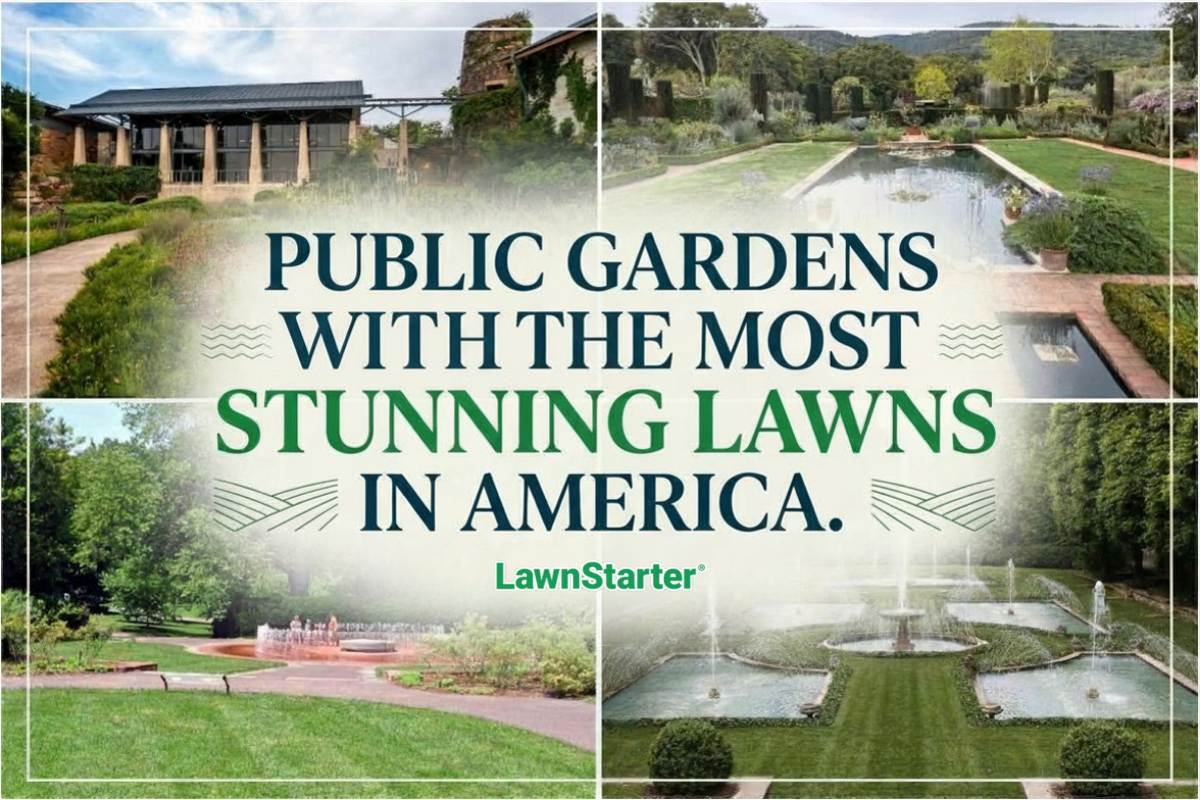
Two gardens sit side by side in St. Louis. Both were founded by the same man in the second half of the 19th century, and both are still open to the public, but represent different ideas of what grass is supposed to do.
Tower Grove Park is a Victorian pleasure ground covering 289 acres of open turf designed for picnics and neighborhood life. Missouri Botanical Garden is a formal collection where turf changes its presence room by room: replaced by water in the Ottoman Garden, structure and stage in the Victorian district, and part of the garden’s soul in the Japanese Garden.
Same founder. Same city. Two entirely different relationships between people and grass.
This contrast is the key to understanding what makes a public garden lawn genuinely remarkable.
Let’s walk through 11 of the public gardens with the most stunning lawns in America. We’ve grouped these into civic pleasure grounds, designed garden landscapes, estate lawns, and gardens showcasing the native and meadow tradition. Each entry includes admission details and visitor tips, everything you need to plan a visit worth making this summer.
- 1. Tower Grove Park – St. Louis, MO
- 2. Forsyth Park – Savannah, GA
- 3. Audubon Park – New Orleans, LA
- 4. Missouri Botanical Garden – St. Louis
- 5. Red Butte Garden and Arboretum – Salt Lake City, UT
- 6. Longwood Gardens – Kennett Square, PA
- 7. Dumbarton Oaks – Washington, DC
- 8. Filoli – Woodside, CA
- 9. Newfields – Indianapolis, IN
- 10. Bellevue Botanical Garden – Bellevue, WA
- 11. Lady Bird Johnson Wildflower Center – Austin, TX
Civic Pleasure Grounds
1. Tower Grove Park – St. Louis, MO
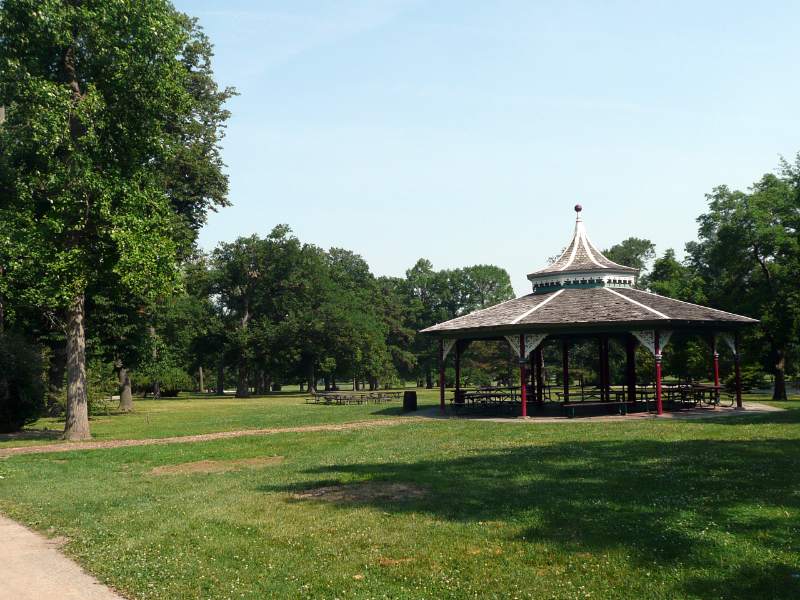
Shaw’s outdoor classroom, still in session
Walk into Tower Grove Park on a Saturday morning, and you’ll see what a well-loved lawn looks like. A kickball game runs on the open grass, a group has claimed a patch of lawn for yoga, and somewhere near the Music Stand, a mother opens a picnic basket. The grass brings it all together.
This is what Henry Shaw had in mind. More or less.
When he donated this land in 1868, Shaw, the English-born businessman and amateur botanist, designed it as an outdoor classroom for citizens of all classes. He created a Gardenesque landscape with exotic specimen trees spaced far apart so visitors could walk among them, study them, and find what he called “utility, variety, and beauty.” The low-cut Victorian lawn was the stage.
150 years later, this stage is thriving under more foot traffic than most historic parks ever face. Every year, Tower Grove draws over 2.5 million visitors across 289 acres, past 10 Victorian pavilions that rank among the best-preserved park architecture in the country, and beneath roughly 7,000 trees from 340 species.
LawnStarter takeaway: A simple, open lawn is the best backdrop for a few specimen trees or shrubs worth showing off.
Visitor Tips: Visiting with kids? Stop by the paddock near the historic stable. You might catch Moonshine the Clydesdale and her pint-sized companion Ricochet, grazing close enough to say hello.
Admission: Free. Open sunrise to sunset.
2. Forsyth Park – Savannah, GA
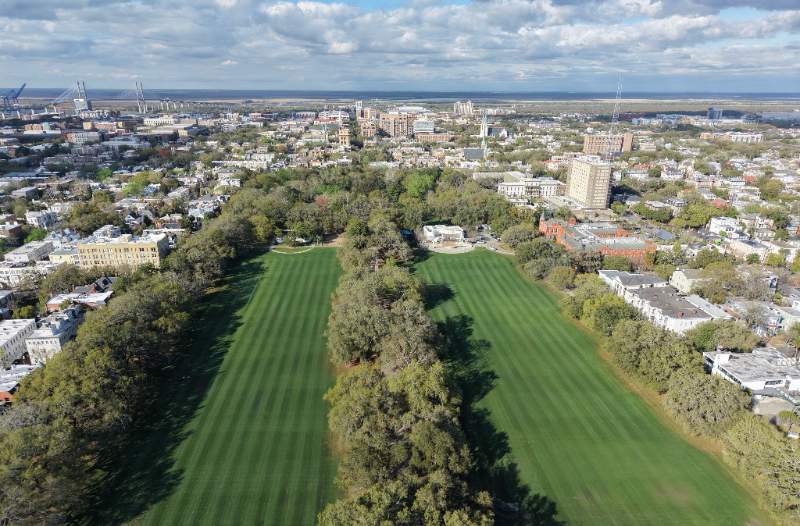
The lawn that stays green year-round
The fountain stops you first — 168 years old, gloss-white, with mermen blowing water through shell horns at the base. Then come the live oak alleys, long and moss-draped, with the hush of a cathedral. And then, the main lawn opens, as far as the eye can see.
Mid-lawn stands the Civil War Memorial, Nova Scotia sandstone turned silver from age. Left and right, uninterrupted green covers everything in sight, framed on all sides by oaks planted in 1871.
Millions of people visit Forsyth Park each year, and many of them end up on the lawn. Jason Mahl, Neighborhood Parks Maintenance Division Director, and his staff make sure the grass can take it. His crew aerates multiple times each summer and mows 3-4 days a week. They water the turf as needed, keeping in mind to be efficient with their water use.
The grass itself is on a strict schedule: Every October, they overseed the Bermuda with perennial ryegrass to keep the lawn green through winter; every May, Bermuda returns for the heat and the crowds. The goal, Mahl says, is to keep all 16 acres usable, for everyone, all year long.
LawnStarter takeaway: The most used lawns are usually the simplest ones. Leave room for the frisbee.
Visitor Tips: The 1858 Forsyth Fountain is the park’s centerpiece and one of the most photographed landmarks in the South. Worth seeing in the morning before the crowds and heat arrive.
Free admission. Open daily.
3. Audubon Park – New Orleans, LA
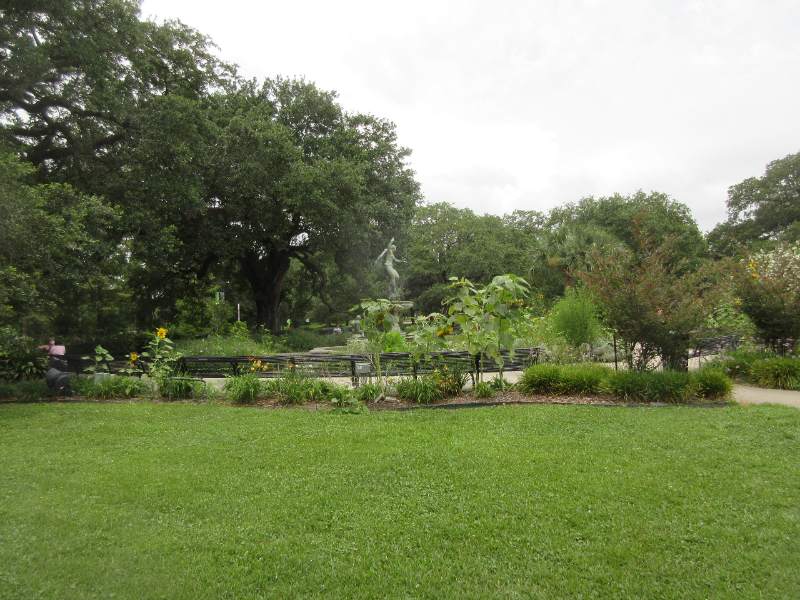
The lawn built on what was once a swamp
Enter Audubon Park by St. Charles Avenue, and the oaks slowly close over you: branches spreading wide, draped in Spanish moss, some of them dipping low enough to graze the ground. The oldest ones here predate the park by a century or more. Their deep shade, a shield from the heat of the city.
That was the idea. In 1898, John Charles Olmsted arrived at a swampy flatland, his first major solo park project. He dug a lagoon to drain the water and built what he believed every city needed: somewhere to escape it. Today, it’s 340 acres of park: wide-open lawns for strolling and picnics, an 81-acre golf course, tennis courts, baseball fields, and a jogging path that locals have circled for generations.
The lagoon is still there. So is Ochsner Island, a small wooded rise in the middle of the water where hundreds of great egrets and night herons nest each spring. On a quiet morning, you hear them before you see the water.
LawnStarter takeaway: If your lawn holds water after rain, a shallow swale or dry creek bed helps drain it while adding contour to your yard.
Visitor tip: Take the St. Charles streetcar from Canal Street. It passes through the Garden District before dropping you across from the park entrance. The ride is half the experience.
Admission: Free. Open daily.
The Designed Garden Landscape
4. Missouri Botanical Garden – St. Louis
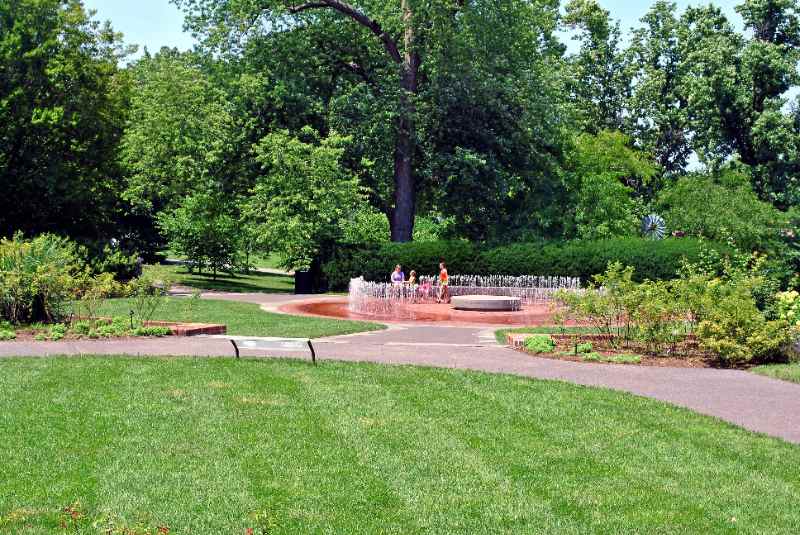
Shaw’s garden, plus a ride around the world
Phileas Fogg traveled the world in 80 days. At the Missouri Botanical Garden — Henry Shaw’s 79-acre Victorian garden, now a living catalog of the world’s landscaping traditions with 6 international gardens — you can do it in one afternoon.
The Ottoman Garden is the first surprise. A walled courtyard where water does what turf does everywhere else: It rests the eye. A reflecting pool (the havuz) anchors the center with roses and pomegranates crowding the edges.
Deeper in, the Victorian District uses the lawn as a stage. It frames everything here: Henry Shaw’s Mausoleum, Tower Grove House, and the 20 circular pincushion beds rising from the turf on the way to Piper Observatory.
At the far end of the garden, the logic shifts again. In the Seiwa-en, the 14-acre Japanese strolling garden designed by Koichi Kawana, the grass is the journey. Wide, open turf surrounds a central lake and lets the eye settle on the water.
Before you leave, double back to the Kemper Center for Home Gardening. Here, grass is science. Different turf varieties grow in labeled side-by-side plots, and plant specialists answer any questions you have.
LawnStarter takeaway: Grass can play many roles. Find the right one for your yard.
Visitor Tips: Visiting with kids? Don’t miss the Children’s Garden. The Climatron — the first geodesic dome ever used as a greenhouse — is a must-see.
Admission: $6-$16 adults, free for kids under 13
5. Red Butte Garden and Arboretum – Salt Lake City, UT
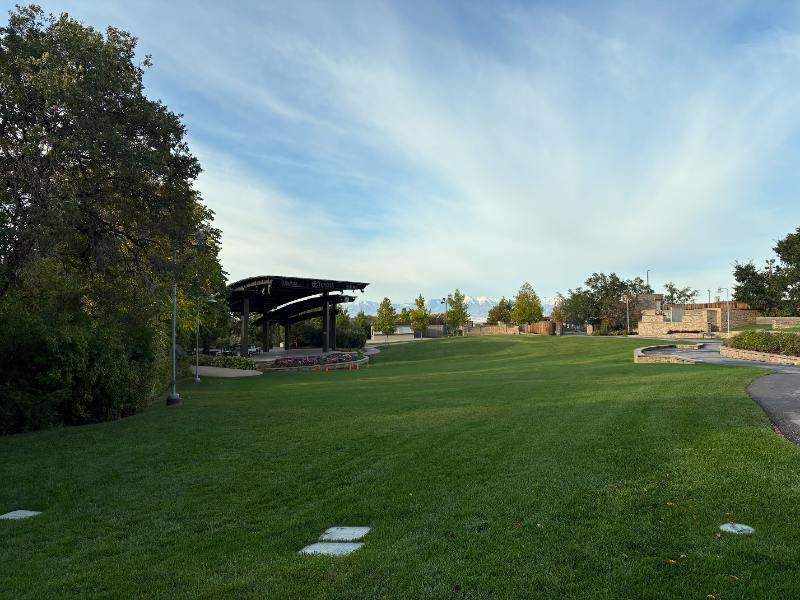
A lawn that holds 3,000 people in the desert
Every green lawn in Salt Lake City is irrigated. At 16 inches of annual rainfall, there’s no other way. Red Butte Garden has spent four decades figuring out which plants, including grass, can survive here and how. Turfgrass covers less than 9% of its developed land, says Trevor Owens of Red Butte’s irrigation team.
The hardest-working of that 9% is the Amphitheater lawn — rebuilt in 2008, planted with turf-type tall fescue, and kept dense through Utah heat, desert drought, and up to 32 concerts a season. “That’s the commitment we made and have maintained since 2008,” Owens says.
3,000 people per show compact clay soil hard enough to shut off water to the roots, so teams coordinate to make sure the lawn stays dry before every concert, explains Owens. Wet soil under that much foot traffic causes more damage than dry soil.
According to Owens, weather station controllers calculate daily water needs and run irrigation in short cycles with breaks between each. Every year, the lawn gets overseeded to hold its density.
Beyond the Amphitheater, the rest of the garden opens up: the Floral Walk winding through serviceberry tunnels and pear arbors in bloom from February to November, the Water Pavilion’s reflecting pool holding the sky and playful koi, the Herb Garden with its unexpected design.
LawnStarter takeaway: Before you repair your lawn, visit Red Butte’s Water Conservation Garden. Plants are grouped by water need, from twice weekly to none, and what thrives at the dry end might surprise you.
Visitor tips: Walk the Oak Tunnel slowly. You’re passing 19th-century Gambel oaks. This shade predates the garden.
Admission: $15 – $18 for adults; $10.00 for youth (3-17); free for children under 2.
6. Longwood Gardens – Kennett Square, PA
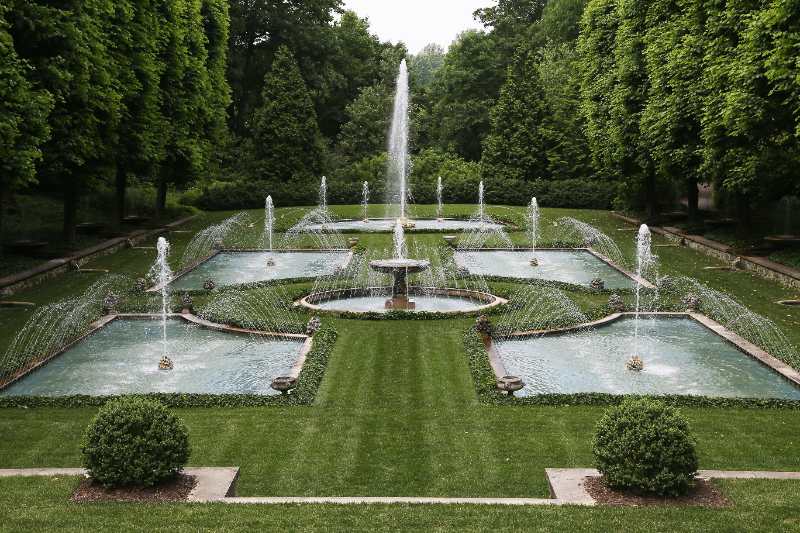
The lawn managed as a golf course
You’ll probably walk right past it without noticing. The grass at Longwood Gardens is close-cut and even, cool underfoot. The kind of lawn that reads as a simple backdrop while 175-foot fountain jets climb the sky in front of you, and hand-pruned linden trees frame the space. But beneath that simplicity lies precision engineering.
Underneath the irrigated sections of this garden — the formal lawns framing the fountains, the rose garden, the Italian Water Garden — 164 sensors track soil moisture, temperature, and salinity in real time. No gardener walks the lawn deciding when to water. The sensors do.
Between 2018 and 2021, this cut water use by 28% in the Main Fountain Garden. The grass didn’t notice. Neither did the 1.6 million visitors walking each year across USA Today’s best botanical garden in America.
This kind of precision has roots. Pierre du Pont, who created these formal gardens, made the far pools of his Italian Water Garden 14 feet longer than the near ones so they’d look identical from the terrace. Find that terrace when you visit. See if you can tell.
LawnStarter takeaway: Add a rain sensor to your sprinkler system, and you get the home version of Longwood’s systems. Water when the soil needs it, not when the clock says.
Visitor tips: Don’t miss the evening illuminated fountain performance on weekends. The 175-foot jets are even more dramatic after dusk.
Admission: ~$25–$35 adults; $20 youth (ages 5-15); free for children under 4.
Estate Lawns
7. Dumbarton Oaks – Washington, DC
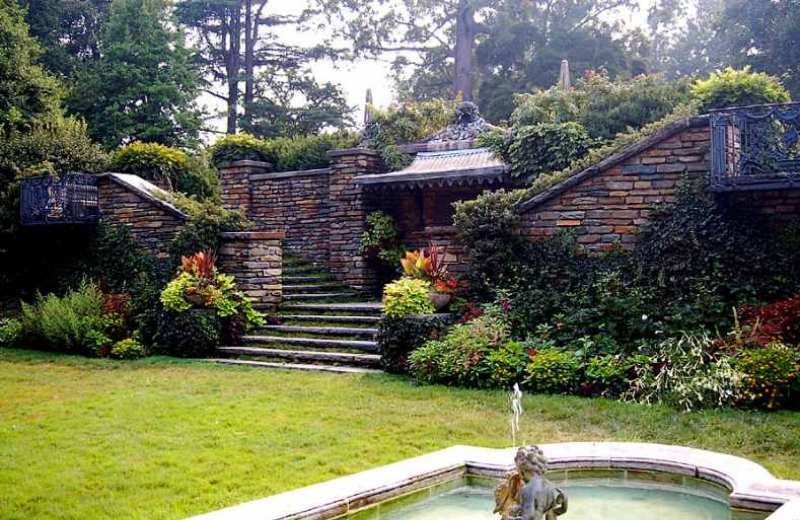
The tapis vert, or green carpet
Walk uphill from M Street, pass through the painted and gilded wrought iron gate at 31st and R Streets, and the city noise drops away. You’re entering Dumbarton Oaks.
Beatrix Farrand began reshaping this hillside in 1921, building a garden that descends from the hilltop in terraces, each room separated from the last. Beech shade gives way to boxwood, and then, the sound of water.
The Fountain Terrace is where you find it, along with lawn design at its best. At the center lies a tapis vert (literally, “green carpet”), a green tapestry of close-cut grass, and Farrand built everything else around it.
Two lead cherubs anchor the ends, spouting thin jets of water into mossy limestone pools. Pressed along the walls, tulips bloom in the spring, salvia in summer, chrysanthemums in autumn — primrose and yellow, deepening to bronze by the end of season. The lawn holds still. The water sounds. Tree shadows move slowly across the grass as the day turns, and if you time it right, so will you.
LawnStarter takeaway: Any backyard can hold this stillness. Clear the center, edge it with flowers, and let the grass do the quiet work in between.
Visitor tips: Come in winter. Admission is free, the crowds are gone, and the bare garden reveals the architecture Farrand built. Reserve online in advance.
Admission: $15 (March – October), free November-December. Children under 2 years — always free. Buy tickets online; none sold on site.
8. Filoli – Woodside, CA
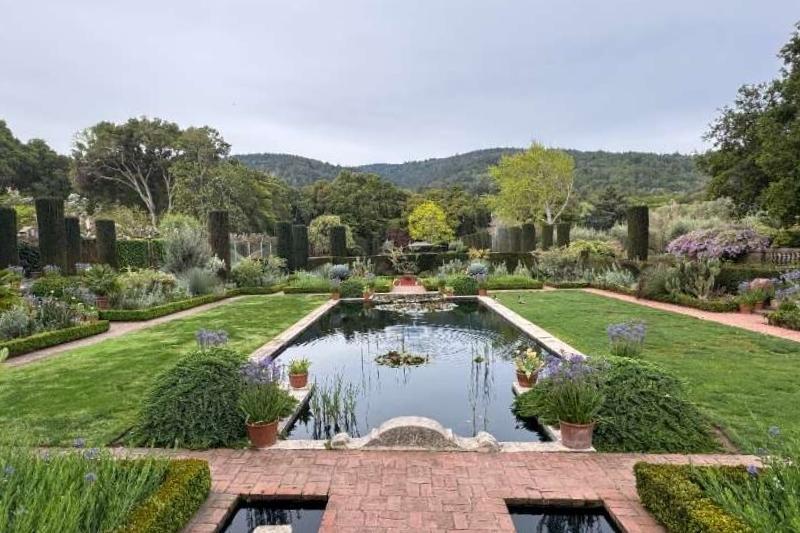
The most important lawn in the garden
At the heart of the Filoli estate in Woodside, California, sits the Sunken Garden. In 2022, Filoli filled it with Mediterranean and desert plants to showcase the season’s theme: “Blue/Gold — The Power and Privilege of Water.” The response was so resounding that the display stayed. Four years later, it is still there. So is the lawn.
Two panels of close-cut turf flank the lily pond, framed by limestone coping and three brick pathways.
“Of all our turf, we want this to look lush and vibrant all year long,” says Jim Salyards, associate director of Horticultural Initiatives. “Keeping up with the irrigation, putting eyes on it while it’s running, is critical to making sure it stays healthy.”
California has been testing that commitment for 50 years. Before Filoli had pipes, the staff spent two full days a week watering the entire garden by hand. Now the garden uses weather-connected smart clocks. “Having efficient irrigation systems is how we water just enough, but not too much,” Salyards says.
This is likely the last summer you’ll see turf and the drought display side by side, says Salyards. Come before it changes.
LawnStarter takeaway: Smart irrigation timers help, but watch your sprinklers run once a month. Dry patches and pooling water don’t show up on a clock.
Visitor tips: Co-hosting the American Public Garden Association’s annual conference June 8-12, Filoli is engineering the beds to be colorful and filled by then. Visit the week after for the full show without the crowds.
Admission: $45 for adults; $43 for seniors; $35 for children.
9. Newfields – Indianapolis, IN
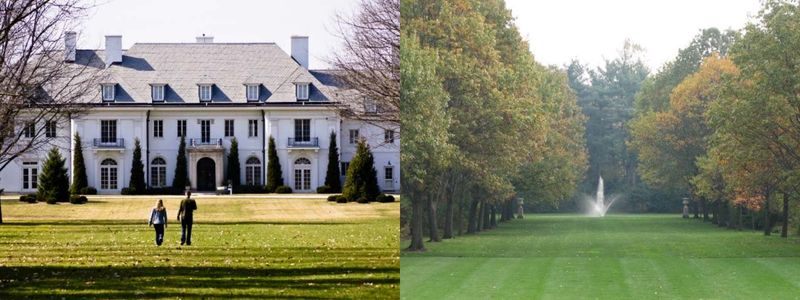
Oldfields at Newfields, looking toward Lilly House.
Photo Credit: Paul J Everett / Wikimedia Commons / CC BY 2.0

Right Image:
Reverse view down the Grand Allée toward the fountain.
Photo Credit: Tonamel / Wikimedia Commons / CC BY 2.0
The lawn with a hidden road
At Newfields, home to the Indianapolis Museum of Art, the lawn is a trick.
The estate was the Gilded Age home of J.K. Lilly Jr., whose family built the pharmaceutical company Eli Lilly Co., now known for weight-loss drugs like Mounjaro. In front of the Lilly House, the Grand Allée, a wide grass corridor, looks like a single unbroken sweep of turf. It isn’t.
Percival Gallagher of the Olmsted Brothers firm set Woodstock Drive straight through the middle of it, but dropped the road surface just low enough that it disappears when you look down at the grass from either end. You see only the lawn.
He also planted the flanking oaks in decreasing size from foreground to background. Standing at Lilly House, the Allée appears to stretch further than its length, with a large fountain at its far end.
Behind the house, the garden descends more than 40 feet through winding paths to a rock-lined stream that feeds three pools. The Allée looks carefully designed. The Rapp Ravine Garden feels like it just grew there.
LawnStarter takeaway: Give your front lawn a focal point (bench, specimen tree) at the far end of your sight line. It makes a small lawn feel longer than it is.
Visitor Tips: Come in the spring. A river of bulbs blooms through the Allée’s center.
Admission: $20 for adults. Check discovernewfields.org for free admission days.
The Native and Meadow Tradition
10. Bellevue Botanical Garden – Bellevue, WA
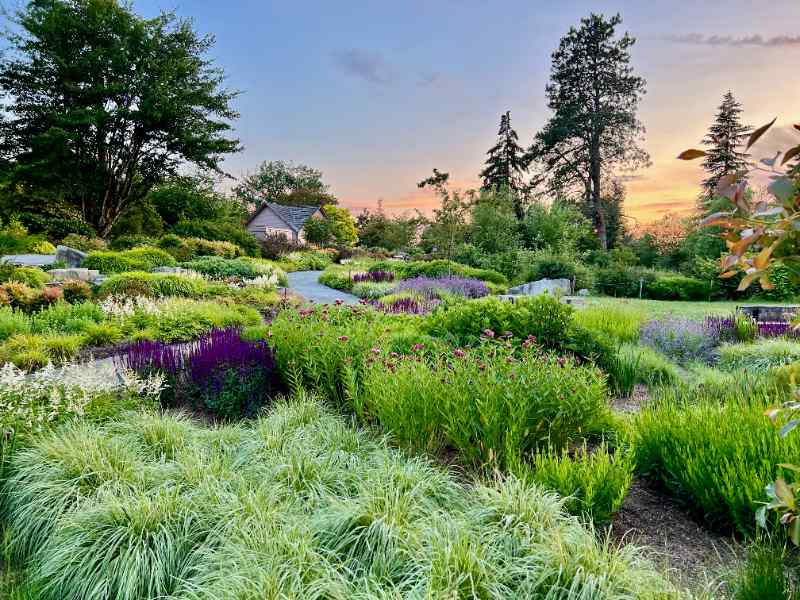
Where the lawn decides to change
Bellevue Botanical Garden has already faced the decision many homeowners dread. In 2017, the Garden’s lawn facing Main Street, waterlogged after construction and compacted to near-solid clay, was pulled up and replanted as a native meadow.
Designer Jil Stenn composed it piece by piece: native and adaptive shrubs, bunchgrasses, and perennials layered for year-round color and pollinator value. More than 450,000 visitors now walk through the Urban Meadow without knowing turf was ever there.
When Garden Director James Gagliardi arrived in 2022, he noticed the Astilbe planted in full sun was burning, behaving not like a Pacific Northwest staple, but like a plant suffering through a Mid-Atlantic July.
“I took this as a sign that conditions in Seattle are changing,” he says, “and some plants that were once dependable in certain situations were not producing the same results they had in the past.”
The Astilbe moved to a shaded area, and heat-tolerant perennials took their place.
Visitors had noticed something else, too: The meadow had peaks — highs and lows of appeal across the season.
“To bridge this gap,” says Gagliardi, “we added more flowers with extended blooms: Coreopsis, Geraniums, Penstemon, Nepeta, and many varieties of Allium.” Foliage color was also a guiding idea: more Amsonia cultivars for golden yellow foliage in the fall, and Penstemon ‘Dark Towers’, one of Garibaldi’s favorites, for its purple foliage and multiple-season interest.
LawnStarter takeaway: The hardest part of replacing a lawn is not knowing what to plant instead. Bellevue has been choosing and revising for nearly a decade. Visit for inspiration.
Visitor tips: QR codes on plant markers link to the garden’s full plant database (worth using if you want to bring ideas home).
Admission: Free. Open dawn to dusk.
11. Lady Bird Johnson Wildflower Center – Austin, TX
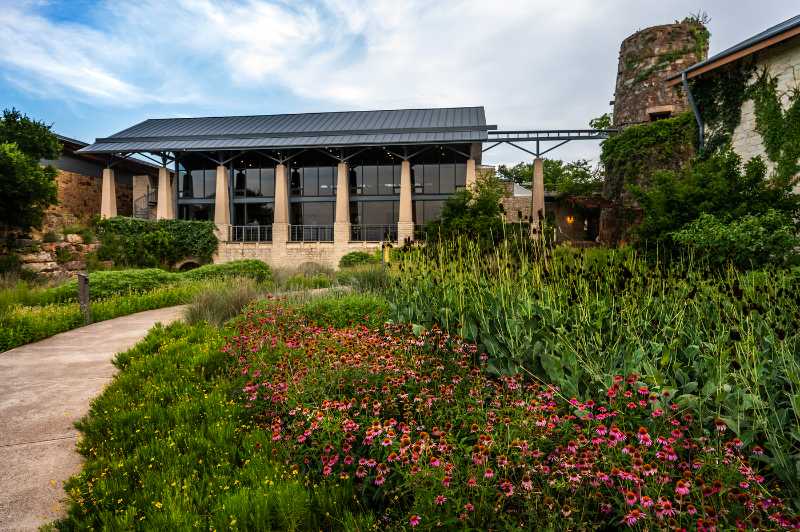
Where you can see what it was before the lawn
In Central Texas, a conventional lawn is a struggle. The heat is relentless, the soil thin, the summers dry enough to turn turf brown without constant irrigation. But the land already knows what to do, if you let it.
Lady Bird Johnson grew up watching wildflowers move across the East Texas landscape without anyone tending them. On her 70th birthday in 1982, she founded a research center dedicated to a simple idea: Plants already here were worth understanding, protecting, and growing.
Walk Lady Bird Johnson Wildflower Center’s 284 acres in April, and you see what she meant. Bluebonnets and Indian paintbrush fill the landscape in wide, unhurried sweeps of color. In the Formal Garden, buffalo grass and pine muhly stand in structured borders, neat and quiet like the Texas dawn. Step into the Naturalistic Garden, and red columbine and mountain laurel grow proud and free.
Texas has everything your yard needs, and it’s on display at the Lady Bird Johnson Wildflower Center.
LawnStarter takeaway: Built a beautiful, resilient yard by replacing some turf with native plants. They look gorgeous and need little to no maintenance.
Visitor tips: Bring sunscreen and a hat to face the Texas sun.
Admission: $12 and $18 adults; $9-$12 youth (3-17), free for children under 2. Open 9 a.m. to 5 p.m. daily (garden entry ends at 4 p.m.)
Main Image: Public garden collage showing America’s stunning lawns. Image Credits: Already attributed in the article