| Key Takeaways |
|---|
| ● Rake like you're doing a workout. Leaf raking injuries follow from treating a moderate-intensity exercise like a light chore. ● Back injuries lead the list. About 1 in 4 raking-exertion ER visits are lower back injuries; warm up, bend at the knees, and take a break every 20 to 30 minutes to avoid one. ● Chest pain is an emergency. Roughly 1 in 5 ER visits are cardiac or systemic events, and chest pain or lightheadedness means stop and call 911. |
Leaf raking looks like a chore, but your lower back treats it like a workout.
An estimated 7,700 people landed in the emergency room in 2025 with leaf raking injuries, according to a LawnStarter analysis of U.S. Consumer Product Safety Commission (CPSC) injury data.
Why? Raking counts as moderate-intensity exercise, closer to doubles tennis than sweeping the porch, and the twisting, bending, and lifting add up, especially if you’ve been sitting at a desk since spring.
According to a chiropractor, most raking injuries are avoidable with a warm-up, steady pacing, and a few changes to how you rake. Follow the tips below to have a safe, injury-free fall season.
History of back problems, allergies, or a big yard? A LawnStarter leaf removal pro can take the physical part off your plate.
- Why Raking Leaves Is Harder on Your Body Than It Looks
- The Most Common Leaf-Raking Injuries
- How to Rake Without Hurting Yourself
- Warning Signs You Should Stop and Rest
- How to Recover After a Long Raking Day
- Who Should Be Cautious or Avoid Raking
- Choosing the Right Rake Matters, Too
- A Rake You’re Not Even Using Can Hurt You
- FAQ
Why Raking Leaves Is Harder on Your Body Than It Looks
Raking is a repetitive-motion activity, and repetitive motion with poor technique and no warm-up or recovery time is what causes overuse injuries. Every pull of the rake stresses the same spots in your lower back, shoulders, neck, and forearms and can cause strains and sprains.
That work counts as a moderate-intensity exercise, the same level the CDC assigns to doubles tennis and power yoga.
Treating raking like it’s not exercise is one of the biggest mistakes people make, says Kevin O’Hara, a chiropractor at O’Hara Family Chiropractic in Arlington Heights, Illinois. So is trying to finish the whole yard in one day and working for several hours without a break.
“Just as you wouldn’t go to the gym and deadlift for 3 straight hours, you shouldn’t rake continuously,” he says.
For some people, a few hours of leaf raking is the most strenuous activity they do all week. Sports medicine calls it the “weekend warrior” pattern, described by Mayo Clinic as sitting all week, then taking on a sudden strenuous activity your body isn’t ready for.
For an unprepared body, that sudden exertion can strain the heart. Roughly 1 in 5 raking injuries treated in the ER is described as a cardiac or systemic event such as chest pain or fainting.
The Most Common Leaf-Raking Injuries
Raking commonly causes:
- Lower back strain and sprain from bending, twisting, or lifting heavy, wet leaf piles
- Shoulder and neck strain from repeating the same motion without switching arms
- Arm and forearm pain from repeated gripping and pulling
- Knee and hip discomfort from kneeling or squatting while bagging leaves
Most of these never reach an ER. Among those that do, the lower back accounts for about a quarter of visits.
Among the cases that are admitted (at least an overnight stay), about 66% are cardiac or systemic events presenting as chest pain, fainting, and in some cases, confirmed irregular heartbeats and heart attacks.
Falls are another serious risk and the main reason people are admitted to the hospital after raking when the cause isn’t cardiac. One 92-year-old woman fell while raking leaves and broke a bone in the left side of the face along with her pelvis.
How to Rake Without Hurting Yourself
O’Hara estimates that 60% to 80% of the patients who show up after a weekend of raking could have “either avoided the injury entirely or significantly reduced its severity.”
Start by treating raking as a workout:
- Put on supportive shoes with real tread.
- Dress in light layers you can shed as you warm up.
- Warm up with a 5-minute walk, then stretch your neck, shoulders, hips, and hamstrings.
The American Academy of Orthopaedic Surgeons recommends stretching slowly and gently, holding a stretch for 10 to 30 seconds. No bouncing, and it shouldn’t hurt.
According to Johns Hopkins Medicine, most raking injuries come from bad form. Here’s how to avoid them:
- Bend at the knees, not the waist, whenever you pick up a pile or a bag.
- Keep the motion in your arms and shoulders, not your torso. Drive the pull toward you with a step back, not a wrist yank.
- Switch your lead hand every few minutes.
- Take a break every 20 to 30 minutes, even if you feel fine, and drink water.
“The leaves don’t care if they’re picked up today or tomorrow. Your spine does. Pace yourself, listen to your body, and remember that the goal is to enjoy your yard, not spend the next week recovering from it,” O’Hara says.
Bagging adds bending, twisting, and lifting to a job that’s already repetitive, which is why this is where a lot of backs give out:
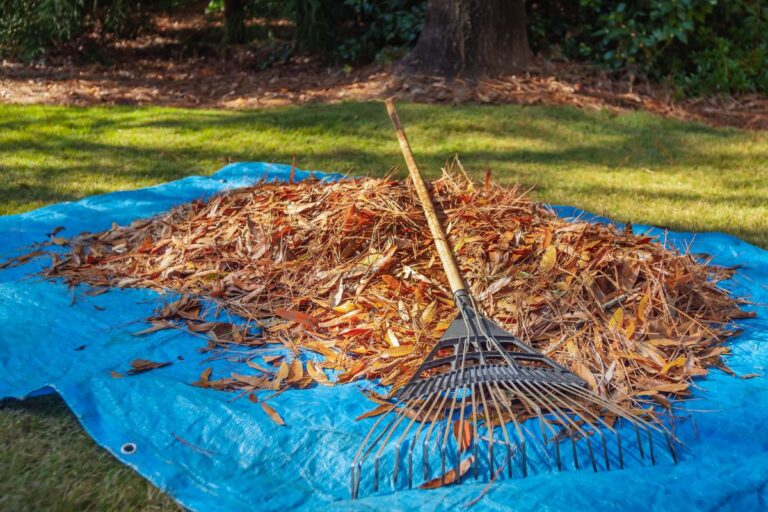
- Use a tarp to drag leaves to the curb instead of repeatedly bending to scoop and carry them.
- Don’t overfill leaf bags, especially wet ones.
- Never sling a full bag over one shoulder. Carry it low and centered, or drag it.
See Related:
Warning Signs You Should Stop and Rest
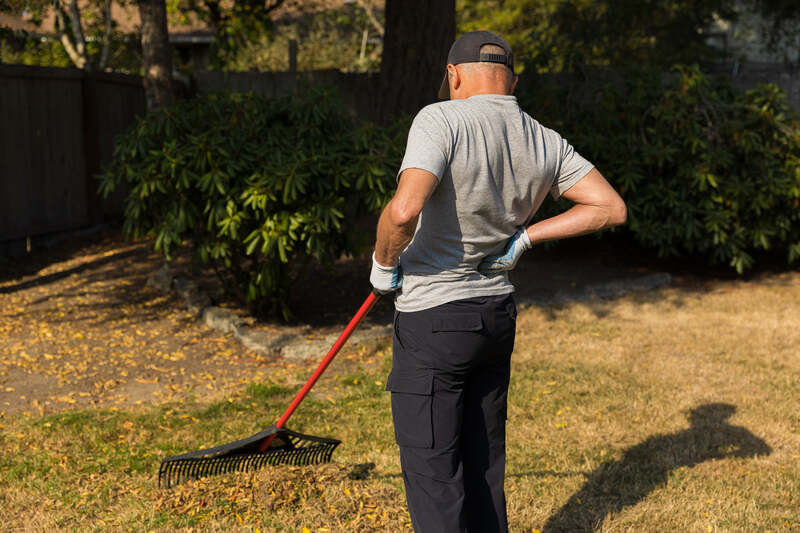
According to O’Hara, the biggest mistake people make is trying to “push through” increasing pain to finish the yard. “By the time they stop, they’ve often turned a mild muscle strain into an injury that takes weeks to heal.”
Pain in your muscles, back, or joints signals it’s time to take a break. Most of the time, it’s temporary and will resolve with rest.
O’Hara says he grows more concerned when the pain:
- Feels sharp instead of achy
- Travels into an arm or leg
- Brings numbness, tingling, or weakness
- Keeps worsening after 48 to 72 hours
“Pain that makes it difficult to stand upright, walk normally, or sleep comfortably deserves to be evaluated,” he says.
Chest pain, shortness of breath, a cold sweat, or lightheadedness is a different matter. The American Heart Association considers these symptoms an emergency. Stop and call 911.
How to Recover After a Long Raking Day
Everyone responds to exertion differently.
“Some muscle soreness for a day or two is perfectly normal, especially if you haven’t been active recently,” O’Hara says.
That delay is normal and has a name: delayed onset muscle soreness. It sets in 1 to 3 days after the activity, not during it, and usually fades within a few days. It rarely lasts more than 5 days, according to Cleveland Clinic.
O’Hara recommends light activity over total rest. “Go for a short walk, do some gentle stretching, and avoid collapsing into a chair for the rest of the evening,” he says.
Cold helps while a spot still feels tender; heat helps a back that’s stiff rather than sore.
Who Should Be Cautious or Avoid Raking

Johns Hopkins advises anyone with a history of heart, lung, bone, joint, or spine problems to check with a healthcare provider before raking.
Age matters too, even without a diagnosis. 74% of people who end up in the ER after raking are 55 or older, according to the CPSC data.
“Older adults who aren’t physically active throughout the year are especially vulnerable,” O’Hara says. “That doesn’t mean they can’t enjoy yard work, but they should work in short sessions, use proper body mechanics, and know when to stop.”
And when the job is too big, splitting it among family members or hiring it out is often the smartest call. As O’Hara puts it, “A few hours of help is often much less expensive than weeks of pain or recovery.”
See Related: How Much Does Leaf Removal Cost?
Choosing the Right Rake Matters, Too
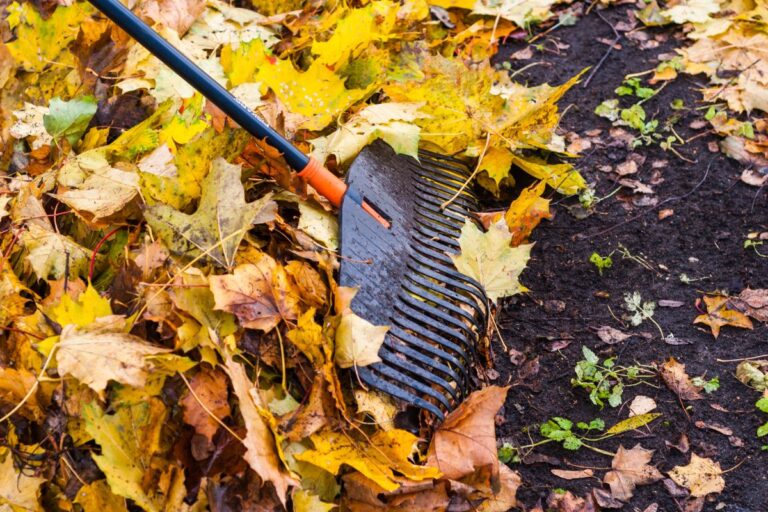
A rake that’s the wrong height forces you to hunch or overreach. Look for one tall enough to use while standing upright, with a padded handle to reduce grip fatigue.
Lightweight rakes with wide, fan-style heads mean fewer total strokes to clear the same ground. Less repetitive motion, less injury risk.
See Related: 12 Types of Rakes: Uses and Tips
A Rake You’re Not Even Using Can Hurt You
The rake itself is a separate hazard once you set it down. About 4,100 people went to the ER in 2025 after stepping on, tripping over, or being struck by a rake, with children 17 and under accounting for 20% of these cases.
Nearly half of these injuries are as simple as stepping on a rake left tines-up in the grass, which usually means a puncture wound to the foot. A 36-year-old woman stepped on one left in the yard, and the handle swung up and hit her in the head, causing a concussion.
They’re also the easiest yard injuries to prevent:
- Hang rakes on a wall hook or a tool rack when you’re done.
- Lay a rake tines-down if you’re setting it aside mid-job.
- Don’t prop one against a wall where wind or a passing child can knock it over.
When Hiring a Pro Beats DIY
Good form helps, but it doesn’t erase the risk of a big yard or a back problem. LawnStarter’s leaf removal pros handle the whole job. Get an instant quote, choose a time, and a background-checked local pro takes it from there.
FAQ
Yes, it’s a moderate-intensity, repetitive-motion activity, which is why warming up matters as much as it would before a workout.
Raking involves more sustained twisting than most chores, and that motion puts direct stress on the discs in your lower back.
Occasional strain usually resolves on its own, but repeated poor form over many seasons can lead to chronic back or shoulder issues, which is why proper technique is worth learning.
Methodology
LawnStarter analyzed 2025 case records from the CPSC’s National Electronic Injury Surveillance System (NEISS), a sample of roughly 100 U.S. emergency departments that CPSC weights to produce national estimates.
Cases were reviewed individually and sorted into 2 groups, reported separately throughout: 146 cases of injury sustained while raking (national estimate 7,650) and 76 cases of injury caused by contact with a rake as an object (national estimate 4,100). NEISS captures only ER-treated injuries, so the true totals are higher.
Read More:
Sources:
Kevin O’Hara, chiropractor at O’Hara Family Chiropractic in Arlington Heights, Illinois. Personal interview.
National Electronic Injury Surveillance System (NEISS). Consumer Product Safety Commission.
“Take Care When Raking Leaves.” Johns Hopkins Medicine.
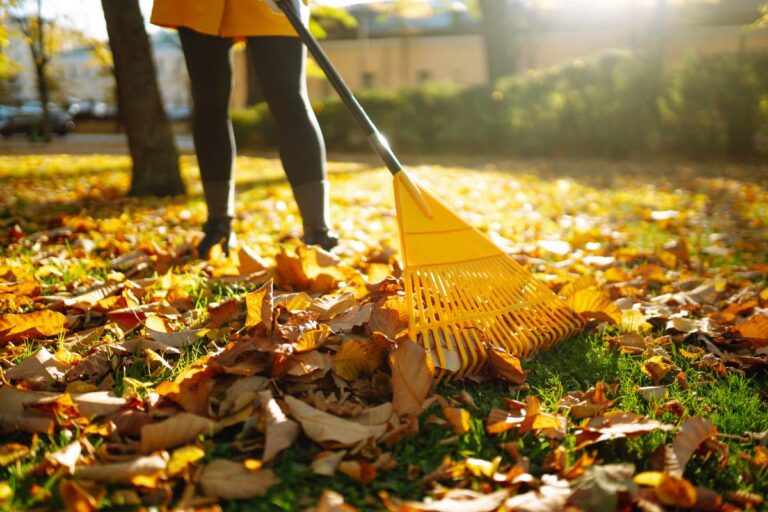
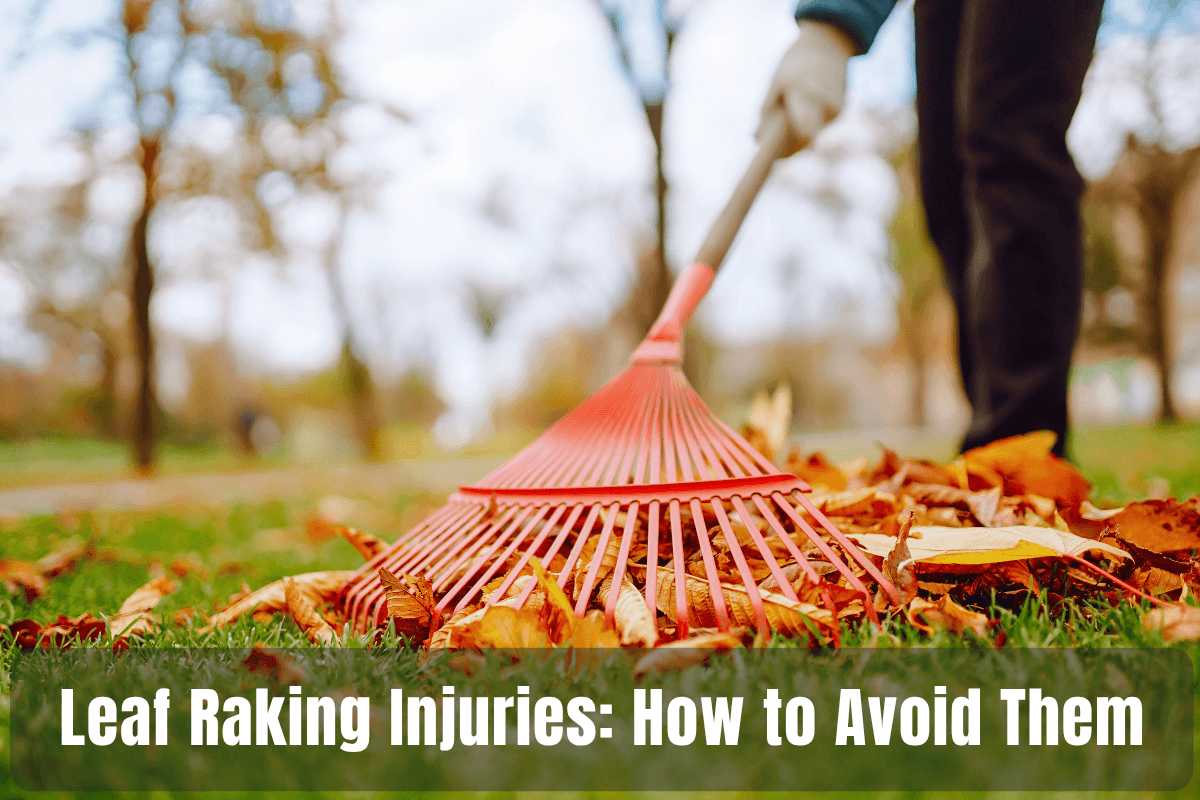
Main Image: A person rakes a pile of autumn leaves. Photo Credit: maxbelchenko / Adobe Stock
Related Posts: