Mulch Calculator: How Much Mulch Do You Need?

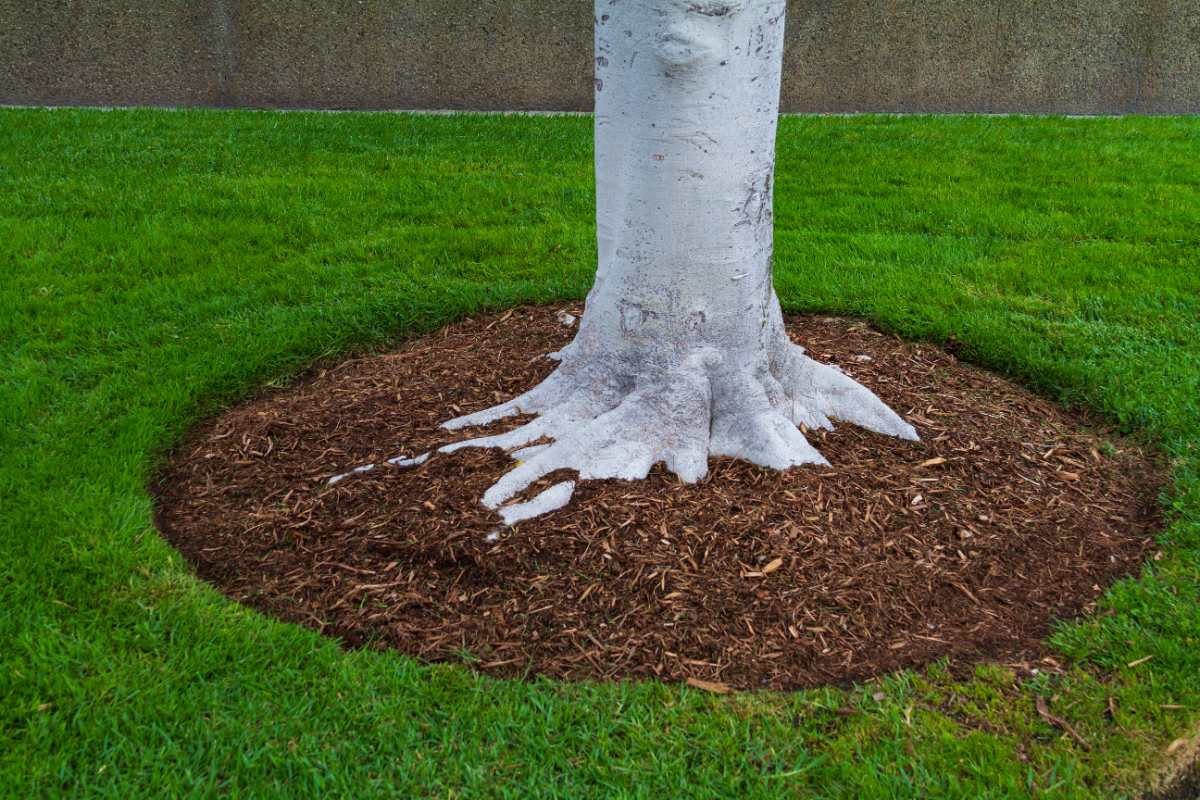
Tree trunk with exposed roots surrounded by a circular ring of brown mulch, set in a neatly maintained green lawn.

Three-quarters through the garden bed when the last bag runs out? Let’s make sure that doesn’t happen. 

Start with the depth. You need 1-2 inches when refreshing existing plantings or mulching vegetable beds, and 3-4 inches for new beds and areas around trees. Once you know the depth, multiply it by your square footage and divide by 12 — that gives you the cubic feet to buy.

Quick example: A 200-square-foot bed at 3 inches deep needs about 50 cubic feet — 1.85 cubic yards of bulk mulch or 25 bags at 2 cubic feet each. Use our calculator below or follow the manual steps to determine exactly how much mulch your project needs.

Need help with mulch installation? LawnStarter connects you with our local landscaping pros who handle measuring, delivery, and spreading — no math required.

Key Takeaways
Standard depth: 1-2 inches to refresh existing mulch; 3-4 inches for new beds and around trees
Quick formula: Square feet × depth in inches ÷ 12 = cubic feet needed
One cubic yard (27 cubic feet) equals 13.5 two-cubic-foot bags. 

Quick Reference: Mulch Conversion Charts
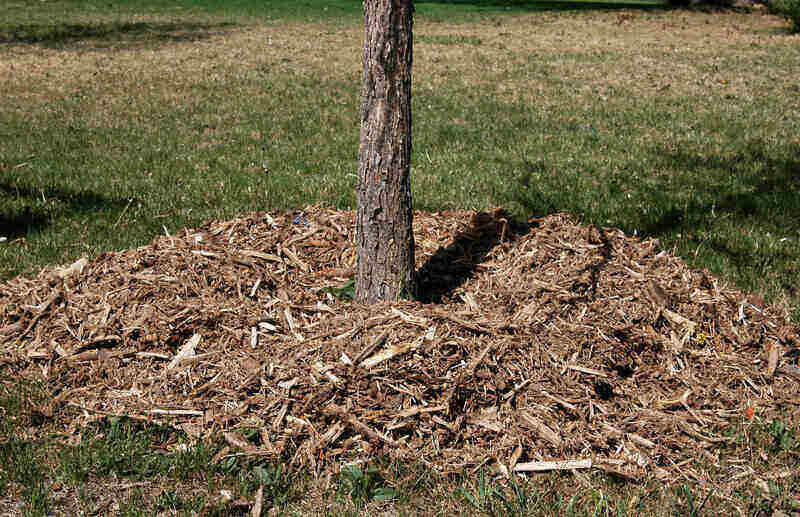
Tree trunk surrounded by a wide ring of wood mulch in a grassy yard, with bare soil visible near base.
Fresh mulch around the base of a tree. Photo Credit: MSPhotographic / Shutterstock

Whether you’re buying online or comparing bagged vs. bulk prices in the store aisle, mulch math is nobody’s idea of fun. Here’s a shortcut: Use the charts below to figure out how much mulch you need. 

Or skip the arithmetic entirely with our landscape mulch calculator further down. 

Bags of Mulch in Cubic Yards

Cubic Yards2 cu. ft. Bags1.5 cu. ft. Bags1 cu. ft. Bags
1 yard13.5 bags18 bags27 bags
2 yards27 bags36 bags54 bags
3 yards40.5 bags54 bags81 bags
4 yards54 bags72 bags108 bags

Estimated Coverage by Depth

Mulch Amount2″ Deep3″ Deep4″ Deep
1 cubic yard162 sq. ft.108 sq. ft.81 sq. ft.
2 cubic feet (1 bag)12 sq. ft.8 sq. ft.6 sq. ft.
1.5 cubic feet (1 bag)9 sq. ft.6 sq. ft.4.5 sq. ft.

Key conversion: 1 cubic yard = 27 cubic feet. To convert cubic feet to yards, divide by 27. To convert yards to cubic feet, multiply by 27.

How Much Mulch Per Square Foot?

Mulch DepthCubic Feet per Sq. Ft.
1 inch0.08 cu. ft.
2 inches0.17 cu. ft.
3 inches0.25 cu. ft.
4 inches0.33 cu. ft.
6 inches0.5 cu. ft.

Example: For 100 square feet at 3 inches deep, you need 100 × 0.25 = 25 cubic feet (about 0.93 cubic yards or 12.5 two-cubic-foot bags).

Mulch Calculator

Choose the shape of your garden bed, then add its measurements (e.g., length and width) in feet and the mulch depth in inches. If you want a cost estimate, select the price unit, then enter the price you’ve seen in the store.

Click Calculate. You’ll get the amount of mulch in cubic yards, cubic feet, tons, and bags, along with the estimated cost.

Mulch Calculator

Mulch Calculator

Area Length Width
Please enter a valid length greater than 0
Please enter a valid width greater than 0

Quick Mulching Tips

DON’T

  • ❌ Pile mulch against tree trunks. This can cause bark rot and invite pests.
  • ❌ Pile mulch against your house foundation
  • ❌ Till carbon-rich mulch (e.g. sawdust) into the soil, it can tie up nitrogen.

DO

  • ✓ Remove weeds before applying mulch
  • ✓ Keep mulch 2-3 inches away from plant stems and 3-4 inches away from tree trunks
  • ✓ Refresh mulch when it starts to decompose, usually annually.

How to Calculate Mulch: Step-by-Step

Step 1: Measure Your Area

Get accurate measurements using smartphone apps like MeasureKit and iPhone Measure, or a measuring tape for straight edges. 

Area formulas to use (or the mulch estimator above ↑) :

  • Rectangle: Length × Width
  • Circle: 3.14 × (Radius × Radius)
  • Triangle: (Base × Height) / 2

Example: A 20-foot by 10-foot rectangular bed has 20 x 10 = 200 square feet

For multiple garden beds with various shapes, calculate each bed separately, then sum the cubic feet. Convert the final total to yards or bags and add a 10% buffer for irregular edges.

Step 2: Choose Your Mulch Depth

LocationRecommended Depth
New beds2-4 inches
Existing beds (refreshing mulch)1-2 inches
Around shrubs2-3 inches
Around trees, on pathways3-4 inches
Vegetable gardens1-2 inches

Leave 1-2 inches of clear space around stems, 3-5 inches around shrubs, and 3-6 inches around tree trunks to prevent rot and pest problems. 

See Related: How Deep Should Much Be?

Step 3: Calculate Volume

Insert the area and depth in our mulch calculator above or use the formula below:

Square Feet × (Depth in Inches / 12) = Cubic Feet

Example calculation for 200 square feet at 3 inches deep:

200 × (3 / 12) = 200 × 0.25 = 50 cubic feet

→ Convert to cubic yards (bulk mulch): 50 cubic feet / 27 = 1.85 cubic yards

→ Convert to bags (2 cubic feet bags): 50 cubic feet / 2 = 25 bags

Bulk vs. Bagged Mulch: Which Should You Buy?

Green hosta plant growing in reddish wood mulch, viewed from above, with broad variegated leaves spreading outward in sunlight.
A variegated hosta plant surrounded by red wood chip mulch. Photo Credit: Tony Unruh / Flickr / CC BY-SA 2.0
Choose Bulk Mulch IfChoose Bagged Mulch If
• Large projects needing 2-5 cubic yards of mulch or more
• Vehicle access for delivery
• Free delivery, or you have a truck to haul it yourself
• Projects need under 2 cubic yards
• No delivery access or storage space
• Need easy transport in a sedan or SUV
• Doing touch-up work or small bed maintenance

Cost Comparison

  • Bulk pricing: $30-$135 per cubic yard
  • Bagged pricing: $44-$112 per cubic yard ($3.25-$8 per 2-cubic-foot bag)

Need more than 2 cubic yards of mulch? It may be cheaper and less time-consuming to buy in bulk.

“If a client doesn’t have the proper means of transportation for bagged mulch, they’ll most likely have to make multiple trips back and forth between the store and home,” says Ciondre Pinnock, the owner of Full Cycle YDM, a landscaping business in New Jersey. 

Many suppliers offer free delivery on bulk orders of 5 cubic yards or more. Depending on quantity, you can save between 7% and 35% on wood-based mulch. 

Here’s an example for shredded hardwood mulch: 

  • Bulk: 5 yards x $42/yard = $210 
  • Bagged: 68 bags x $3.33/bag = $228 
  • Savings: $18

Price source: Mulch and Stone (Maryland) for bulk; Home Depot for bagged.

The price decreases with the amount, so the more you buy, the cheaper per cubic foot. They also vary with location, type of mulch, and provider, so search carefully for the best option before you buy. 

See Related: How Much Does Mulch Cost?

Types of Mulch and Coverage Differences

Different mulch types affect how much you need:

  • Shredded bark: Compacts more. You may need 20% extra.
  • Hay, straw: Very lightweight. You need 4-6 inches initially for a 2-inch settled depth.
  • Wood chips, bark nuggets: Minimal settling — calculate as-is.
  • Stone/gravel: Sold by weight; typically 1.5-2 tons per cubic yard.

See Related: 

Common Mulch Calculation Mistakes

Small street trees planted in raised mulch mounds beside a curb, sidewalk, and storm drain, with grass around them.
Mulch applied around young trees in a sidewalk planting strip. Photo Credit: Mokkie / Wikimedia Commons / CC BY-SA 4.0

You forgot to check the existing mulch depth. Rake back your current mulch and measure. If you still have 1-2 inches of old mulch, you need to add only 1-2 inches of fresh material, not a full 3-inch layer. This alone can cut your order in half.

You didn’t account for mulch settling. Hay and straw compact significantly after installation. You need to apply 4-6 inches initially to achieve a 2-inch finished depth.

You’re mulching right up to the trunk. Leave a 3- to 6-inch mulch-free zone around tree trunks, and 3-5 inches around shrub stems. Subtract the clear zone from your total area before calculating the mulch amount. 

Forgetting this step can not only tax your wallet but also harm your trees’ health. 

Piling up mulch around the trunk can trigger adventitious roots — new roots that form from tissue under the bark, says Bert Cregg, professor of horticulture and forestry at Michigan State University. These roots can begin to circle and constrict the trunk, a process called girdling. 

Over time, “this can result in reduced tree growth or, in extreme cases, trees can break off at the constricted point.”

See Related: How to Mulch Around Trees

Money-Saving Mulch Tips

Find free mulch. Chip Drop delivers free arborist wood chips. Many municipal composting sites offer free or low-cost mulch to residents. Local tree care companies often need to dispose of chips — call and ask. You can save $100 to $400 on materials for projects that require 3 cubic yards or more.

See Related: Where to Get Free Mulch

Time your purchase.  “The best time to purchase mulch on sale is early spring, Memorial Day, and late summer sales,” says Pinnock. “During these times, major big box stores like Home Depot and Lowe’s often drop prices and offer deals.” Home improvement stores regularly discount mulch by up to 50% during promotions.

Coordinate with neighbors. If your neighbors need mulch, order bulk together to split delivery costs and potentially negotiate volume discounts.

Use your yard waste. Shredded leaves work well in perennial beds for winter protection. Thin layers of grass clippings suit vegetable gardens. Pine needles are ideal for acid-loving plants.

See Related: 

Special Mulch Projects

Slopes and Uneven Ground

Close-up of a hand holding damp brown mulch and wood chips outdoors, with stone paving and a light-colored wall nearby.
Double-shredded mulch. Photo Credit: Ciondre Pinnock, Full Cycle YDM

On sloped ground, use double-shredded hardwood, says Pinnock.

“You need a mulch that reacts like Velcro,” he explains. “Smooth, large cut mulch will most likely get washed away in the rain, but because double-shredded hardwood is shredded twice, the fibers interlock with one another. And when they get wet, they stick to one another.”

Spread it in a 1-2 inch layer to prevent washout. Secure with pegs and twine or netting on slopes steeper than 3:1 (18 degrees).

Add extra mulch in low spots to level uneven areas.

See Related: How to Keep Mulch in Place

Circular Beds and Tree Ring Mulching

Unlike rectangular beds, tree rings require circle math and subtracting the no-mulch area (6 inches). Nobody needs that headache. Here’s the shortcut (bags are 2 cubic feet).

Ring Diameter (Full width of the circle, edge to edge)3-Inch Deep4-Inch Deep
4 feet2 bags3 bags
6 feet4 bags5 bags
8 feet7 bags9 bags
10 feet10 bags14 bags

Different tree ring size? Use our mulch calculator above — choose “Circle border” from the Select Shape options. 

How wide should the ring size be?

“The wider the better, especially if there is turf involved. This provides more soil resources (water, nutrients) for the tree,” says Cregg. “Obviously, there are limits, but extending the mulch zone out to the edge of the tree crown (the full spread of the tree’s branches) is a great goal.”

FAQ

How Many Bags of Mulch Are in a Cubic Yard?

It depends on the bag size. A cubic yard equals about 27 cubic feet, so it would be 27 bags (1 cu. ft.), 18 bags (1.5 cu. ft.), or 13.5 bags (2 cu. ft.). Always check the bag’s cubic footage on the label before calculating.

Is 2 Inches of Mulch Enough for Weed Control?

Two inches of fine mulch, such as triple-ground bark, provides adequate weed suppression. Apply coarse mulch, such as wood chips, 3-4 inches deep to effectively block sunlight and prevent germination, especially in new beds or areas with heavy weed pressure. 

Should I Remove Old Mulch Before Adding New?

You need to remove the old layer only if it shows signs of fungus, mold, or pest infestation. Complete replacement is necessary every 3-5 years. 

Choose Professional Mulch Installation

Ready for a perfectly mulched yard without the work? LawnStarter connects you with our local landscaping pros who handle every step — from calculating amounts to professional installation. Get your free quote today.

Sources:

Main Image: Tree trunk surrounded by brown mulch ring. Image Credit: Felipe Sanchez / Adobe Stock

Sinziana Spiridon

Sinziana Spiridon is an outdoorsy blog writer with a green thumb and a passion for organic gardening. When not writing about weeds, pests, soil, and growing plants, she's tending to her veggie garden and the lovely turf strip in her front yard.