| Key Takeaways |
|---|
| • Landscape methods like mowing and leaf removal are less effective than once believed against blacklegged (Lyme-carrying) ticks. • Pesticide treatment is the most effective yard-level tick control method, reducing populations by nearly 94%. • Combining yard treatments with personal protection practices like tick checks gives you the strongest defense against ticks. |
If you’ve been mowing short and raking leaves to get rid of ticks in your yard, research is challenging some standard tick-control advice and pointing homeowners toward methods that better move the needle.
We spoke with leading tick researchers who recommend targeted treatments, awareness of your yard’s high-risk zones, and personal protection as the best defense against blacklegged ticks, which carry Lyme disease.
| Meet the Experts | |
 | Erika Machtinger, associate professor of entomology and Extension vector-borne disease team lead at Penn State University |
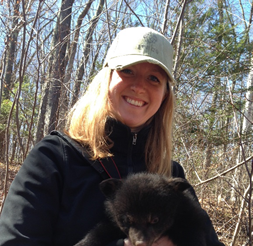 | Megan Linske, lead investigator and assistant scientist at the Center for Vector Biology and Zoonotic Diseases at the Connecticut Agricultural Experiment Station |
 | Joellen Lampman, Tick and School IPM Coordinator at Cornell University |
Rethinking Common Tick Control Methods
If you live in a high-risk area for ticks, you’ve probably heard that a lawn mowed short with wood chips along the perimeter can reduce your risk of a tick bite. But recent research has prompted “a very important shift in our understanding of yard tick control,” says Erika Machtinger, associate professor of entomology and vector-borne disease team lead at Penn State University.
| Old Advice | Current Verdict |
| Mow your grass short. | Mowing height won’t reduce the number of blacklegged ticks (aka deer ticks) in your lawn, but it may help reduce other species. |
| Maintain a wood chip barrier between forested areas and lawns. | Mulch barriers don’t deter blacklegged ticks but may deter other species. The border also serves as a warning sign that you’re entering a tick-dense area. |
| Rake leaves and pile along the woodland’s edge. | Raking leaves to the lawn’s edge increases tick density along the perimeter. Municipal composting or mulch-mowing is a better option. |
| Apply beneficial nematodes to kill ticks. | Effectiveness depends on the species of nematode and species of tick. Also, nematodes have been tested only in a lab setting, so there are no recommendations for use as yard tick-deterrents currently. |
1. Keep Your Lawn Well-Maintained (Still Valid but Less So)
Mowing your grass short to deter blacklegged ticks seems logical. Shorter grass allows more sunlight and air movement, reducing humidity and causing death by desiccation (drying out). But the research doesn’t fully support it.
Megan Linske, lead investigator and assistant scientist at the Center for Vector Biology and Zoonotic Diseases, found no significant difference in tick densities between mowed and unmowed areas. She explains that “grass in general is not hospitable for ticks, regardless of height … its vertical growth does not trap optimal temperature and humidity levels like leaf litter or shrubbery understory.”
Joellen Lampman, the tick and Integrated Pest Management coordinator at Cornell University, has also questioned mowing short for years. “I always ask, ‘how short is short?’ And I have yet to get an answer.” She explains that mowing short has not been studied under research conditions.
There are exceptions. “Expanding species like the lone star tick and the Asian longhorned tick can tolerate lower humidity,” Machtinger says, and are commonly found in grassy areas. So, for these two species, among others, “maintaining mowed lawns remains a valid recommendation” to reduce their habitat.
Worth noting is that different types of ticks carry all sorts of diseases, including Rocky Mountain spotted fever, tularemia, Q fever, Powassan virus disease, and tick paralysis.
See Related: Types of Ticks: What Do Ticks Look Like? (And What Diseases They Can Carry)
2. Build a Wood Chip Barrier
Wood chip barriers are a standard recommendation for tick control. Their rough, dry materials were thought to dehydrate ticks before they crossed into your lawn. Since 82% of tick nymphs are found within the first 3 yards of the woodland perimeter, a 3-foot barrier strip along that edge seems like a logical defense.
Unfortunately, wood chip barriers aren’t effective for all tick species.
“Wood chip barriers may not physically impede the blacklegged tick because this species primarily relies on … climbing vegetation to wait for a host rather than horizontal movement across the ground,“ Machtinger says. “Wood chip barriers are likely more effective against horizontally mobile tick species, such as the lone star tick and the Asian longhorned tick.”
Lampman agrees. The recommendation of wood chip barriers as tick deterrents “has more to do with awareness than a physical barrier to ticks. It serves as a warning that you are leaving a less tick-risky area and entering one where you are more likely to encounter a tick.”
3. Rake Your Leaves

Raking leaves seems like a logical way to get rid of ticks, but it isn’t so straightforward, especially for wooded properties.
Linske’s study found “when leaf litter was removed from smaller areas (~200 square meters), ticks were still present at the edges of those areas.”
When you remove leaves from the lawn, the ticks left behind quickly concentrate in the remaining leaves along the edges, increasing the population density along the perimeter.
What you do with your leaves matters too. A 2020 study by Jordan and Schulze found 3X more blacklegged tick nymphs where homeowners moved leaves to the forest edge compared to areas where leaves fell and were distributed naturally.
“We recommend mowing fallen leaves right into the lawn when fall arrives to improve soil quality and moisture-holding capacity,” Lampman says. “Composting them, away from the woodland edge (or through your local municipality), is another option.”
4. Use Beneficial Nematodes
Beneficial nematodes are microscopic worms that can kill ticks by infecting them with bacteria. Some species show real promise in lab settings, but those results haven’t been tested in the yard. Lampman notes that study after study concludes with some variation of “results are promising and further research is needed.”
Effectiveness also varies widely depending on the species of both the nematodes and the ticks.
3 Most Effective Tick Control Methods
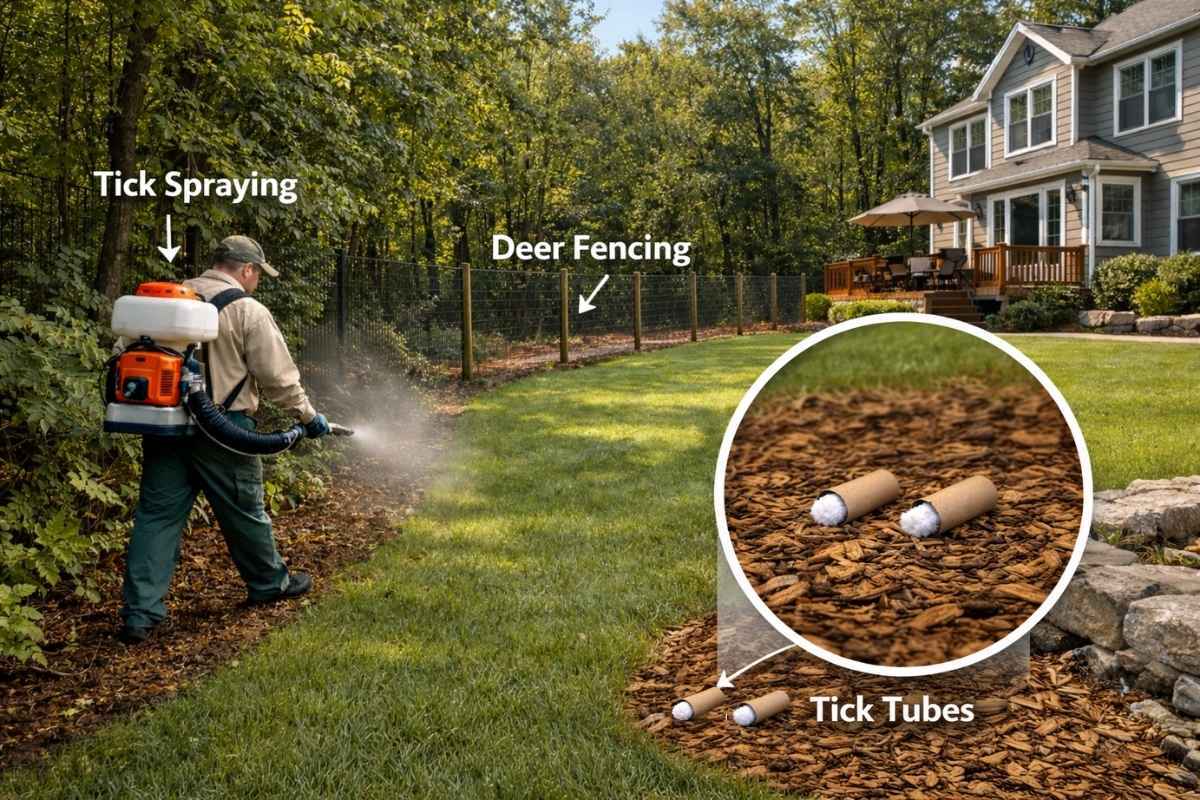
Although mowing your lawn short may no longer be recommended to reduce your risk of a Lyme-carrying tick, there are 3 effective, evidence-based strategies you can use: Spray strategically, use fencing on deer-heavy properties, and place tick tubes along your yard’s perimeter.
| Method | Effectiveness | Best For |
| Tick Sprays | Very High | Immediate, targeted results |
| Fencing | High | Deer-heavy properties |
| Tick Tubes | High | Targeting larvae at the source |
1. Apply Tick Sprays
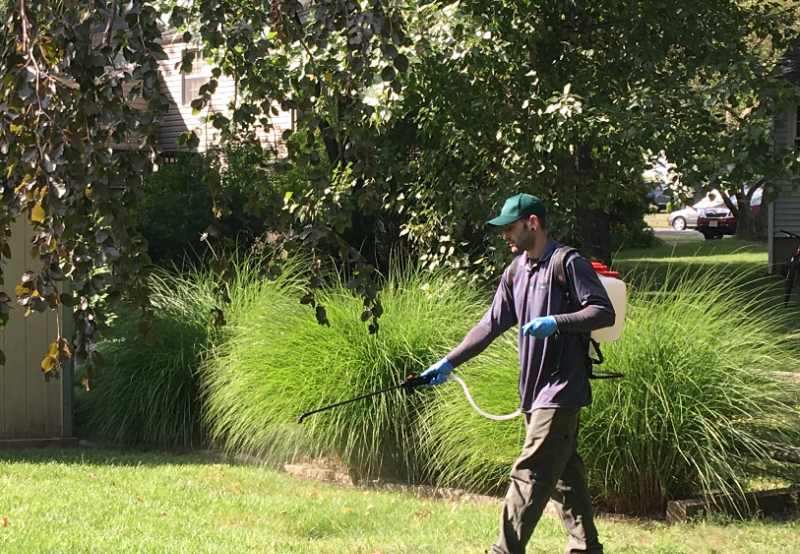
Tick sprays are the most effective yard-level tick control method available, reducing nymph populations by nearly 94% when applied correctly. The key is knowing where to spray.
Where to treat: Instead of spraying your entire yard, use a targeted approach, focusing on the high-density areas where ticks concentrate:
- The first few yards where your lawn meets the woods
- Dense ornamental plantings
- Ground cover close to the house
- Stone walls
Why stone walls? Linske found that tick densities around stone walls were nearly triple those in comparable habitats without stone walls.
The greater density is “largely because small mammals such as the white-footed mice utilize them for shelter. These species of wildlife are key hosts for blacklegged ticks, especially the juveniles,” Linske says.
Applying tick-killing pesticides “in a highly targeted manner to these specific habitats provides excellent control while minimizing environmental impact,” says Machtinger.
When to treat: Spray in mid- to late May to target nymphs during their peak activity, and in September or October to suppress active adults before they overwinter. Machtinger notes that new research suggests a single fall application may be just as effective.
2. Install Fencing
Ticks rarely travel far on their own. Most make it into your yard by hitching a ride on animals like white-tailed deer (the most common host of adult blacklegged ticks), raccoons, and rabbits.
Research has shown that deer fencing can reduce nymphal (juvenile) tick populations by as much as 84% and eliminate larval ticks within 70 yards or more of the fence.
Install fencing at least 8-10 feet tall to deter deer, using solid or semi-solid materials that animals can’t squeeze through. Bury fencing 6–12 inches underground to prevent burrowing, and repair gaps quickly.
For comprehensive protection, combine fencing with deer-resistant landscaping that makes your yard naturally less attractive to deer and the ticks they carry.
3. Deploy Tick Control Tubes
Tick tubes are one of the most targeted and effective tick control options available.
Tick control tubes are biodegradable cardboard tubes filled with pesticide-treated cotton. Mice and other rodents — which aren’t deterred by fencing — collect the treated cotton for nesting material, bringing the pesticide back to their nests where juvenile ticks are killed.
Place tubes around the perimeter of your yard near stone walls, brush piles, and wooded edges where rodents nest. Use approximately 24 tubes per acre, no more than 10 yards apart, and replace twice per year in spring and summer.
Take a Layered Approach to Tick Control
The Tick Project, a large-scale residential tick control study, found that even when tick populations were reduced, tick-borne disease rates didn’t drop. The most effective tick control strategy combines the methods above with personal protection.
“Wearing permethrin-treated clothing and conducting tick checks still play a necessary role in protecting ourselves from tick bites and tick-borne diseases,” Lampman says.
Machtinger puts it plainly:
“Recent research shows that features such as wood chip borders and short-mowed grass may not reliably block or kill blacklegged ticks as was once believed… The most important step is not relying on just one method of residential management, but recognizing where risk exists and taking steps to protect yourself and your pets.”
Lampman adds, “There is no one thing that you can do to reduce tick risk.”
FAQ About Tick Control
Using backyard chickens to control ticks is widely recommended, but the research behind it doesn’t hold up. The cited source is a 1991 African study on livestock ticks, not the blacklegged ticks found in backyards across the U.S.
The University of Rhode Island’s TickEncounter Resource Center also notes chickens may actually serve as hosts for the Asian longhorned tick, an invasive species now established in the eastern U.S.
Perform a simple “tick drag” test using a white flannel cloth attached to a stick. Drag it over grass and leaf litter, checking every 10-15 feet for dark specks. Focus on shaded areas, woodpiles, and yard edges in late spring or early fall, when tick populations are highest.
Ticks typically become inactive below 35 degrees, but don’t die until they are exposed to 10 degrees or lower for multiple days. When winter temperatures rise above freezing, ticks may become active.
To kill ticks on clothing, tumble dry on high heat (above 130 degrees) for at least 6 minutes.
Know When to Call a Pro
If DIY methods aren’t enough — especially if you have a large yard, heavily wooded lot, or a home with young children — professional treatment may be your best option.
And, of course, for a well-maintained lawn without all of the work, LawnStarter’s local lawn care pros have you covered. Get a free lawn mowing quote in seconds. First mow is $19 when you give us 3 mows to prove our quality work.
Sources:
- “Perimeter Treatments.” The University of Rhode Island.
- “Protecting Your Yard.” Harvard Health Publishing.
- “The Leaves Are Falling, Manage Wisely for Ticks.” By Joellen Lampman, Cornell Integrated Pest Management.
- Erika T. Machtinger, associate professor of entomology & Extension vector-borne disease team lead, Pennsylvania State University, University Park, PA. Personal interview.
- Joellen Lampman, Tick and school IPM coordinator, Cornell Integrated Pest Management Program, Voorheesville, NY. Personal interview.
- Megan Linske, assistant scientist, Center for Vector Biology and Zoonotic Diseases, The Connecticut Agricultural Experiment Station, New Haven, CT. Personal interview.
Main Image: Tick control methods shown around wooded backyard lawn. Image Credit: Image created using ChatGPT.
Related Posts: