| Key Takeaways |
|---|
| • Fire-resistant landscaping: Clear the first 5 feet around your house of any flammable materials. • Fire-ready yards need seasonal upkeep, not just one big cleanup. • Preparation works best when whole neighborhoods act. |
Over 40,000 wildfires have burned so far in 2026, the highest number in a decade, according to the National Interagency Fire Center. What can you do to protect your home? Start with a wildfire-ready lawn.
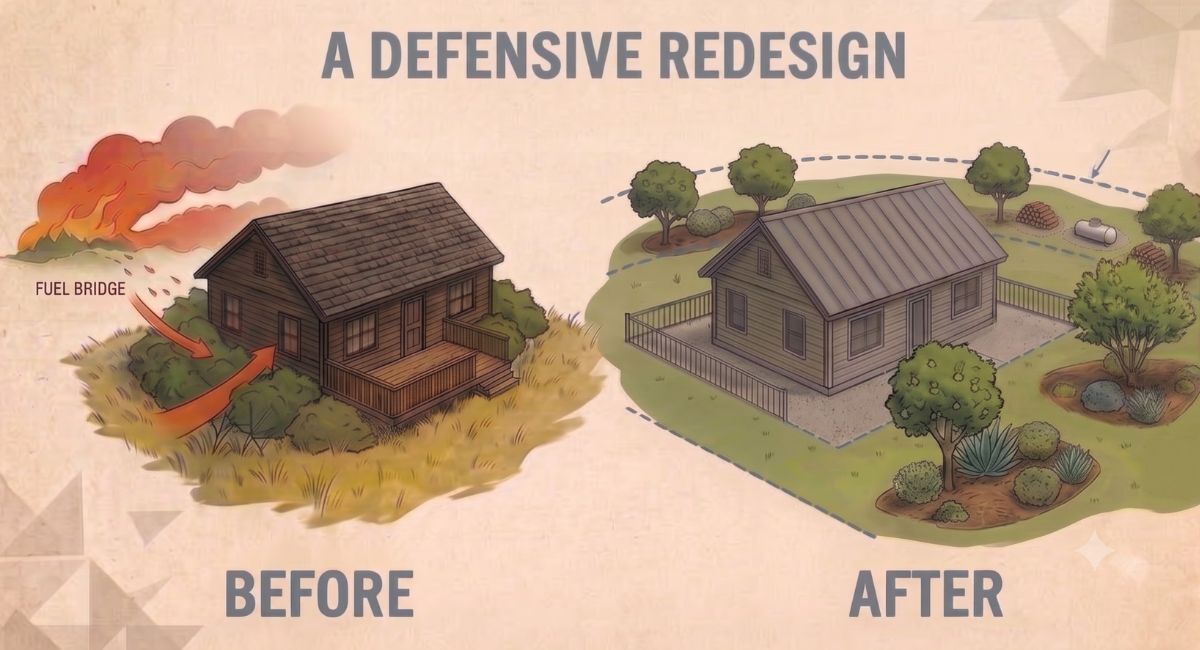
Your yard is often the fuel bridge: An ember catches dry mulch, then a juniper, and lands on a wood fence attached to your house. But with fire-resistant landscaping, you can break these bridges and cut the risk that a wildfire will destroy your home.
California just made clearing the first 5 feet mandatory. On Aug. 19, 2026, the state’s Board of Forestry and Fire Prevention adopted the strictest home landscaping rules in the country, limiting what can grow and sit within 5 feet of a house for nearly 2 million homes in high fire-risk areas.
If you live in a fire-prone part of the West, here’s how to make your yard part of the defense, with expert tips from fire professionals and a homeowner just like you.
Why Western Homeowners Can’t Wait
More than 2.5 million homes across 14 states are at risk of wildfire damage, per insurance industry data. California has the greatest exposure, followed by Colorado, Texas, Oregon, and Arizona.
And this is wildfire season in every one of these states.
| State | Wildfire Season |
|---|---|
| California | Northern California: June through Nov. Southern California: May to Oct. |
| Colorado | May to Sept. |
| Texas | Feb. to April; Aug. to Oct. |
| Oregon | May to Oct. |
| Arizona | Year-round |
“When the fire happens, a common response is ‘I didn’t think it could happen here or to me,’” says Ken Pimlott, who retired as director and chief of the California Department of Forestry and Fire Protection (CAL FIRE) after 30 years.
The numbers show it can, and it does. Wildfires destroyed 12,773 residential properties across the U.S. in 2025 alone, according to the National Interagency Coordination Center.
In January 2025, the Los Angeles wildfires destroyed more than 16,000 structures, killed 31 people, and caused $76 billion to $131 billion in economic damage — the costliest wildland fires in U.S. history.
What Makes a Landscape Fire-Resistant?
A fire-resistant landscape breaks every path a wildfire can take to your house. It comes down to 3 things: what sits near your home, how easily it burns, and whether flames can jump from one plant to the next.
The goal is defensible space: a buffer area where vegetation is managed to slow the spread of fire, reduce heat, and give firefighters room to defend it safely.
The secret is attention to detail.
“Most homeowners aren’t leaving piles of firewood against the house or letting grass grow 6 feet tall,” says Jessamyn Hise, community outreach manager for Fire Safe Marin in California.
Instead, small vulnerabilities accumulate into fire risk, she says, such as “plants growing into eaves, wooden fences attached directly to the home, or debris tucked into corners where no one thinks to look.”
The Zones of Defensible Space
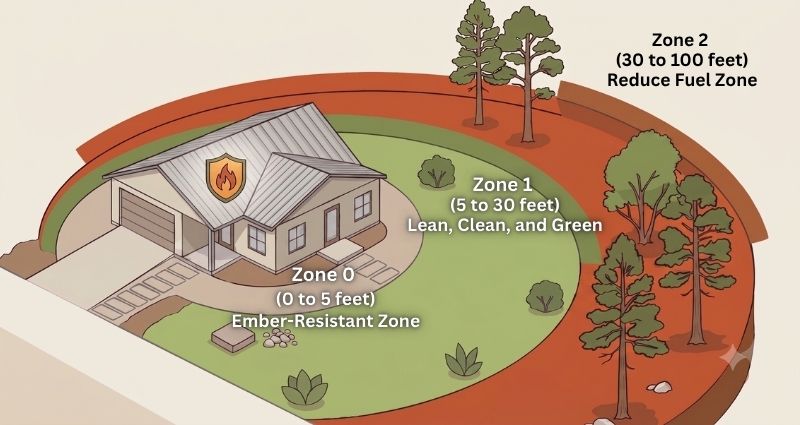
Fire agencies divide defensible space into zones that radiate outward from your home. Zone requirements vary by state, but the same core idea holds across the fire-prone West: Clear aggressively near the house, then loosen as you move farther away.
Pimlott’s former agency, CAL FIRE, breaks defensible space into 3 zones:
Zone 0 (0 to 5 feet): Ember-Resistant Zone
- Replace woody plants and mulch with rock, gravel, pavers, or concrete.
- Clear leaves and debris from the roof, gutters, decks, and under stairs.
- Trim branches within 10 feet of chimneys.
- Replace flammable fencing with noncombustible materials.
- Relocate firewood, garbage bins, and vehicles to Zone 1 or 2
A 2025 study in Nature Communications estimates that when homeowners harden their house (by using fire-resistant materials like concrete) and clear flammable material within 5 feet of their house, twice as many homes survive a wildfire: 40% versus 20%.
What California’s new rules require: Under the Zone 0 standards adopted Aug. 19, 2026, lawns, flowers, and nonwoody plants under 18 inches can stay in the first 5 feet, but not directly under the roofline.
Trees can stay if branches are trimmed 5 feet away from any structure. Mulch, wood chips, dead leaves, and firewood can not. New construction must comply immediately; existing homes have until 2029 at the earliest. The rules cover State Responsibility Areas and Very High Fire Hazard Severity Zones.
Zone 1 (5 to 30 feet): Lean, Clean, and Green
- Remove dead plants, dry grass, weeds, leaves, and needles year-round.
- Space plants, trees, and combustibles (wood piles, patio furniture, play sets) so nothing forms a continuous line of fuel.
- Keep tree branches at least 10 feet from other trees.
Zone 2 (30 to 100 feet): Reduced Fuel Zone
- Cut annual grasses to a height of 4 inches or less to reduce fuel.
- Remove debris (fallen leaves, needles, twigs, bark) or keep the layer under 3 inches deep.
- Space tree canopies 10 feet apart, wider on slopes.
- Break the fuel ladder between grass, shrubs, and low branches.
- Clear 10 feet around wood piles and propane tanks.
See Related: How to Create Fire-Resistant Landscaping
What to Tackle First
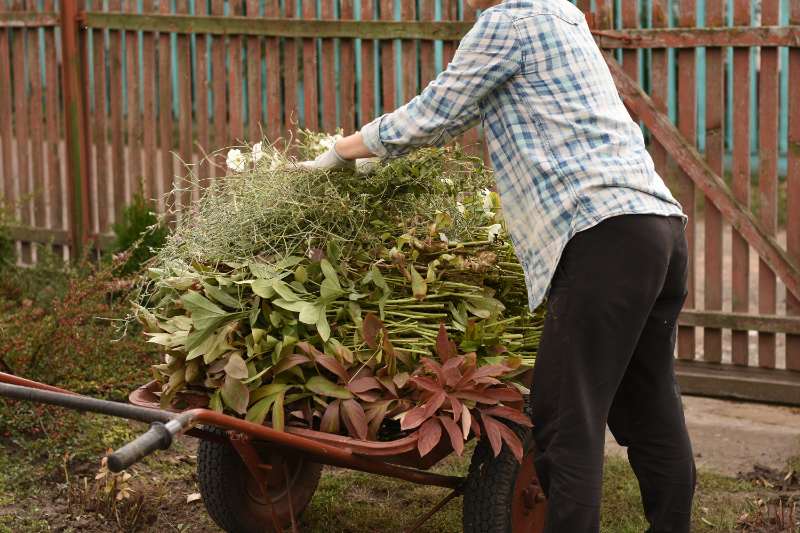
First, walk your property with a fire’s eyes. “I encourage property owners to walk the circle around their home and envision what a fire would burn,” Pimlott says. “Identify the obvious items they can correct first.”
Start with the simple, low-cost fixes, he says, the approach he has used on his own property, adding more work over time.
In practice, flag these for removal on that first walk:
- Dry leaves, needles, and dead branches on the ground and on the roof
- Plants touching your home or growing into eaves
- Mulch in the first 5 feet; firewood and stored combustibles within 30 feet
- Branches overhanging the roof or within 10 feet of a chimney
- Wood fencing attached to the house
From Green to Gravel in Zone 0
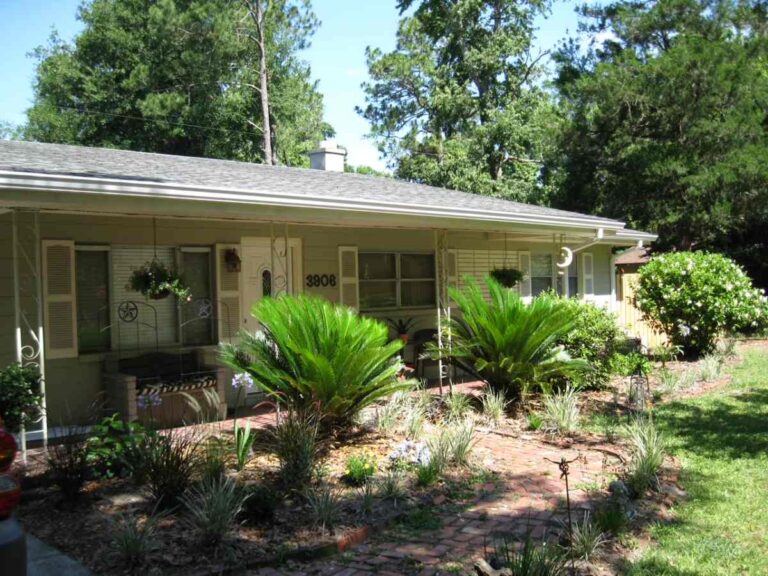
Zone 0 is where homeowner Melea Avrach focused. After most of her Altadena, California, neighborhood burned in the 2025 Eaton Fire, she cleared the first 5 feet around her house.
The hardest part was giving up a row of birds-of-paradise along her breezeway and a stand of pencil cactus that had shaded her windows for years.
She covered the area with gravel. “I cringed at putting it in, fearing my yard would look like a used car lot,” she says. Avrach made it work with large rocks that had tumbled off a nearby hillside in heavy rain.
“It’s worth the peace of mind,” she says, and “rocks are pretty easy to maintain.”
Fire-Resistant Plants and Trees for Western Yards
Beyond 5 feet, a fire-resistant yard can still be green and beautiful if you choose and keep the right vegetation.
Which Trees Can Stay
Tree removal is where homeowners hesitate most. Ryan Reed, ISA-certified arborist and president of LAM Tree Service in Evergreen, Colorado, has seen the attitude change.
“People have definitely started to be comfortable with removing trees and having a less dense forest around their house,” he says.
Which trees go varies by property, and a trained professional should evaluate the site, Reed says.
“I select the trees most valuable to the landscape and work outward from them, removing trees that negatively impact their health or increase fire risk.”
The trees you keep need some care, too. Reed’s crews “high-skirt” the remaining trees, trimming limbs from the lower crown.
What to Plant
No plant is fireproof, but some resist ignition better than others. Oregon State University’s (OSU) Fire-Resistant Plants for Home Landscapes guide identifies what those plants share:
- Open, loose branching patterns
- Little dead wood; doesn’t accumulate dry, dead material
- Wide, flat, moist, supple leaves
- Minimal sap or resin; sap is waterlike, with no strong odor
Placement and spacing matter as does mature size. Know your plant’s mature size so it doesn’t spread into the first 5 feet or push branches over the roofline, says Amy Jo Detweiler, OSU Extension horticulturist and co-author of the guide.
She says a plant doesn’t need every characteristic on the list to be fire-resistant, but it should have several.
| Plant Type | Examples | Defensible Space Zones |
| Succulents | Stonecrop, hens and chicks, ice plant | 1-2 |
| Shrubs | California lilac, white forsythia, serviceberry | 1-2 |
| Ground covers | Creeping phlox, kinnikinnick, rockcress | 1-2 |
| Blooming perennials | Daylily, iris, coneflower, penstemons | 1-2 |
| Trees (properly spaced) | Chokecherry, hackberry, Rocky Mountain maple | 2 |
Sources: Oregon State University, Idaho Fire Wise
Prune carefully, too: Improper cuts can trigger “a flush of growth that may lead to more dead wood or act as a litter trap for fall leaves,” she says.
Avoid juniper, arborvitae, and any plant with resinous, oily sap, or heavily fibrous dry material.
See Related: Fire-Resistant Landscaping Plants
Why One Big Cleanup Isn’t Enough
Even the best-designed fire-resistant yard fails without upkeep: Pruned plants regrow into fuel ladders, and gravel catches dry leaves.
“Where people tend to drop the ball is assuming that one big cleanup is enough,” Fire Safe Marin’s Hise says.
Landscapes are living systems that grow, shed, and change with the weather, she says, and she recommends a seasonal maintenance routine:
- Winter: Prune heavily and replace risky plants.
- Spring: Reduce fine fuels (dry grass, leaves, and twigs), clear roofs and gutters, and finish home-hardening projects.
- Summer and fall: Water, clear debris after strong winds.
“You don’t wait until your engine fails to change the oil, and you don’t wait until wildfire season is underway to think about your landscape,” Hise says.
How Neighborhoods Get Fire-Ready
Grants, Chipper Days, and neighbors trading ideas in firewise communities make preparedness the norm, not one household’s burden.
“Those kinds of support systems are often what move people from thinking about wildfire preparedness to actually taking action,” Hise says.
Mosquito, an isolated El Dorado County community threatened by multiple large fires, including 2022’s Mosquito Fire, shows what that looks like.
Grassroots efforts led by its Fire Safe Council built resilience into neighborhood life, Pimlott says. The ingredients: block parties with preparedness resources, red flags on National Weather Service warning days, an annual ReadyFest, and volunteers organized to help seniors and others who can’t manage the work themselves.
What motivates people, Hise says, is making the work feel achievable: Instead of long checklists, 1 or 2 high-impact fixes they can do this weekend. “Once people build a little momentum, they’re much more likely to keep going.”
If the risk is shared, so is the work.
“During wind-driven fires, embers don’t respect property lines. They can rain down across entire neighborhoods,” Hise says.
FAQ
The difference between Zones 1 and 2 is purpose.
Zone 1 (5-30 feet) eliminates fuel: no dead material, well-spaced and well-watered plants. Zone 2 (30-100 feet) reduces fuel to slow a fire before it reaches your home: grass mowed to 4 inches, dead debris no deeper than 3 inches, lower branches pruned.
Yes. Insurers are passing the wildfire damage cost back to homeowners or walking away entirely from coverage. California premiums rose 84% between 2020 and 2026, Stanford researchers found, and the state’s FAIR Plan, its insurer of last resort, covered over 680,000 properties in March 2026, double its count in September 2023.
A fire-ready yard now does more than protect your house; it protects your insurance. Under new laws such as Colorado’s House Bill 25-1182, in effect since July 1, 2026, homeowners who document mitigation work can earn premium credits and challenge the wildfire risk scores insurers use to price or non-renew their policies.
Certification through a program like IBHS Wildfire Prepared Home carries the most weight.
Hire a Local Lawn Care Pro to Become Wildfire-Ready
Getting fire-resistant landscaping right takes planning, the right plants, and time you may not have. If you’d rather leave it to someone who does this every day, LawnStarter’s landscaping pros make it simple. Get an instant quote, pick a time, and a background-checked local pro will handle the rest.
Sources:
- “2025 Incident Archive.” California Department of Forestry and Fire Protection.
- “2025 Wildfires Were the Costliest Ever, Researchers Say.” By Rebecca Dzombak. New York Times.
- Amy Jo Detweiler, professor and Extension horticulturist, Oregon State University, Bend, OR. Personal interview.
- “Fire Risk to Structures in California’s Wildland-Urban Interface.” By researchers Maryam Zamanialaei, Daniel San Martin, Maria Theodori, Dwi Marhaendro Jati Purnomo, Ali Tohidi, Chris Lautenberger, Yiren Qin, Arnaud Trouvé, and Michael Gollner. Nature Communications, vol. 16, 8041 (2025).
- Jessamyn Hise, Community Outreach Manager for Fire Safe Marin, San Francisco Bay Area, CA. Personal interview.
- Ken Pimlott, Director and Chief of the California Department of Forestry and Fire Protection (retired), Somerset, California. Personal interview.
- Melea Avrach, homeowner, Altadena, CA. Personal interview.
- “National Fire News.” National Interagency Fire Center. Accessed July 20, 2026.
- Ryan Reed, ISA-certified arborist and president of LAM Tree Service, Evergreen, CO. Personal interview.
Main Image: Before-and-after infographic illustrating how to create defensible space around a home to reduce wildfire risk. Photo Credit: created using Gemini AI and Canva Pro
Related Posts: